Search
Invitrogen
APBA2 Polyclonal Antibody
{{$productOrderCtrl.translations['antibody.pdp.commerceCard.promotion.promotions']}}
{{$productOrderCtrl.translations['antibody.pdp.commerceCard.promotion.promocode']}}: {{promo.promoCode}} {{promo.promoTitle}} {{promo.promoDescription}}. {{$productOrderCtrl.translations['antibody.pdp.commerceCard.promotion.learnmore']}}
{{$ctrl.translations['antibody.pdp.skuNotes.additionalInformation']}}:
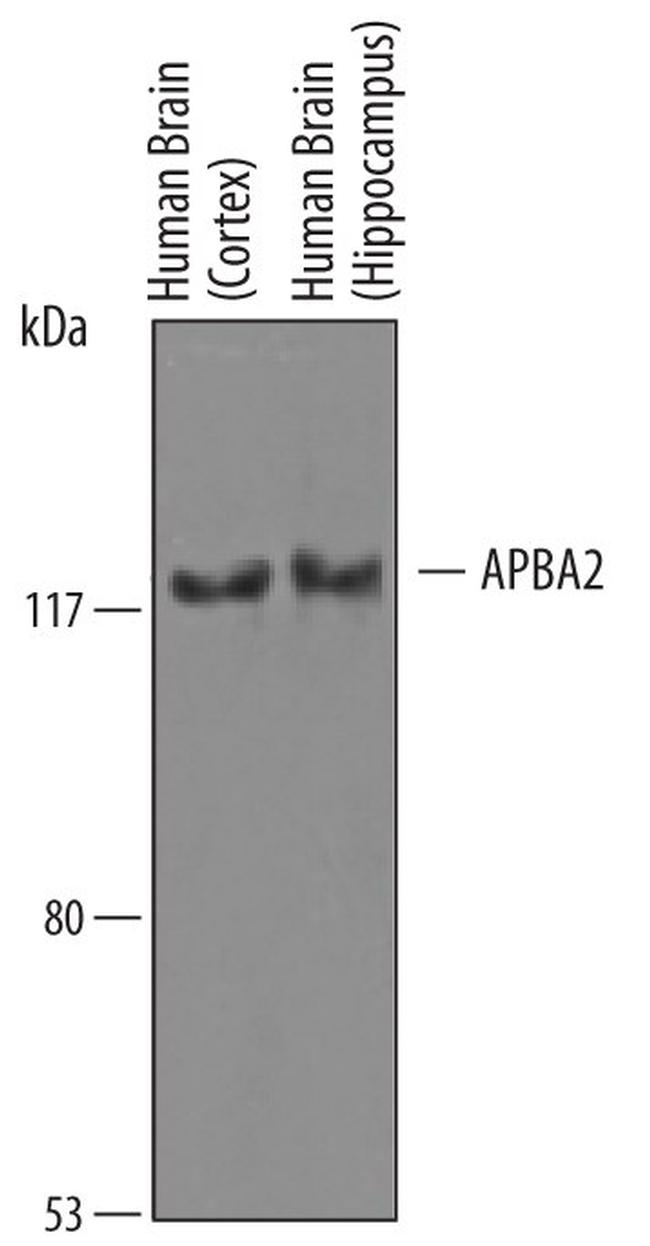
FIGURE: 1 / 1
APBA2 Antibody (PA5-47830) in WB
Western blot analysis of APBA2 in human brain (cortex) tissue and human brain (hippocampus) tissue. Samples were incubated in APBA2 polyclonal antibody (Product # PA5-47830) using a dilution of 1 µg/mL followed by a HRP-conjugated Anti-Sheep IgG secondary antibody. A specific band was detected for APBA2 at approximately 120 kDa (as indicated). This experiment was conducted under reducing conditions.
Please note: We are reviewing Western blot images included in the antibody testing data in our catalog, including those provided by third parties. Unless expressly labeled or annotated as “raw-unedited”, Western blot images included in the antibody testing data in our catalog may have been edited, optimized or otherwise adjusted for presentation.

Product Details
PA5-47830
Product Specifications
Species Reactivity
Human,
Mouse,
Rat
Host/Isotype
Sheep
/ IgG
Class
Polyclonal
Type
Antibody
Immunogen
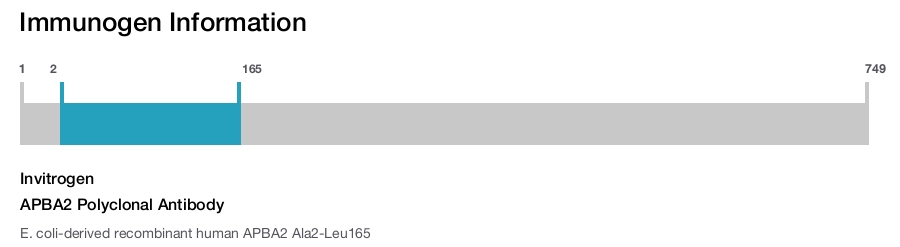
E. coli-derived recombinant human APBA2 Ala2-Leu165
Conjugate
Unconjugated
Unconjugated
Unconjugated
Form
Lyophilized
Concentration
0.2 mg/mL once reconstituted
Amount
100 µg
Purification
Antigen affinity chromatography
Storage buffer
PBS with 5% trehalose
Contains
No Preservative
Storage conditions
-20°C, Avoid Freeze/Thaw Cycles
Shipping conditions
Ambient (domestic); Wet ice (international)
RRID
Product Specific Information
This antibody detects human APBA2 in direct ELISAs and human, mouse and rat in Western blots. In direct ELISAs, less than 1% cross-reactivity with recombinant human (rh) APBA1 and rhAPBA3 is observed.
Reconstitute at 0.2 mg/mL in sterile PBS.
Target Information
APBA2, a member of the X11 protein family, is a phosphotyrosine-binding domain protein and is a neuronal adapter protein that interacts with amyloid precursor protein (APP) and neuritic plaques in the brains of patients with Alzheimer's disease. It stabilizes APP and inhibits production of proteolytic APP fragments including the Abeta peptide that is deposited in the brains of Alzheimer's disease patients. APBA2 is believed to be involved in signal transduction processes and is also regarded as a putative vesicular trafficking protein in the brain that can form a complex with the potential to couple synaptic vesicle exocytosis to neuronal cell adhesion. Recent reports suggest that it may also be a candidate gene for autism.
For Research Use Only. Not for use in diagnostic procedures. Not for resale without express authorization.
References (0)
Have you cited this product in a publication?
Let us know so we can reference it here.
Bioinformatics
Protein Aliases: adapter protein X11beta; amyloid beta (A4) precursor protein-binding, family A, member 2; amyloid beta (A4) precursor protein-binding, family A, member 2 (X11-like); contains PDZ and PTB domains; homologue to a human gene expressed in the nervous system; bp 510-533: putative transmembrane domain of X11 protein; Mint 2; mint-2; neuron-specific X11L protein; neuronal Munc18-1-interacting protein 2; phosphotyrosine-binding/-interacting domain (PTB)-bearing protein; unnamed protein product; X11-like protein
Gene Aliases: D15S1518E; HsT16821; LIN-10; MGC:14091; MINT2; mXllL; X11-BETA; X11-like; X11L; XllL
UniProt ID: (Human) Q99767, (Mouse) P98084, (Rat) O35431
Entrez Gene ID: (Human) 321, (Mouse) 11784, (Rat) 83610
Disclaimer

Clicking the images or links will redirect you to a website hosted by BenchSci that provides third-party scientific content. Neither the content nor the BenchSci technology and processes for selection have been evaluated by us; we are providing them as-is and without warranty of any kind, including for use or application of the Thermo Fisher Scientific products presented.

Performance Guarantee
If an Invitrogen™ antibody doesn't perform as described on our website or datasheet,we'll replace the product at no cost to you, or provide you with a credit for a future purchase.*
Learn more
We're here to help
Get expert recommendations for common problems or connect directly with an on staff expert for technical assistance related to applications, equipment and general product use.
Contact tech support