Search
Invitrogen
CLCNKA Polyclonal Antibody
{{$productOrderCtrl.translations['antibody.pdp.commerceCard.promotion.promotions']}}
{{$productOrderCtrl.translations['antibody.pdp.commerceCard.promotion.promocode']}}: {{promo.promoCode}} {{promo.promoTitle}} {{promo.promoDescription}}. {{$productOrderCtrl.translations['antibody.pdp.commerceCard.promotion.learnmore']}}
{{$ctrl.translations['antibody.pdp.skuNotes.additionalInformation']}}:
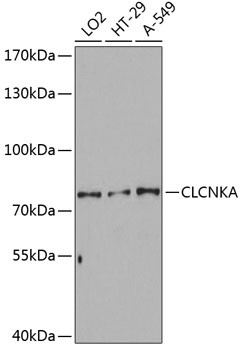
FIGURE: 1 / 1
CLCNKA Antibody (PA5-92064) in WB
Western blot analysis of CLCNKA in extracts of various cell lines. Samples were incubated with CLCNKA Polyclonal antibody (Product # PA5-92064) using a dilution of 1:3,000, followed by HRP Goat Anti-Rabbit IgG (H+L) at a dilution of 1:10,000. Lysates/proteins: 25 µg per lane. Blocking buffer: 3% nonfat dry milk in TBST. Detection: ECL Enhanced Kit. Exposure time: 90s.
Please note: We are reviewing Western blot images included in the antibody testing data in our catalog, including those provided by third parties. Unless expressly labeled or annotated as “raw-unedited”, Western blot images included in the antibody testing data in our catalog may have been edited, optimized or otherwise adjusted for presentation.

Product Details
PA5-92064
Product Specifications
Species Reactivity
Human,
Mouse
Host/Isotype
Rabbit
/ IgG
Class
Polyclonal
Type
Antibody
Immunogen
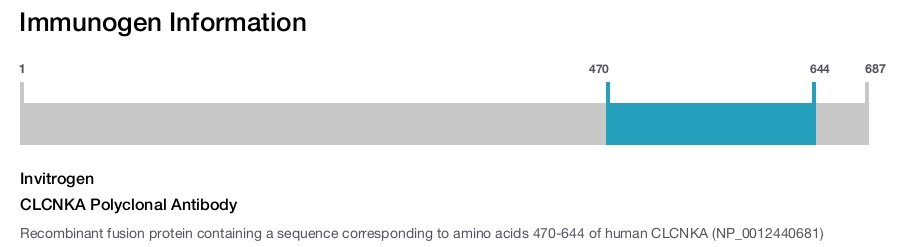
Recombinant fusion protein containing a sequence corresponding to amino acids 470-644 of human CLCNKA (NP_0012440681)
Conjugate
Unconjugated
Unconjugated
Unconjugated
Form
Liquid
Concentration
0.18 mg/mL
Amount
18 µg
Purification
Affinity Chromatography
Storage buffer
PBS, pH 7.3, with 50% glycerol
Contains
0.01% thimerosal
Storage conditions
-20°C, Avoid Freeze/Thaw Cycles
Shipping conditions
Ambient (domestic); Wet ice (international)
RRID
Product Specific Information
Immunogen sequence: QSCQPSFYDG TIIVKKLPYL PRILGRNIGS HHVRVEHFMN HSITTLAKDT PLEEVVKVVT STDVTEYPLV ESTESQILVG IVQRAQLVQA LQAEPPSRAP GHQQCLQDIL ARGCPTEPVT LTLFSETTLH QAQNLFKLLN LQSLFVTSRG RAVGCVSWVE MKKAISNLTN PPAPK; Positive Samples: LO2, HT-29, A-549; Cellular Location: Membrane, Multi-pass membrane protein
Target Information
CLC-KA is a kidney-specific chloride channel that mediates transepithelial chloride transport in the thin ascending limb of the Henle loop in the inner medulla. CLC-KA plays a crucial role in urine concentration. The gene encoding human CLC-KA maps to chromosome 1p36. Mutations in this gene may be associated with nephrogenic diabetes insipidus in those cases where mutations in the vasopressin V2 receptor and the AQP2 water channel are lacking. CLC-KB mediates basolateral chloride ion efflux in the thick ascending limb and in more distal nephron segments. The gene encoding human CLC-KB maps to chromosome 1p36. Mutations in this gene cause type III Barter's syndrome which is characterized by renal salt-wasting and low blood pressure.
⚠WARNING: This product can expose you to chemicals including mercury, which is known to the State of California to cause birth defects or other reproductive harm. For more information go to www.P65Warnings.ca.gov.
For Research Use Only. Not for use in diagnostic procedures. Not for resale without express authorization.
References (0)
Have you cited this product in a publication?
Let us know so we can reference it here.
Bioinformatics
Protein Aliases: chloride channel K1; chloride channel Ka; chloride channel, kidney, A; chloride channel, voltage-sensitive Ka; CLC-KA; CLCKA; putative basolateral cTAL chloride channel ClC-Ka; unnamed protein product
Gene Aliases: CLC-K1; CLCK1; Clcnk1; hClC-Ka
UniProt ID: (Human) P51800, (Mouse) Q9WUB7
Entrez Gene ID: (Human) 1187, (Mouse) 12733
Disclaimer

Clicking the images or links will redirect you to a website hosted by BenchSci that provides third-party scientific content. Neither the content nor the BenchSci technology and processes for selection have been evaluated by us; we are providing them as-is and without warranty of any kind, including for use or application of the Thermo Fisher Scientific products presented.

Performance Guarantee
If an Invitrogen™ antibody doesn't perform as described on our website or datasheet,we'll replace the product at no cost to you, or provide you with a credit for a future purchase.*
Learn more
We're here to help
Get expert recommendations for common problems or connect directly with an on staff expert for technical assistance related to applications, equipment and general product use.
Contact tech support