Search
Abnova
DLGAP4 Polyclonal Antibody, MaxPab™
{{$productOrderCtrl.translations['antibody.pdp.commerceCard.promotion.promotions']}}
{{$productOrderCtrl.translations['antibody.pdp.commerceCard.promotion.promocode']}}: {{promo.promoCode}} {{promo.promoTitle}} {{promo.promoDescription}}. {{$productOrderCtrl.translations['antibody.pdp.commerceCard.promotion.learnmore']}}
{{$ctrl.translations['antibody.pdp.skuNotes.additionalInformation']}}:
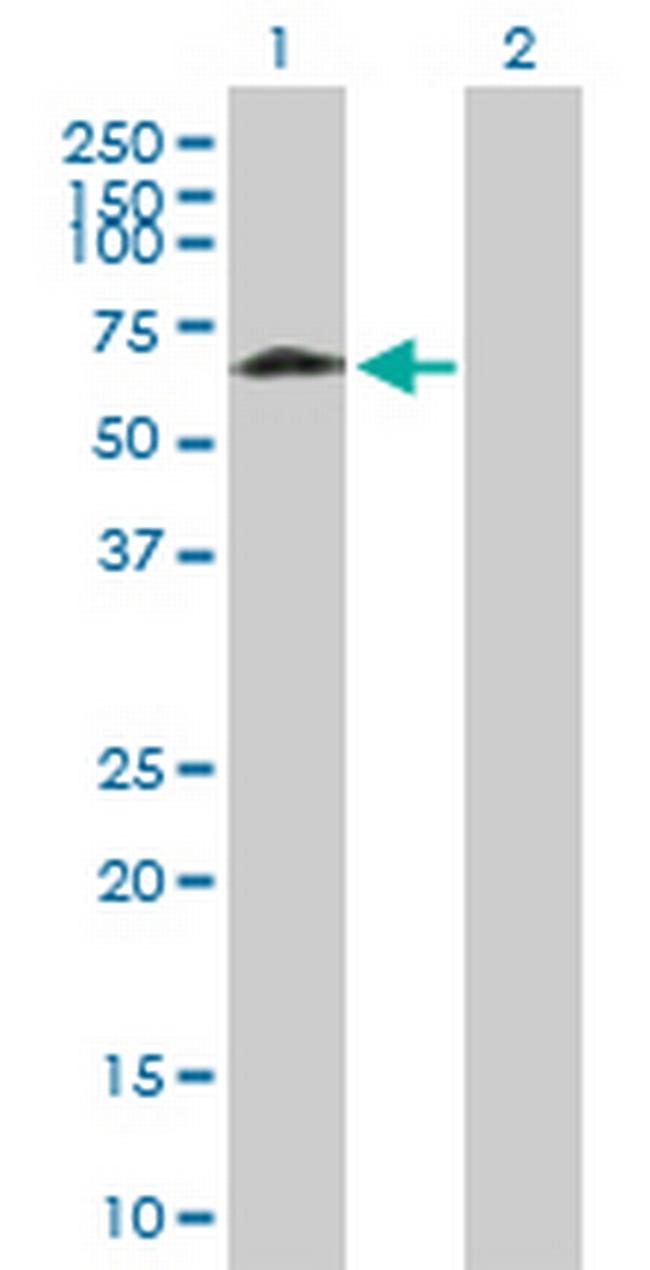
Please note: We are reviewing Western blot images included in the antibody testing data in our catalog, including those provided by third parties. Unless expressly labeled or annotated as “raw-unedited”, Western blot images included in the antibody testing data in our catalog may have been edited, optimized or otherwise adjusted for presentation.

Product Details
H00022839-B01P
Product Specifications
Species Reactivity
Human
Host/Isotype
Mouse
/ IgG
Class
Polyclonal
Type
Antibody
Immunogen
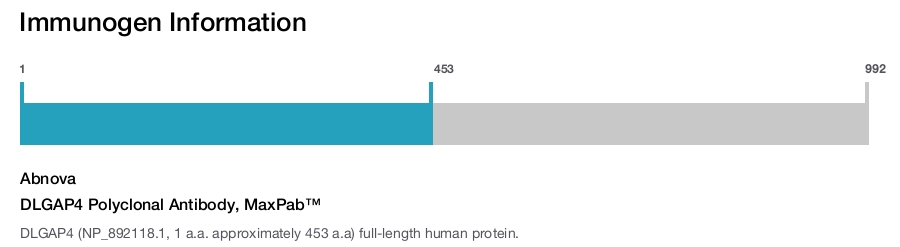
DLGAP4 (NP_892118.1, 1 a.a. approximately 453 a.a) full-length human protein.
Conjugate
Unconjugated
Unconjugated
Unconjugated
Form
Liquid
Concentration
0.5 mg/mL
Amount
50 µg
Purification
Protein A
Storage buffer
PBS, pH 7.4
Contains
no preservative
Storage conditions
-20°C, Avoid Freeze/Thaw Cycles
Shipping conditions
Ambient (domestic); Wet ice (international)
Product Specific Information
Product may be used with Western Blot (Transfected lysate).
The Isotype of this product is composed of an IgG Mixture.
Immunogen sequence: MALCLELLKQ CSSCLVAYKK TPPPVPPRTT SKPFISVTVQ SSTESAQDTY LDSQDHKSEV TSQSGLSNSS DSLDSSTRPP SVTRGGVAPA PEAPEPPPKH AALKSEQGTL TSSESHPEAA PKRKLSSIGI QVDCIQPVPK EEPSPATKFQ SIGVQVEDDW RSSVPSHSMS SRRDTDSDTQ DANDSSCKSS ERSLPDCTPH PNSISIDAGP RQAPKIAQIK RNLSYGDNSD PALEASSLPP PDPWLETSSS SPAEPAQPGA CRRDGYWFLK LLQAETERLE GWCCQMDKET KENNLSEEVL GKVLSAVGSA QLLMSQKFQQ FRGLCEQNLN PDANPRPTAQ DLAGFWDLLQ LSIEDISMKF DELYHLKANS WQLVETPEKR KEEKKPPPPV PKKPAKSKPA VSRDKASDAS DKQRQEARKR LLAAKRAASV RQNSATESAD SIEIYVPEAQ TRL
Target Information
SAP90/PSD-95-associated protein 4 (SAPAP4, also known as DLGAP4) is a member of a protein family whose members specifically interact with PSD-95/SAP90, a membrane-associated guanylate kinase localized at postsynaptic density (PSD) in neuronal cells. Like the other SAPAP proteins, SAPAP4 is thought to be an adaptor protein that also interacts with different synaptic scaffolding proteins, cytoskeletal and signaling components, such as focal adhesion kinase (FAK) and proline-rich tyrosine kinase 2 (PYK2). SAPAP4 mRNA is targeted to cell bodies in a similar manner to SAPAP1 and -2, whereas SAPAP3 mRNA is detected mainly in cell bodies.
For Research Use Only. Not for use in diagnostic procedures. Not for resale without express authorization.
References (0)
Have you cited this product in a publication?
Let us know so we can reference it here.
Bioinformatics
Protein Aliases: discs large homolog associated protein 4; PSD-95/SAP90-binding protein 4; RP5-977B1.6; SAP90/PSD-95-associated protein 4
Gene Aliases: DAP-4; DAP4; DLP4; SAPAP-4; SAPAP4
UniProt ID: (Human) Q9Y2H0
Entrez Gene ID: (Human) 22839
Disclaimer

Clicking the images or links will redirect you to a website hosted by BenchSci that provides third-party scientific content. Neither the content nor the BenchSci technology and processes for selection have been evaluated by us; we are providing them as-is and without warranty of any kind, including for use or application of the Thermo Fisher Scientific products presented.

Performance Guarantee
If an Invitrogen™ antibody doesn't perform as described on our website or datasheet,we'll replace the product at no cost to you, or provide you with a credit for a future purchase.*
Learn more
We're here to help
Get expert recommendations for common problems or connect directly with an on staff expert for technical assistance related to applications, equipment and general product use.
Contact tech support