Search
Invitrogen
Etomidate Recombinant Mouse Monoclonal Antibody (2C3)
{{$productOrderCtrl.translations['antibody.pdp.commerceCard.promotion.promotions']}}
{{$productOrderCtrl.translations['antibody.pdp.commerceCard.promotion.promocode']}}: {{promo.promoCode}} {{promo.promoTitle}} {{promo.promoDescription}}. {{$productOrderCtrl.translations['antibody.pdp.commerceCard.promotion.learnmore']}}
{{$ctrl.translations['antibody.pdp.skuNotes.additionalInformation']}}:
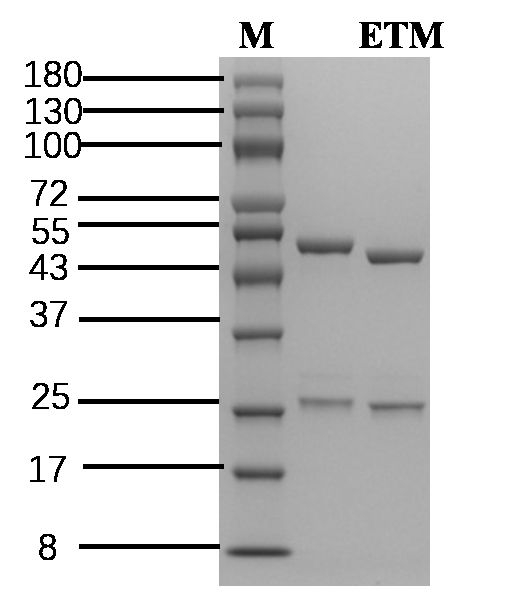
FIGURE: 1 / 1
Etomidate Antibody (MA566514) in SDS-PAGE
SDS-PAGE characterization of Etomidate under reducing conditions. Lane M: Protein marker (kDa); Lane ETM: Purified Etomidate Recombinant Monoclonal (Product # MA566514). Etomidate showing heavy chain (~50 kDa) and light chain (~25 kDa). Gels were stained with Coomassie Brilliant Blue R-344.
Please note: We are reviewing Western blot images included in the antibody testing data in our catalog, including those provided by third parties. Unless expressly labeled or annotated as “raw-unedited”, Western blot images included in the antibody testing data in our catalog may have been edited, optimized or otherwise adjusted for presentation.

Product Details
MA566514
Product Specifications
Species Reactivity
Chemical
Host/Isotype
Mouse
/ IgG
Expression System
CHO cells
Class
Recombinant Monoclonal
Type
Antibody
Clone
2C3
Immunogen
Conjugate of ETM hapten and KLH.
Conjugate
Unconjugated
Unconjugated
Unconjugated
Form
Liquid
Concentration
7.2 mg/mL
Amount
200 µg
Purification
Protein G
Storage buffer
PBS
Contains
0.1% NeoCide PC-950
Storage conditions
-20°C
Shipping conditions
Ambient (domestic); Wet ice (international)
RRID
Target Information
Etomidate is a hypnotic agent primarily used for the induction of anesthesia, functioning as a positive allosteric modulator on the gamma-aminobutyric acid type A receptor, thereby enhancing the inhibitory effects of gamma-aminobutyric acid. This intravenous hypnotic is utilized for anesthesia induction, maintenance, critical care sedation, and treating Cushing's disease. Despite its benefits, etomidate is associated with undesirable effects such as pain on injection, myoclonus, CNS excitation, adrenocortical depression, and postoperative nausea and vomiting. The pharmaceutical design of etomidate aims to address these issues, with ongoing research exploring alternative administration routes and dosage forms to expand its application. While etomidate remains clinically relevant due to its hemodynamic stability and rapid onset and offset, alternatives like propofol, ketamine, and remimazolam are being considered due to fewer side effects.
For Research Use Only. Not for use in diagnostic procedures. Not for resale without express authorization.
References (0)
Have you cited this product in a publication?
Let us know so we can reference it here.
Disclaimer

Clicking the images or links will redirect you to a website hosted by BenchSci that provides third-party scientific content. Neither the content nor the BenchSci technology and processes for selection have been evaluated by us; we are providing them as-is and without warranty of any kind, including for use or application of the Thermo Fisher Scientific products presented.

Performance Guarantee
If an Invitrogen™ antibody doesn't perform as described on our website or datasheet,we'll replace the product at no cost to you, or provide you with a credit for a future purchase.*
Learn more
We're here to help
Get expert recommendations for common problems or connect directly with an on staff expert for technical assistance related to applications, equipment and general product use.
Contact tech support