Search
Invitrogen
GSC2 Polyclonal Antibody
{{$productOrderCtrl.translations['antibody.pdp.commerceCard.promotion.promotions']}}
{{$productOrderCtrl.translations['antibody.pdp.commerceCard.promotion.promocode']}}: {{promo.promoCode}} {{promo.promoTitle}} {{promo.promoDescription}}. {{$productOrderCtrl.translations['antibody.pdp.commerceCard.promotion.learnmore']}}
{{$ctrl.translations['antibody.pdp.skuNotes.additionalInformation']}}:
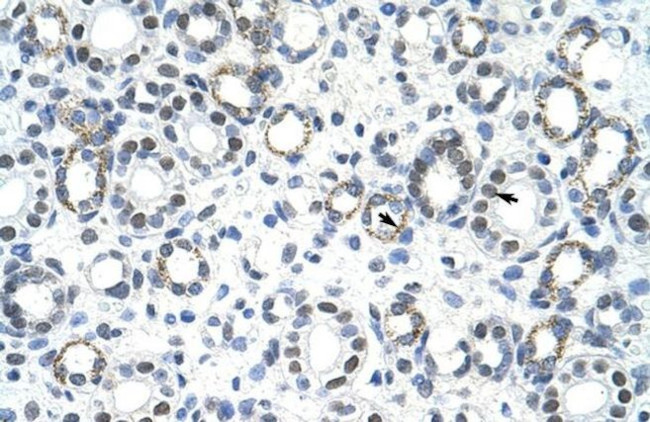
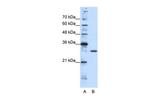
Please note: We are reviewing Western blot images included in the antibody testing data in our catalog, including those provided by third parties. Unless expressly labeled or annotated as “raw-unedited”, Western blot images included in the antibody testing data in our catalog may have been edited, optimized or otherwise adjusted for presentation.


Product Details
PA5-41494
Applications
Tested Dilution
Publications
Product Specifications
Species Reactivity
Human
Host/Isotype
Rabbit
/ IgG
Class
Polyclonal
Type
Antibody
Immunogen
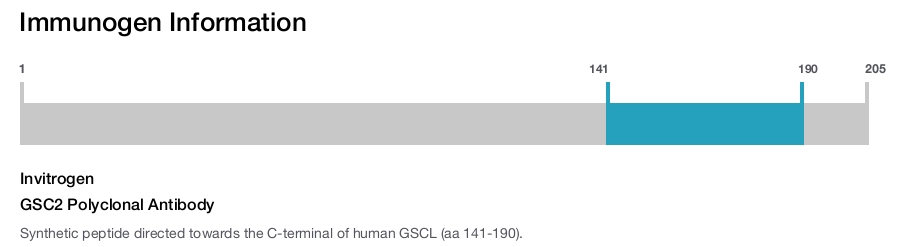
Synthetic peptide directed towards the C-terminal of human GSCL (aa 141-190).
Conjugate
Unconjugated
Unconjugated
Unconjugated
Form
Liquid
Concentration
1 mg/mL
Amount
100 µg
Purification
Protein A
Storage buffer
PBS with 2% sucrose
Contains
0.09% sodium azide
Storage conditions
-20°C, Avoid Freeze/Thaw Cycles
Shipping conditions
Ambient (domestic); Wet ice (international)
RRID
Product Specific Information
Peptide sequence: LEALFVQNQY PDVSTRERLA GRIRLREERV EVWFKNRRAK WRHQKRASAS
Sequence homology: Cow: 93%; Dog: 93%; Guinea Pig: 100%; Horse: 85%; Human: 100%; Mouse: 100%; Rabbit: 85%; Rat: 100%; Zebrafish: 91%
Target Information
Goosecoidlike (GSCL) resides in the critical region for VCFS/DGS on 22q11. Velocardiofacial syndrome (VCFS) is phenotypically related to DiGeorge syndrome (DGS) and both syndromes are associated with hemizygous 22q11 deletions. Because many of the tissues and structures affected in VCFS/DGS derive from the pharyngeal arches of the developing embryo, it is believed that haploinsufficiency of a gene involved in embryonic development may be responsible for its etiology.Goosecoidlike (GSCL), a homeodomain-containing gene, resides in the critical region for VCFS/DGS on 22q11. Velocardiofacial syndrome (VCFS) is a developmental disorder characterized by conotruncal heart defects, craniofacial anomalies, and learning disabilities. VCFS is phenotypically related to DiGeorge syndrome (DGS) and both syndromes are associated with hemizygous 22q11 deletions. Because many of the tissues and structures affected in VCFS/DGS derive from the pharyngeal arches of the developing embryo, it is believed that haploinsufficiency of a gene involved in embryonic development may be responsible for its etiology. The gene is expressed in a limited number of adult tissues, as well as in early human development.
For Research Use Only. Not for use in diagnostic procedures. Not for resale without express authorization.
References (0)
Have you cited this product in a publication?
Let us know so we can reference it here.
Bioinformatics
RNA polymerase II core promoter proximal region sequence-specific DNA binding
RNA polymerase II transcription factor activity, sequence-specific DNA binding
DNA binding
transcription factor activity, sequence-specific DNA binding
protein binding
sequence-specific DNA binding
sequence-specific double-stranded DNA binding
Disclaimer

Clicking the images or links will redirect you to a website hosted by BenchSci that provides third-party scientific content. Neither the content nor the BenchSci technology and processes for selection have been evaluated by us; we are providing them as-is and without warranty of any kind, including for use or application of the Thermo Fisher Scientific products presented.

Performance Guarantee
If an Invitrogen™ antibody doesn't perform as described on our website or datasheet,we'll replace the product at no cost to you, or provide you with a credit for a future purchase.*
Learn more
We're here to help
Get expert recommendations for common problems or connect directly with an on staff expert for technical assistance related to applications, equipment and general product use.
Contact tech support