Search
Invitrogen
HRX Monoclonal Antibody (4A5A12)
{{$productOrderCtrl.translations['antibody.pdp.commerceCard.promotion.promotions']}}
{{$productOrderCtrl.translations['antibody.pdp.commerceCard.promotion.promocode']}}: {{promo.promoCode}} {{promo.promoTitle}} {{promo.promoDescription}}. {{$productOrderCtrl.translations['antibody.pdp.commerceCard.promotion.learnmore']}}
{{$ctrl.translations['antibody.pdp.skuNotes.additionalInformation']}}:
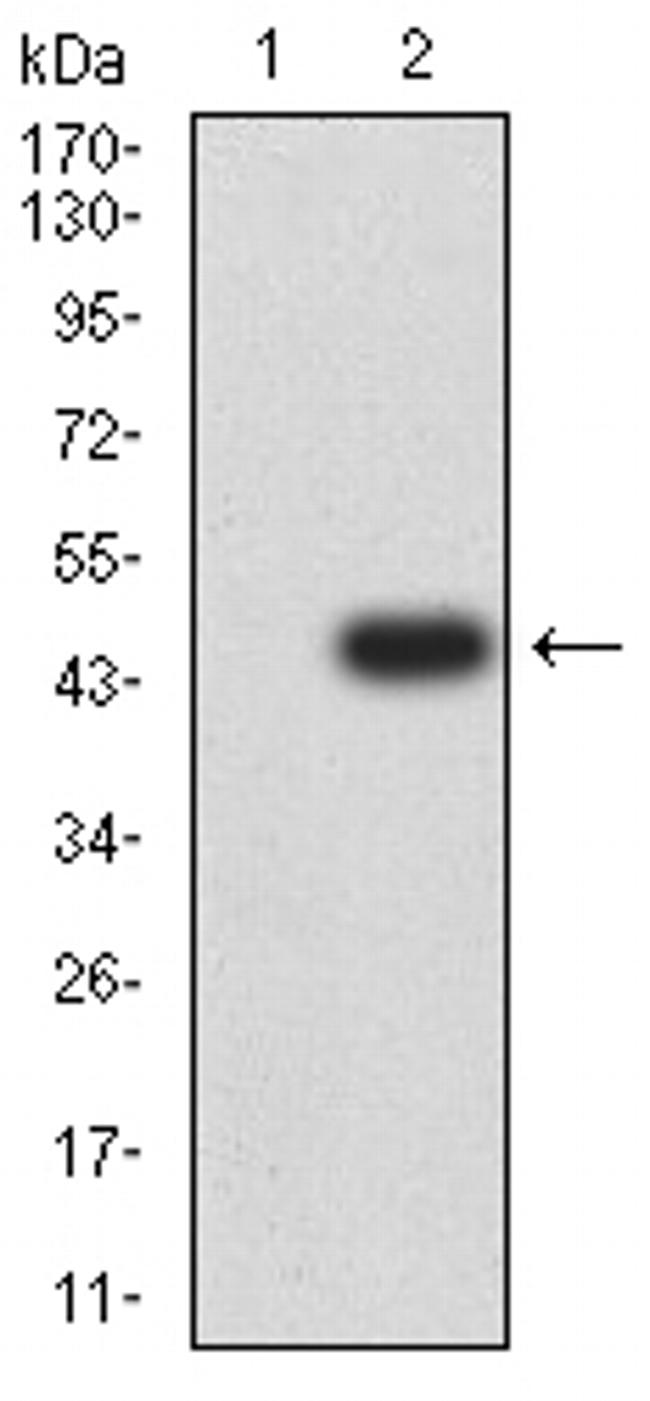
Please note: We are reviewing Western blot images included in the antibody testing data in our catalog, including those provided by third parties. Unless expressly labeled or annotated as “raw-unedited”, Western blot images included in the antibody testing data in our catalog may have been edited, optimized or otherwise adjusted for presentation.


Product Details
MA5-38553
Applications
Tested Dilution
Publications
Product Specifications
Species Reactivity
Human
Host/Isotype
Mouse
/ IgG1
Class
Monoclonal
Type
Antibody
Clone
4A5A12
Immunogen
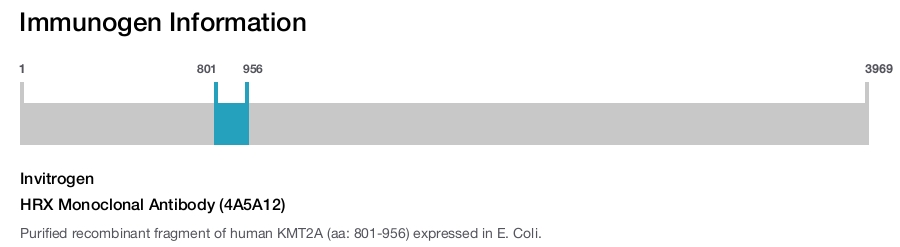
Purified recombinant fragment of human KMT2A (aa: 801-956) expressed in E. Coli.
Conjugate
Unconjugated
Unconjugated
Unconjugated
Form
Liquid
Concentration
1 mg/mL
Amount
100 µg
Purification
Protein G
Storage buffer
PBS
Contains
0.05% sodium azide
Storage conditions
Store at 4°C short term. For long term storage, store at -20°C, avoiding freeze/thaw cycles.
Shipping conditions
Ambient (domestic); Wet ice (international)
RRID
Product Specific Information
This antibody has been tested in indirect ELISA.
Target Information
KMT2A is a histone methyltransferase that plays an essential role in early development and hematopoiesis. It is a catalytic subunit of the MLL1/MLL complex, a multiprotein complex that mediates both methylation of 'Lys-4' of histone H3 (H3K4me) complex and acetylation of 'Lys-16' of histone H4 (H4K16ac). In the MLL1/MLL complex, KMT2A specifically mediates H3K4me, a tag for epigenetic transcriptional activation. KMT2A has weak methyltransferase activity by itself, and requires other components of the MLL1/MLL complex to obtain full methyltransferase activity. It has no activity toward histone H3 phosphorylated on 'Thr-3', less activity toward H3 dimethylated on 'Arg-8' or 'Lys-9', and has higher activity toward H3 acetylated on 'Lys-9'. Required for transcriptional activation of HOXA9 and promotes PPP1R15A-induced apoptosis.
For Research Use Only. Not for use in diagnostic procedures. Not for resale without express authorization.
References (0)
Have you cited this product in a publication?
Let us know so we can reference it here.
Bioinformatics
Protein Aliases: Acute lymphocytic 1; CXXC-type zinc finger protein 7; e10e5; HRX; lysine (K)-specific methyltransferase 2A; lysine N-methyltransferase 2A; mixed lineage leukemia 1; MLL; myeloid/lymphoid or mixed-lineage leukemia (trithorax homolog, Drosophila); trithorax-like protein; trx Zinc-finger region homolog; unnamed protein product; zinc finger protein HRX
Gene Aliases: ALL-1; ALL1; CXXC7; GAS7; HRX; HTRX; HTRX1; MLL; MLL1; MLL1A; TRX1; WDSTS
UniProt ID: (Human) Q03164
Entrez Gene ID: (Human) 4297
DNA binding
AT DNA binding
chromatin binding
protein binding
zinc ion binding
histone methyltransferase activity (H3-K4 specific)
identical protein binding
protein homodimerization activity
unmethylated CpG binding
protein-cysteine methyltransferase activity
histone H3K4 monomethyltransferase activity
histone H3K4 trimethyltransferase activity
immune system process
regulation of transcription, DNA-templated
positive regulation of gene expression
circadian regulation of gene expression
embryonic hemopoiesis
response to potassium ion
regulation of gene expression, epigenetic
T-helper 2 cell differentiation
positive regulation of gene expression, epigenetic
positive regulation of transcription, DNA-templated
positive regulation of transcription from RNA polymerase II promoter
membrane depolarization
definitive hemopoiesis
protein-containing complex assembly
cellular response to transforming growth factor beta stimulus
negative regulation of methylation-dependent chromatin silencing
Disclaimer

Clicking the images or links will redirect you to a website hosted by BenchSci that provides third-party scientific content. Neither the content nor the BenchSci technology and processes for selection have been evaluated by us; we are providing them as-is and without warranty of any kind, including for use or application of the Thermo Fisher Scientific products presented.

Performance Guarantee
If an Invitrogen™ antibody doesn't perform as described on our website or datasheet,we'll replace the product at no cost to you, or provide you with a credit for a future purchase.*
Learn more
We're here to help
Get expert recommendations for common problems or connect directly with an on staff expert for technical assistance related to applications, equipment and general product use.
Contact tech support