Search
Invitrogen
JAM-A (CD321) Polyclonal Antibody
{{$productOrderCtrl.translations['antibody.pdp.commerceCard.promotion.promotions']}}
{{$productOrderCtrl.translations['antibody.pdp.commerceCard.promotion.promocode']}}: {{promo.promoCode}} {{promo.promoTitle}} {{promo.promoDescription}}. {{$productOrderCtrl.translations['antibody.pdp.commerceCard.promotion.learnmore']}}
{{$ctrl.translations['antibody.pdp.skuNotes.additionalInformation']}}:
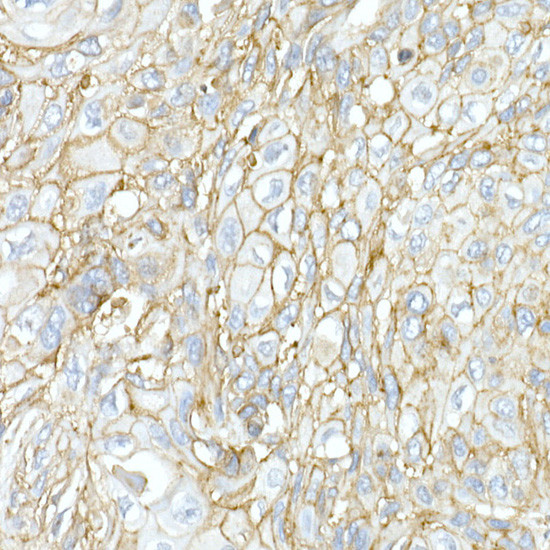
FIGURE: 1 / 4
JAM-A (CD321) Antibody (PA5-120157) in IHC (P)
Immunohistochemistry analysis of JAM-A (CD321) in paraffin-embedded human esophageal cancer. Samples were incubated with JAM-A (CD321) Polyclonal antibody (Product # PA5-120157) using a dilution of 1:50 (40x lens). Perform high pressure antigen retrieval with 10 mM citrate buffer pH 6.0 before commencing with IHC staining protocol.
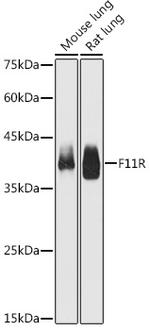
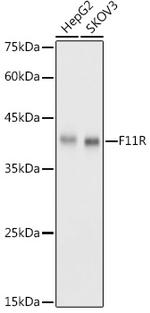
Please note: We are reviewing Western blot images included in the antibody testing data in our catalog, including those provided by third parties. Unless expressly labeled or annotated as “raw-unedited”, Western blot images included in the antibody testing data in our catalog may have been edited, optimized or otherwise adjusted for presentation.


Product Details
PA5-120157
Applications
Tested Dilution
Publications
Product Specifications
Species Reactivity
Human,
Mouse,
Rat
Published species
Mouse
Host/Isotype
Rabbit
/ IgG
Class
Polyclonal
Type
Antibody
Immunogen
Recombinant protein (or fragment)
Conjugate
Unconjugated
Unconjugated
Unconjugated
Form
Liquid
Concentration
2.41 mg/mL
Amount
241 µg
Purification
Affinity Chromatography
Storage buffer
PBS, pH 7.3, with 50% glycerol
Contains
0.09% sodium azide
Storage conditions
-20°C, Avoid Freeze/Thaw Cycles
Shipping conditions
Ambient (domestic); Wet ice (international)
RRID
Product Specific Information
Positive test controls include: HepG2, SKOV3, Mouse lung, Rat lung. The target is usually found in the following locations: Cell junction, Cell membrane, Single-pass type I membrane protein, tight junction.
Immunogen sequence: SVTVHSSEPE VRIPENNPVK LSCAYSGFSS PRVEWKFDQG DTTRLVCYNN KITASYEDRV TFLPTGITFK SVTREDTGTY TCMVSEEGGN SYGEVKVKLI VLVPPSKPTV NIPSSATIGN RAVLTCSEQD GSPPSEYTWF KDGIVMPTNP KSTRAFSNSS YVLNPTTGEL VFDPLSASDT GEYSCEARNG YGTPMTSNAV RMEAVERNVG V
Target Information
CD321 (F11R, JAM-1, JAM-A) is a cell-surface adhesion molecule belonging to the Ig superfamily of receptors. CD321 is a 32-41 kD glycoprotein, possessing two extracellular Ig-like domains, a transmembrane region, and a short cytosolic tail. The protein assembles at the membrane as a homodimer, and can associate laterally with other membrane proteins including integrins. CD321 is expressed on a variety of cell types, including leukocytes, platelets, erythrocytes, stem cells, epithelial and endothelial cells, and plays a role in mediating cell-cell contact. CD321 can be found in close proximity to several components of epithelial tight junctions, including ZO-1 and occludin. CD321 is involved in the maintenance of epithelial and endothelial barriers, hematopoiesis, angiogenesis, and tumor proliferation, invasion, and metastasis.
For Research Use Only. Not for use in diagnostic procedures. Not for resale without express authorization.
Bioinformatics
Protein Aliases: BV11 antigen; F11 R; F11 receptor/F11R; F11R; immunoglobulin superfamily; JAM; JAM-1; JAM-1; platelet adhesion molecule PAM-1; JAM-A; junction cell adhesion molecule A; junction cell adhesion molecule1; junctional adhesion molecule 1; platelet adhesion molecule 1; platelet F11 receptor; platelet membrane glycoprotein; unnamed protein product
Gene Aliases: 9130004G24; CD321; ESTM33; JAM; JAM-1; JAM-A; JAM1; JAMA; JCAM; Jcam1; KAT; Ly106; PAM-1
UniProt ID: (Human) Q9Y624, (Mouse) O88792, (Rat) Q9JHY1
Entrez Gene ID: (Human) 50848, (Mouse) 16456, (Rat) 116479
regulation of cytokine production
system process
cell adhesion
leukocyte cell-cell adhesion
regulation of cell shape
cell differentiation
epithelial cell differentiation
actomyosin structure organization
regulation of actin cytoskeleton organization
positive regulation of Rho protein signal transduction
memory T cell extravasation
positive regulation of blood pressure
intestinal absorption
regulation of cytoskeleton organization
negative regulation of stress fiber assembly
cellular response to mechanical stimulus
protein localization to plasma membrane
establishment of endothelial intestinal barrier
regulation of membrane permeability
cell-cell adhesion
positive regulation of platelet aggregation
protein localization to bicellular tight junction
positive regulation of establishment of endothelial barrier
regulation of bicellular tight junction assembly
inflammatory response
maintenance of blood-brain barrier
leukocyte migration
Disclaimer

Clicking the images or links will redirect you to a website hosted by BenchSci that provides third-party scientific content. Neither the content nor the BenchSci technology and processes for selection have been evaluated by us; we are providing them as-is and without warranty of any kind, including for use or application of the Thermo Fisher Scientific products presented.

Performance Guarantee
If an Invitrogen™ antibody doesn't perform as described on our website or datasheet,we'll replace the product at no cost to you, or provide you with a credit for a future purchase.*
Learn more
We're here to help
Get expert recommendations for common problems or connect directly with an on staff expert for technical assistance related to applications, equipment and general product use.
Contact tech support