Search
Abnova
LCAT Polyclonal Antibody, MaxPab™
{{$productOrderCtrl.translations['antibody.pdp.commerceCard.promotion.promotions']}}
{{$productOrderCtrl.translations['antibody.pdp.commerceCard.promotion.promocode']}}: {{promo.promoCode}} {{promo.promoTitle}} {{promo.promoDescription}}. {{$productOrderCtrl.translations['antibody.pdp.commerceCard.promotion.learnmore']}}
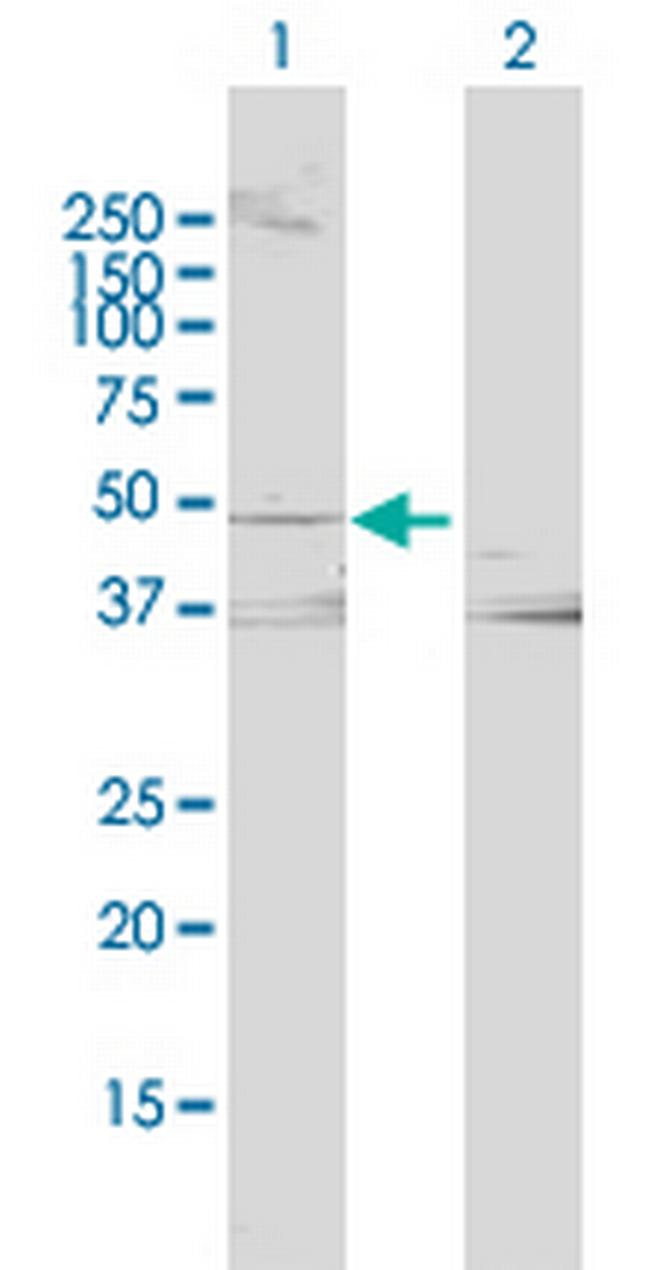
Please note: We are reviewing Western blot images included in the antibody testing data in our catalog, including those provided by third parties. Unless expressly labeled or annotated as “raw-unedited”, Western blot images included in the antibody testing data in our catalog may have been edited, optimized or otherwise adjusted for presentation.

Product Details
H00003931-D01P
Product Specifications
Species Reactivity
Human
Host/Isotype
Rabbit
/ IgG
Class
Polyclonal
Type
Antibody
Immunogen
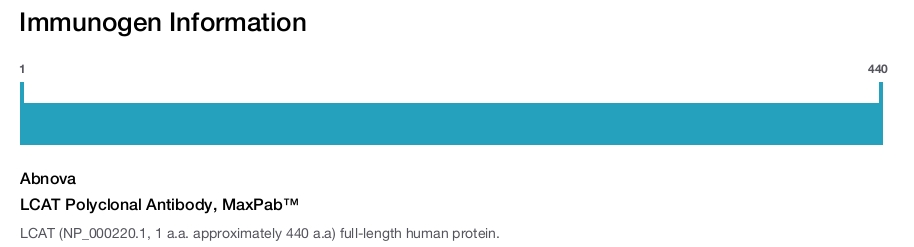
LCAT (NP_000220.1, 1 a.a. approximately 440 a.a) full-length human protein.
Conjugate
Unconjugated
Unconjugated
Unconjugated
Form
Liquid
Concentration
0.5-1 mg/mL
Amount
100 µg
Purification
Protein A
Storage buffer
PBS, pH 7.4
Contains
no preservative
Storage conditions
-20°C, Avoid Freeze/Thaw Cycles
Shipping conditions
Ambient (domestic); Wet ice (international)
Product Specific Information
Product may be used with Western Blot (Transfected lysate).
The Isotype of this product is composed of an IgG Mixture.
Immunogen sequence: MGPPGSPWQW VTLLLGLLLP PAAPFWLLNV LFPPHTTPKA ELSNHTRPVI LVPGCLGNQL EAKLDKPDVV NWMCYRKTED FFTIWLDLNM FLPLGVDCWI DNTRVVYNRS SGLVSNAPGV QIRVPGFGKT YSVEYLDSSK LAGYLHTLVQ NLVNNGYVRD ETVRAAPYDW RLEPGQQEEY YRKLAGLVEE MHAAYGKPVF LIGHSLGCLH LLYFLLRQPQ AWKDRFIDGF ISLGAPWGGS IKPMLVLASG DNQGIPIMSS IKLKEEQRIT TTSPWMFPSR MAWPEDHVFI STPSFNYTGR DFQRFFADLH FEEGWYMWLQ SRDLLAGLPA PGVEVYCLYG VGLPTPRTYI YDHGFPYTDP VGVLYEDGDD TVATRSTELC GLWQGRQPQP VHLLPLHGIQ HLNMVFSNLT LEHINAILLG AYRQGPPASP TASPEPPPPE
Target Information
Lecithin: cholesterol acyltransferase (LCAT) is the plasma enzyme responsible for most HDL cholesteryl esters in human plasma. In species with cholesteryl ester transfer protein (CETP) it is also responsible for a significant proportion of VLDL and LDL cholesteryl esters. LCAT, through the esterification of cholesterol, plays a role in the reverse cholesterol transport pathway by facilitating the net movement of cholesterol from peripheral tissues back to the liver for excretion. LCAT deficiency results in low levels of plasma HDL, whereas a transgenic overexpression of LCAT results in increased plasma HDL concentrations.
For Research Use Only. Not for use in diagnostic procedures. Not for resale without express authorization.
References (0)
Have you cited this product in a publication?
Let us know so we can reference it here.
Bioinformatics
Protein Aliases: 1-alkyl-2-acetylglycerophosphocholine esterase; lecithin-cholesterol acyltransferase precursor (EC 2.3.1.43); lecithin:cholesterol acyltransferase precursor; PAF acetylhydrolase; phosphatidylcholine--sterol O-acyltransferase; phospholipid-cholesterol acyltransferase; platelet-activating factor acetylhydrolase; testicular secretory protein Li 24
UniProt ID: (Human) P04180
Entrez Gene ID: (Human) 3931
lipid metabolic process
phospholipid metabolic process
phosphatidylcholine biosynthetic process
cholesterol metabolic process
cholesterol transport
very-low-density lipoprotein particle remodeling
high-density lipoprotein particle remodeling
lipoprotein metabolic process
cholesterol homeostasis
reverse cholesterol transport
phosphatidylcholine metabolic process
response to copper ion
response to glucocorticoid
regulation of high-density lipoprotein particle assembly
Disclaimer

Clicking the images or links will redirect you to a website hosted by BenchSci that provides third-party scientific content. Neither the content nor the BenchSci technology and processes for selection have been evaluated by us; we are providing them as-is and without warranty of any kind, including for use or application of the Thermo Fisher Scientific products presented.

Performance Guarantee
If an Invitrogen™ antibody doesn't perform as described on our website or datasheet,we'll replace the product at no cost to you, or provide you with a credit for a future purchase.*
Learn more
We're here to help
Get expert recommendations for common problems or connect directly with an on staff expert for technical assistance related to applications, equipment and general product use.
Contact tech support