Search
Abnova
LY86 Monoclonal Antibody (1H3)
{{$productOrderCtrl.translations['antibody.pdp.commerceCard.promotion.promotions']}}
{{$productOrderCtrl.translations['antibody.pdp.commerceCard.promotion.promocode']}}: {{promo.promoCode}} {{promo.promoTitle}} {{promo.promoDescription}}. {{$productOrderCtrl.translations['antibody.pdp.commerceCard.promotion.learnmore']}}
{{$ctrl.translations['antibody.pdp.skuNotes.additionalInformation']}}:
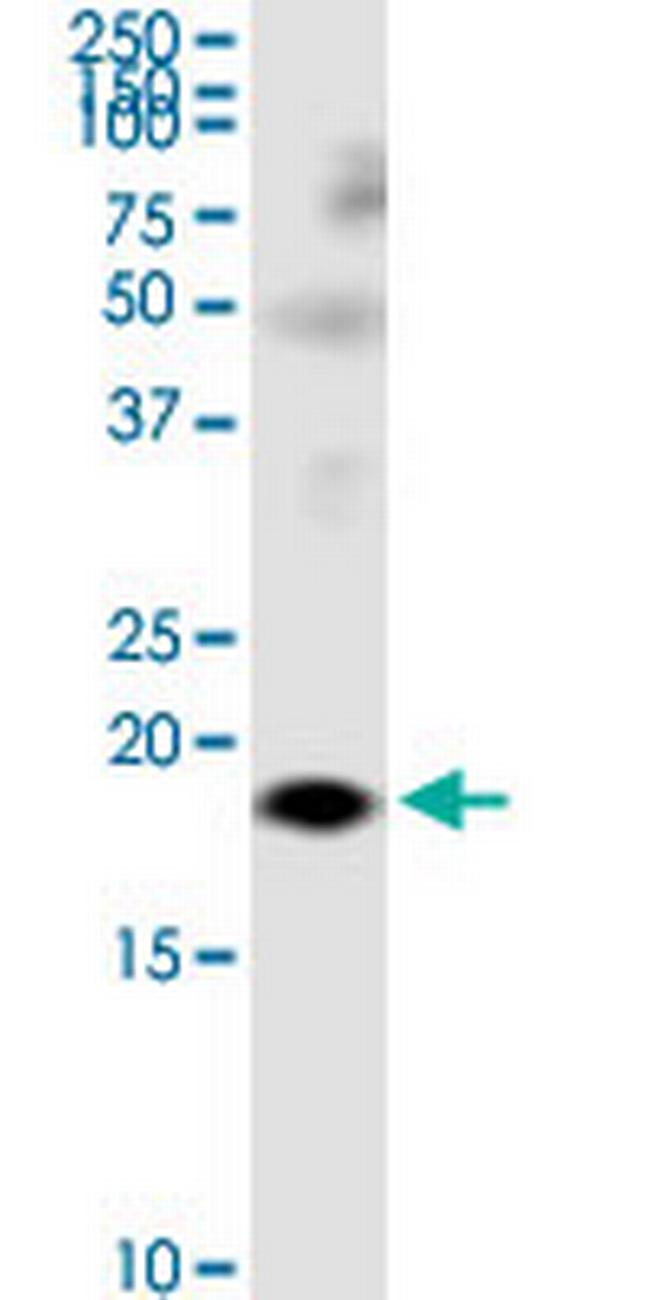
Please note: We are reviewing Western blot images included in the antibody testing data in our catalog, including those provided by third parties. Unless expressly labeled or annotated as “raw-unedited”, Western blot images included in the antibody testing data in our catalog may have been edited, optimized or otherwise adjusted for presentation.

Product Details
H00009450-M01
Product Specifications
Species Reactivity
Human
Host/Isotype
Mouse
/ IgG2a, kappa
Class
Monoclonal
Type
Antibody
Clone
1H3
Immunogen
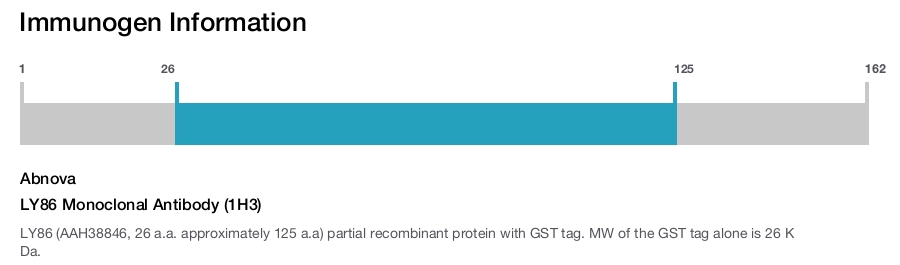
LY86 (AAH38846, 26 a.a. approximately 125 a.a) partial recombinant protein with GST tag. MW of the GST tag alone is 26 KDa.
Conjugate
Unconjugated
Unconjugated
Unconjugated
Form
Liquid
Concentration
0.25 mg/mL
Amount
100 µg
Purification
Protein A
Storage buffer
PBS, pH 7.4
Contains
no preservative
Storage conditions
-20°C, Avoid Freeze/Thaw Cycles
Shipping conditions
Ambient (domestic); Wet ice (international)
Product Specific Information
Product may be used with Western Blot (Cell lysate).
Immunogen sequence: AWPTHVVCSD SGLEVLYQSC DPLQDFGFSV EKCSKQLKSN INIRFGIILR EDIKELFLDL ALMSQGSSVL NFSYPICEAA LPKFSFCGRR KGEQIYYAGP
Target Information
MD-1, also known as LY86, is a glycoprotein involved in innate immunity. It is a component of the RP105/MD-1 complex, which is expressed primarily in immune cells like B-cells. MD-1 is structurally similar to MD-2, sharing only 16% sequence identity, yet both are implicated in lipopolysaccharide recognition. The protein contains the ML (MD-2-related lipid-recognition) domain, which is conserved across various species and mediates diverse biological functions by interacting with specific lipids. Structurally, MD-1 is characterized by a beta-rich fold consisting of multiple strands, which is integral to its biological activities. Though MD-1 mainly associates with RP105, its role in lipid recognition suggests functional similarities with proteins such as GM2A and NPC2, implying participation in broader immune signaling pathways.
For Research Use Only. Not for use in diagnostic procedures. Not for resale without express authorization.
References (0)
Have you cited this product in a publication?
Let us know so we can reference it here.
Bioinformatics
Protein Aliases: ly-86; MD-1, RP105-associated; product associated with RP105; protein MD-1; RP1-80N2.1
Gene Aliases: dJ80N2.1; MD-1; MD1; MMD-1
UniProt ID: (Human) O95711
Entrez Gene ID: (Human) 9450
Disclaimer

Clicking the images or links will redirect you to a website hosted by BenchSci that provides third-party scientific content. Neither the content nor the BenchSci technology and processes for selection have been evaluated by us; we are providing them as-is and without warranty of any kind, including for use or application of the Thermo Fisher Scientific products presented.

Performance Guarantee
If an Invitrogen™ antibody doesn't perform as described on our website or datasheet,we'll replace the product at no cost to you, or provide you with a credit for a future purchase.*
Learn more
We're here to help
Get expert recommendations for common problems or connect directly with an on staff expert for technical assistance related to applications, equipment and general product use.
Contact tech support