Search
Invitrogen
SIRP alpha Recombinant Rabbit Monoclonal Antibody (001)
{{$productOrderCtrl.translations['antibody.pdp.commerceCard.promotion.promotions']}}
{{$productOrderCtrl.translations['antibody.pdp.commerceCard.promotion.promocode']}}: {{promo.promoCode}} {{promo.promoTitle}} {{promo.promoDescription}}. {{$productOrderCtrl.translations['antibody.pdp.commerceCard.promotion.learnmore']}}
{{$ctrl.translations['antibody.pdp.skuNotes.additionalInformation']}}:
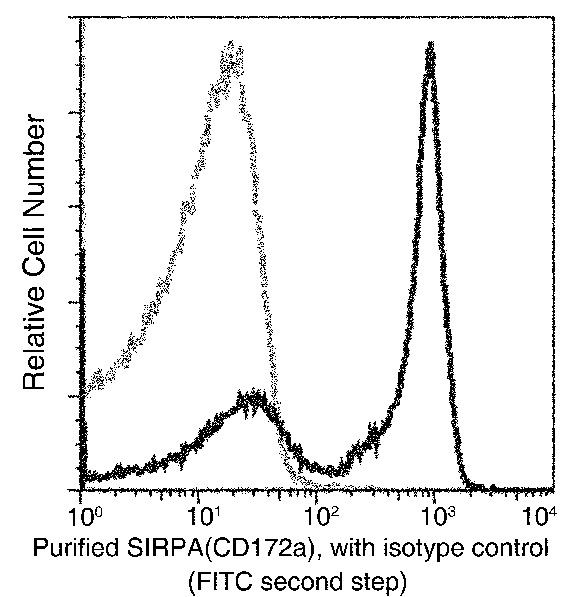
FIGURE: 1 / 1
SIRP alpha Antibody (MA5-29806) in Flow
Flow cytometric analysis of Mouse SIRP alpha expression on BABL/c bone marrow cells. Cells were stained with SIRP alpha Recombinant Rabbit Monoclonal Antibody (1) (Product # MA5-29806), then a FITC-conjugated Secondary antibody. The fluorescence histograms were derived from gated events with the forward and side light-scatter characteristics of intact cells.
Please note: We are reviewing Western blot images included in the antibody testing data in our catalog, including those provided by third parties. Unless expressly labeled or annotated as “raw-unedited”, Western blot images included in the antibody testing data in our catalog may have been edited, optimized or otherwise adjusted for presentation.

Product Details
MA5-29806
Applications
Tested Dilution
Publications
Product Specifications
Species Reactivity
Mouse
Host/Isotype
Rabbit
/ IgG
Expression System
HEK293 cells
Class
Recombinant Monoclonal
Type
Antibody
Clone
001
Immunogen
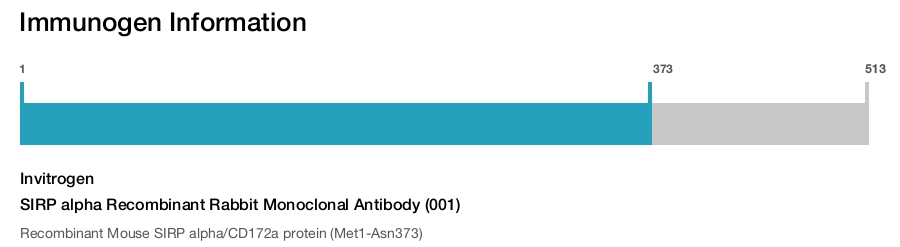
Recombinant Mouse SIRP alpha/CD172a protein (Met1-Asn373)
Conjugate
Unconjugated
Unconjugated
Unconjugated
Form
Liquid
Concentration
1 mg/mL
Amount
100 µg
Purification
Protein A
Storage buffer
PBS
Contains
no preservative
Storage conditions
Store at 4°C short term. For long term storage, store at -20°C, avoiding freeze/thaw cycles.
Shipping conditions
Ambient (domestic); Wet ice (international)
RRID
Product Specific Information
This product is preservative free. It is recommended to add sodium azide to avoid contamination (final concentration 0.05%-0.1%).
Recombinant rabbit monoclonal antibodies are produced using in vitro expression systems. The expression systems are developed by cloning in the specific antibody DNA sequences from immunoreactive rabbits. Then, individual clones are screened to select the best candidates for production. The advantages of using recombinant rabbit monoclonal antibodies include: better specificity and sensitivity, lot-to-lot consistency, animal origin-free formulations, and broader immunoreactivity to diverse targets due to larger rabbit immune repertoire.
This antibody has specificity for Mouse SIRP alpha/CD172a.
Target Information
SIRP alpha (CD172a, signal-regulatory protein alpha) is a receptor-type transmembrane glycoprotein expressed on cells of myeloid origin, including granulocytes, dendritic cells (DCs), macrophages, mast cells and hematopoietic stem cells. SIRP alpha acts as a substrate for several activated tyrosine kinases, including EGFR, PDGFR, src and insulin receptor and is involved in the negative regulation of receptor tyrosine kinase-coupled signaling pathways. The ligand binding of SIRP alpha to integrin-associated protein CD47 results in tyrosine kinase phosphorylation of immunoreceptor tyrosine-based inhibitory motifs (ITIMs) within the cytoplasmic region of SIRP alpha, which mediates the recruitment and activation of the tyrosine phosphatases SHP-1 and SHP-2. Ligation of SIRP alpha with CD47 has been demonstrated in several regulatory processes, including the inhibition of host cell phagocytosis by macrophages and the bi-directional activation of T cells and DCs. SIRP alpha has regulatory effects on cellular responses induced by serum, growth factors, insulin, oncogenes, growth hormones and cell adhesion, and plays a general role in different physiological and pathological processes. Cancer cells highly express CD47, which activates SIRP alpha and inhibits macrophage-mediated destruction of cancerous cell growth.
For Research Use Only. Not for use in diagnostic procedures. Not for resale without express authorization.
References (0)
Have you cited this product in a publication?
Let us know so we can reference it here.
Bioinformatics
Protein Aliases: brain Ig-like molecule with tyrosine-based activation motifs; brain immunological-like with tyrosine-based motifs; CD172 alpha; CD172 antigen-like family member A; inhibitory receptor SHPS-1; mSIRP-alpha1; myD-1 antigen; protein tyrosine phosphatase, non-receptor type substrate 1; SHP substrate 1; signal-regulatory protein alpha-1; sirp-alpha-1; SIRPalpha; SIRPalpha2
Gene Aliases: Bit; CD172a; Idd13.2; P84; Ptpns1; SHP-1; SHPS-1; SIRP
UniProt ID: (Mouse) P97797
Entrez Gene ID: (Mouse) 19261
protein phosphatase inhibitor activity
protein binding
protein phosphatase binding
GTPase regulator activity
protein phosphorylated amino acid binding
protein binding involved in heterotypic cell-cell adhesion
protein binding involved in cell-cell adhesion
protein antigen binding
protein tyrosine kinase binding
hematopoietic progenitor cell differentiation
phagocytosis, recognition
phagocytosis, engulfment
cytoskeleton organization
actin filament organization
cell-matrix adhesion
regulation of gene expression
cell migration
negative regulation of lipopolysaccharide-mediated signaling pathway
regulation of interferon-gamma production
regulation of interleukin-1 beta production
regulation of interleukin-6 production
regulation of tumor necrosis factor production
negative regulation of interferon-beta production
negative regulation of interleukin-6 production
negative regulation of tumor necrosis factor production
heterotypic cell-cell adhesion
monocyte extravasation
negative regulation of I-kappaB kinase/NF-kappaB signaling
negative regulation of nitric oxide biosynthetic process
regulation of nitric oxide biosynthetic process
negative regulation of JNK cascade
cell motility
negative regulation of inflammatory response
negative regulation of phagocytosis
positive regulation of phagocytosis
positive regulation of T cell activation
cellular response to hydrogen peroxide
negative regulation of ERK1 and ERK2 cascade
cellular response to interferon-gamma
cellular response to interleukin-1
cellular response to interleukin-12
negative regulation of macrophage inflammatory protein 1 alpha production
negative regulation of chemokine (C-C motif) ligand 5 production
myeloid leukocyte migration
granulocyte migration
cell-cell adhesion
negative regulation of cytokine production involved in inflammatory response
positive regulation of reactive oxygen species metabolic process
Disclaimer

Clicking the images or links will redirect you to a website hosted by BenchSci that provides third-party scientific content. Neither the content nor the BenchSci technology and processes for selection have been evaluated by us; we are providing them as-is and without warranty of any kind, including for use or application of the Thermo Fisher Scientific products presented.

Performance Guarantee
If an Invitrogen™ antibody doesn't perform as described on our website or datasheet,we'll replace the product at no cost to you, or provide you with a credit for a future purchase.*
Learn more
We're here to help
Get expert recommendations for common problems or connect directly with an on staff expert for technical assistance related to applications, equipment and general product use.
Contact tech support