Search
Rockland
PDK1 Polyclonal Antibody
{{$productOrderCtrl.translations['antibody.pdp.commerceCard.promotion.promotions']}}
{{$productOrderCtrl.translations['antibody.pdp.commerceCard.promotion.promocode']}}: {{promo.promoCode}} {{promo.promoTitle}} {{promo.promoDescription}}. {{$productOrderCtrl.translations['antibody.pdp.commerceCard.promotion.learnmore']}}
{{$ctrl.translations['antibody.pdp.skuNotes.additionalInformation']}}:
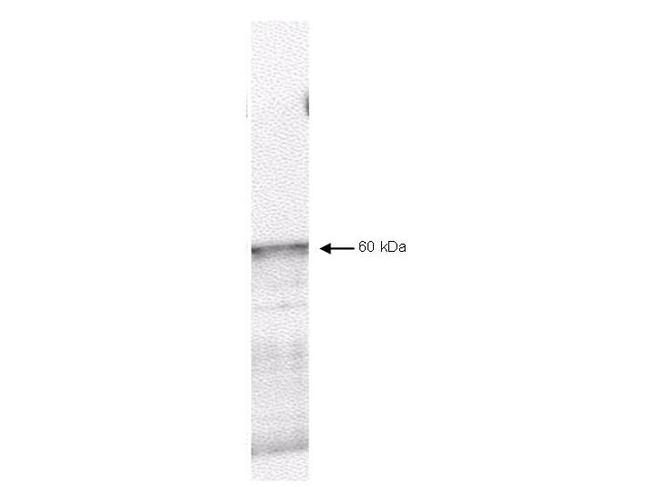
FIGURE: 1 / 1
PDK1 Antibody (600-401-411) in WB
Western blot using Rocklands affinity purified anti-PDK-1 antibody shows detection of myc-tagged human PDK-1 at 60kDa in ~10 µg of a virus infected Sf9 cell lysate (arrow). The nitrocellulose membrane was probed overnight at 4° C with the primary antibody diluted 1:750 in 1% non-fat dry milk. HRP conjugated Goat-anti-Rabbit IgG [H&L] (p/n 611-1302) and chemiluminescent detection is recommended. Other detection systems will yield similar results.
Please note: We are reviewing Western blot images included in the antibody testing data in our catalog, including those provided by third parties. Unless expressly labeled or annotated as “raw-unedited”, Western blot images included in the antibody testing data in our catalog may have been edited, optimized or otherwise adjusted for presentation.

Product Details
600-401-411
Applications
Tested Dilution
Publications
Product Specifications
Species Reactivity
Human
Host/Isotype
Rabbit
/ IgG
Class
Polyclonal
Type
Antibody
Immunogen
This affinity purified antibody was prepared from whole rabbit serum produced by repeated immunizations with a synthetic peptide corresponding to a region near the C-terminal of human PDK-1 protein.
Conjugate
Unconjugated
Unconjugated
Unconjugated
Form
Liquid
Concentration
1.3 mg/mL
Amount
100 µg
Purification
Affinity chromatography
Storage buffer
0.02M potassium phosphate, pH 7.2, with 0.15M NaCl
Contains
0.01% sodium azide
Storage conditions
-20°C, Avoid Freeze/Thaw Cycles
Shipping conditions
Ambient (domestic); Wet ice (international)
Product Specific Information
Store vial at -20° C prior to opening. Aliquot contents and freeze at -20° C or below for extended storage. Avoid cycles of freezing and thawing. Centrifuge product if not completely clear after standing at room temperature. This product is stable for several weeks at 4° C as an undiluted liquid. Dilute only prior to immediate use.
Directed against human PDK-1. A BLAST analysis was used to suggest cross-reactivity with PDK-1 protein from mouse, rat and dog based on 92% homology with the immunizing sequence. Reactivity against homologues from other sources is unknown.
Target Information
PDPK1 (3 Phosphoinositide Dependent Protein Kinase 1) phosphorylates AGC kinases. PDPK1 activates conventional PKC and PKC zeta through phosphorylation of critical threonine residues in the activation loop. PDPK1 also phosphorylates Protein Kinase B (PKB) at threonine 308 in the presence of phosphatidylinositol-3,4,5-trisphosphate. Active Akt inactivates Glycogen Synthase Kinase 3 (GSK3), eventually leading to the dephosphorylation and activation of glycogen synthase, and the stimulation of glycogen synthesis. Because of the role that PDPK1 plays in insulin-induced glycogen synthesis and PKC activation, it is a potentially important target for metabolic drug research.
For Research Use Only. Not for use in diagnostic procedures. Not for resale without express authorization.
References (0)
Have you cited this product in a publication?
Let us know so we can reference it here.
Bioinformatics
Protein Aliases: HGNC:8809; isoenzyme 1; kinase isoenzyme 1; lipoamide; OTTHUMP00000174525; OTTHUMP00000205076; PDPK1; PkB kinase like gene 1; PkB-like 1; predicted protein of HQ0461; unnamed protein product
Gene Aliases: PDK1; PRO0461
UniProt ID: (Human) O15530
Entrez Gene ID: (Human) 5170
type B pancreatic cell development
protein phosphorylation
epidermal growth factor receptor signaling pathway
insulin receptor signaling pathway
regulation of endothelial cell migration
negative regulation of cardiac muscle cell apoptotic process
cell migration
calcium-mediated signaling
actin cytoskeleton organization
negative regulation of transforming growth factor beta receptor signaling pathway
T cell costimulation
cellular response to insulin stimulus
negative regulation of toll-like receptor signaling pathway
intracellular signal transduction
negative regulation of apoptotic process
regulation of I-kappaB kinase/NF-kappaB signaling
regulation of mast cell degranulation
protein kinase B signaling
positive regulation of blood vessel endothelial cell migration
positive regulation of angiogenesis
protein autophosphorylation
insulin-like growth factor receptor signaling pathway
positive regulation of release of sequestered calcium ion into cytosol
positive regulation of protein kinase B signaling
cellular response to epidermal growth factor stimulus
extrinsic apoptotic signaling pathway
vascular endothelial cell response to laminar fluid shear stress
intracellular signaling cassette
positive regulation of protein localization to plasma membrane
positive regulation of sprouting angiogenesis
positive regulation of vascular endothelial cell proliferation
negative regulation of endothelial cell apoptotic process
Disclaimer

Clicking the images or links will redirect you to a website hosted by BenchSci that provides third-party scientific content. Neither the content nor the BenchSci technology and processes for selection have been evaluated by us; we are providing them as-is and without warranty of any kind, including for use or application of the Thermo Fisher Scientific products presented.

Performance Guarantee
If an Invitrogen™ antibody doesn't perform as described on our website or datasheet,we'll replace the product at no cost to you, or provide you with a credit for a future purchase.*
Learn more
We're here to help
Get expert recommendations for common problems or connect directly with an on staff expert for technical assistance related to applications, equipment and general product use.
Contact tech support