Search
Abnova
PIM2 Polyclonal Antibody, MaxPab™
{{$productOrderCtrl.translations['antibody.pdp.commerceCard.promotion.promotions']}}
{{$productOrderCtrl.translations['antibody.pdp.commerceCard.promotion.promocode']}}: {{promo.promoCode}} {{promo.promoTitle}} {{promo.promoDescription}}. {{$productOrderCtrl.translations['antibody.pdp.commerceCard.promotion.learnmore']}}
{{$ctrl.translations['antibody.pdp.skuNotes.additionalInformation']}}:
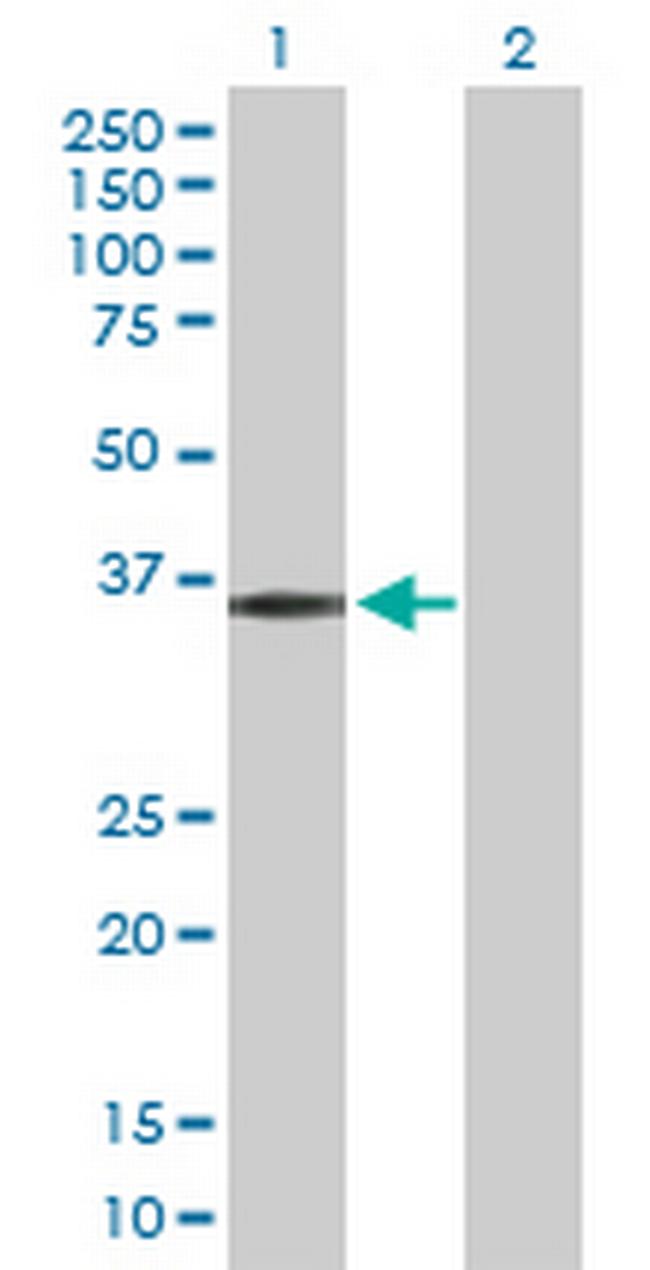
Please note: We are reviewing Western blot images included in the antibody testing data in our catalog, including those provided by third parties. Unless expressly labeled or annotated as “raw-unedited”, Western blot images included in the antibody testing data in our catalog may have been edited, optimized or otherwise adjusted for presentation.

Product Details
H00011040-D01P
Product Specifications
Species Reactivity
Human
Host/Isotype
Rabbit
/ IgG
Class
Polyclonal
Type
Antibody
Immunogen
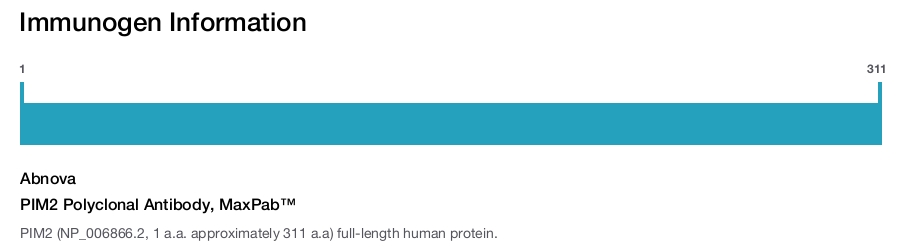
PIM2 (NP_006866.2, 1 a.a. approximately 311 a.a) full-length human protein.
Conjugate
Unconjugated
Unconjugated
Unconjugated
Form
Liquid
Concentration
0.5-1 mg/mL
Amount
100 µg
Purification
Protein A
Storage buffer
PBS, pH 7.4
Contains
no preservative
Storage conditions
-20°C, Avoid Freeze/Thaw Cycles
Shipping conditions
Ambient (domestic); Wet ice (international)
Product Specific Information
Product may be used with Western Blot (Transfected lysate).
The Isotype of this product is composed of an IgG Mixture.
Immunogen sequence: MLTKPLQGPP APPGTPTPPP GGKDREAFEA EYRLGPLLGK GGFGTVFAGH RLTDRLQVAI KVIPRNRVLG WSPLSDSVTC PLEVALLWKV GAGGGHPGVI RLLDWFETQE GFMLVLERPL PAQDLFDYIT EKGPLGEGPS RCFFGQVVAA IQHCHSRGVV HRDIKDENIL IDLRRGCAKL IDFGSGALLH DEPYTDFDGT RVYSPPEWIS RHQYHALPAT VWSLGILLYD MVCGDIPFER DQEILEAELH FPAHVSPDCC ALIRRCLAPK PSSRPSLEEI LLDPWMQTPA EDVPLNPSKG GPAPLAWSLL P
Target Information
PIM2 is a proto-oncogene which phosphorylates BAD, which partially inhibits its apopotopic function. PIM proteins (PIM-1, PIM-2 and PIM-3) are oncogene-encoded serine/threonine kinases. PIM-2 is highly homologous to Pim-1 with similar oncogenic functions. PIM-2 is most abundantly expressed in hematopoietic tissues, spleen, thymus, and peripheral blood leukocytes, as well as in testis, small intestine, and colon. PIM2 expression is negatively regulated by growth factor depletion. Increased levels of PIM-2 has also been observed in certain cancers.
For Research Use Only. Not for use in diagnostic procedures. Not for resale without express authorization.
References (0)
Have you cited this product in a publication?
Let us know so we can reference it here.
Bioinformatics
Protein Aliases: pim-2 oncogene; pim-2h; proto-oncogene Pim-2 (serine threonine kinase); unnamed protein product
UniProt ID: (Human) Q9P1W9
Entrez Gene ID: (Human) 11040
G1/S transition of mitotic cell cycle
protein phosphorylation
regulation of mitotic cell cycle
negative regulation of cell proliferation
response to virus
positive regulation of autophagy
negative regulation of apoptotic process
positive regulation of I-kappaB kinase/NF-kappaB signaling
positive regulation of transcription, DNA-templated
protein stabilization
Disclaimer

Clicking the images or links will redirect you to a website hosted by BenchSci that provides third-party scientific content. Neither the content nor the BenchSci technology and processes for selection have been evaluated by us; we are providing them as-is and without warranty of any kind, including for use or application of the Thermo Fisher Scientific products presented.

Performance Guarantee
If an Invitrogen™ antibody doesn't perform as described on our website or datasheet,we'll replace the product at no cost to you, or provide you with a credit for a future purchase.*
Learn more
We're here to help
Get expert recommendations for common problems or connect directly with an on staff expert for technical assistance related to applications, equipment and general product use.
Contact tech support