Search
Invitrogen
PIWIL2 Polyclonal Antibody
{{$productOrderCtrl.translations['antibody.pdp.commerceCard.promotion.promotions']}}
{{$productOrderCtrl.translations['antibody.pdp.commerceCard.promotion.promocode']}}: {{promo.promoCode}} {{promo.promoTitle}} {{promo.promoDescription}}. {{$productOrderCtrl.translations['antibody.pdp.commerceCard.promotion.learnmore']}}
{{$ctrl.translations['antibody.pdp.skuNotes.additionalInformation']}}:
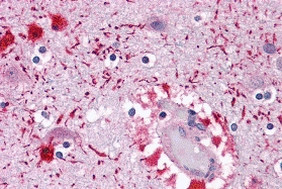
Please note: We are reviewing Western blot images included in the antibody testing data in our catalog, including those provided by third parties. Unless expressly labeled or annotated as “raw-unedited”, Western blot images included in the antibody testing data in our catalog may have been edited, optimized or otherwise adjusted for presentation.

产品信息
PA5-34341
产品规格
种属反应
Human
宿主/亚型
Rabbit
/ IgG
分类
Polyclonal
类型
Antibody
抗原
A 14 amino acid synthetic peptide near the center of human PIWI-L2
偶联物
Unconjugated
Unconjugated
Unconjugated
形式
Liquid
浓度
1 mg/mL
规格
100 µg
纯化类型
Antigen affinity chromatography
保存液
PBS
内含物
0.02% sodium azide
保存条件
Maintain refrigerated at 2-8°C for up to 3 months. For long term storage store at -20°C
运输条件
Ambient (domestic); Wet ice (international)
RRID
产品详细信息
A suggested positive control is human brain tissue lysate.
PA5-34341 can be used with blocking peptide PEP-1384.
靶标信息
The piwi gene of Drosophila belongs to a novel class of evolutionarily conserved genes (the piwi or Argonaute family). The Piwi family is required for germ and stem cell development in invertebrates, and two Piwi members, MIWI and MILI (Miwi like, Piwil2, Piwi-like protein 2), are essential for spermatogenesis in mouse. MIWI and MILI partner with Piwi-interacting RNAs (piRNAs) which are 26-31 nucleotides in length clearly distinct from the 21-23 nucleotides of microRNAs (miRNAs) or short interfering RNAs (siRNAs). A search for murine small RNAs that might program Piwi proteins for transposon suppression revealed developmentally regulated piRNA loci, some of which resemble transposon master control loci of Drosophila. MILI might be programmed by distinct piRNA populations at different stages of germ cell development, suggesting MILI plays an important role in meiotic prophase progression.
仅用于科研。不用于诊断过程。未经明确授权不得转售。
篇参考文献 (0)
您是否在文献中引用过该产品?请点击下方按钮邮件告知我们。
生物信息学
蛋白别名: cancer/testis antigen 80; PIWI-L2; piwi-like 2; PIWIL2; piwil2-like protein; PL2L106; PL2L80A; testicular tissue protein Li 141; unnamed protein product
基因别名: CT80; HILI; mili; PIWIL1L
UniProt ID: (Human) Q8TC59
Entrez Gene ID: (Human) 55124
spermatogenesis
germ-line stem cell population maintenance
gene silencing by RNA
piRNA metabolic process
negative regulation of circadian rhythm
oogenesis
secondary piRNA processing
piRNA-mediated gene silencing by mRNA destabilization
transposable element silencing by heterochromatin formation
transposable element silencing by mRNA destabilization
transposable element silencing by piRNA-mediated DNA methylation
positive regulation of cytoplasmic translation
Disclaimer

Clicking the images or links will redirect you to a website hosted by BenchSci that provides third-party scientific content. Neither the content nor the BenchSci technology and processes for selection have been evaluated by us; we are providing them as-is and without warranty of any kind, including for use or application of the Thermo Fisher Scientific products presented.

