Search
Invitrogen
Polyoma Virus Medium T Monoclonal Antibody (PyMT)
{{$productOrderCtrl.translations['antibody.pdp.commerceCard.promotion.promotions']}}
{{$productOrderCtrl.translations['antibody.pdp.commerceCard.promotion.promocode']}}: {{promo.promoCode}} {{promo.promoTitle}} {{promo.promoDescription}}. {{$productOrderCtrl.translations['antibody.pdp.commerceCard.promotion.learnmore']}}
{{$ctrl.translations['antibody.pdp.skuNotes.additionalInformation']}}:
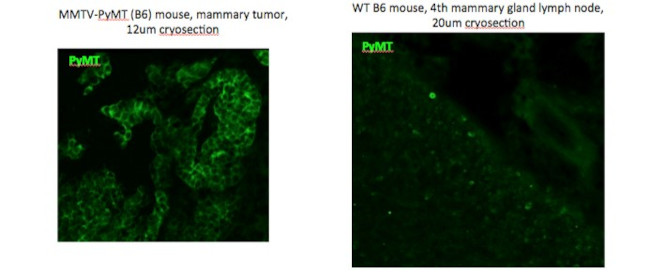
图: 1 / 2
Polyoma Virus Medium T Antibody (MA1-46061) in ICC/IF
Immunofluorescence analysis of Polyoma Virus Medium T (green) in PyMT+ mammary tumor cells and mammary gland lymph node. Cells were stained with a Polyoma Virus Medium T Monoclonal Antibody (Product # MA1-46061) at a dilution of 1:500 overnight at 4C, and then incubated with secondary goat anti-rat IgG - Alexa Fluor 488 antibody (Product # A-11006) at a dilution of 1:500 for 1 hour. Data courtesy of Antib... View More
Please note: We are reviewing Western blot images included in the antibody testing data in our catalog, including those provided by third parties. Unless expressly labeled or annotated as “raw-unedited”, Western blot images included in the antibody testing data in our catalog may have been edited, optimized or otherwise adjusted for presentation.


产品信息
MA1-46061
应用
建议稀释比
已发表文章
产品规格
种属反应
Virus
已发表种属
Virus
宿主/亚型
Rat
/ IgG2b
分类
Monoclonal
类型
Antibody
克隆号
PyMT
抗原
Polyoma Virus-transformed Wistar rat fibroblast cell line Py REWA5/T1A1.
偶联物
Unconjugated
Unconjugated
Unconjugated
形式
Liquid
浓度
1 mg/mL
规格
100 µg
纯化类型
Protein G
保存液
PBS
内含物
0.02% sodium azide
保存条件
Store at 4°C short term. For long term storage, store at -20°C, avoiding freeze/thaw cycles.
运输条件
Ambient (domestic); Wet ice (international)
RRID
靶标信息
The Polyoma Virus Medium T (MT) antigen is associated with oncogenic processes in the virus's host cells. Polyoma Virus is a small, double-stranded DNA virus that primarily infects mice, leading either to lytic or abortive infections. The MT antigen plays a pivotal role in the virus's ability to induce tumors and transform cells. Structurally, the Polyoma Virus includes multiple T-antigens, with MT being one such protein that resembles growth factor receptors and mimics their function, thereby activating signaling pathways that lead to cell proliferation and transformation. The MT antigen has been extensively studied for its ability to initiate and sustain signaling pathways integral to cancer research, such as activating tyrosine kinases and phosphatidylinositol 3-kinases pathways, which are crucial for cell survival, growth, and division. The coding regions and structure of MT, derived from genetic, mRNA, peptide, and DNA analysis, have established its importance in polyoma's oncogenic activity, offering critical insights into molecular changes underlying tumorigenesis. Understanding the MT antigen's structure and function has significantly contributed to the study of viral mechanisms and cancer development.
仅用于科研。不用于诊断过程。未经明确授权不得转售。
生物信息学
蛋白别名: MPyVgp2
Disclaimer

Clicking the images or links will redirect you to a website hosted by BenchSci that provides third-party scientific content. Neither the content nor the BenchSci technology and processes for selection have been evaluated by us; we are providing them as-is and without warranty of any kind, including for use or application of the Thermo Fisher Scientific products presented.

