Search
Agrisera
PsbS/22 kDa Lhc-like PSII protein Polyclonal Antibody
{{$productOrderCtrl.translations['antibody.pdp.commerceCard.promotion.promotions']}}
{{$productOrderCtrl.translations['antibody.pdp.commerceCard.promotion.viewpromo']}}
{{$productOrderCtrl.translations['antibody.pdp.commerceCard.promotion.promocode']}}: {{promo.promoCode}} {{promo.promoTitle}} {{promo.promoDescription}}. {{$productOrderCtrl.translations['antibody.pdp.commerceCard.promotion.learnmore']}}
Additional Information:
{{banner.description}}
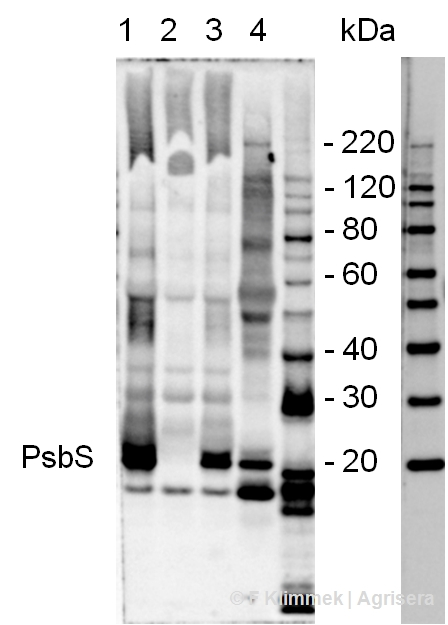
FIGURE: 1 / 1
PsbS/22 kDa Lhc-like PSII protein Antibody (AS03-032) in WB
15 µg of Arabidopsis thaliana thylakoids from (1) Psb S-overexpressing line, (2) Psb S-deficient npq 4-line, and (3) wt (col) together with (4) total leaf protein from Arabidopsis thaliana wt extracted with PEB, AS08 300, were separated on 4-12% Nu PAGE(Invitrogen) LDS-PAGE and blotted 1 h to nitrocellulose. Filters were blocked 1 h with 2% low-fat milk powder in TBS-T (0.1% TWEEN 20) and probed with anti-P... View More
Please note: We are reviewing Western blot images included in the antibody testing data in our catalog, including those provided by third parties. Unless expressly labeled or annotated as “raw-unedited”, Western blot images included in the antibody testing data in our catalog may have been edited, optimized or otherwise adjusted for presentation.

Product Details
AS03-032
Product Specifications
Species Reactivity
Plant
Host/Isotype
Chicken
Class
Polyclonal
Type
Antibody
Immunogen
KLH-conjugated synthetic peptide derived from available di and monocot PsbS sequences, including Arabidopsis thaliana (At1g44575).
Conjugate
Unconjugated
Unconjugated
Unconjugated
Form
Liquid
Purification
purified
Storage buffer
PBS
Contains
0.02% sodium azide
Storage conditions
4°C
Shipping conditions
Ambient (domestic); Wet ice (international)
Product Specific Information
Store at 4°C; make aliquots to avoid working with a stock. Please remember to spin the tubes briefly prior to opening them to avoid any losses that might occur from material adhering to the cap or sides of the tube.
Specific Species Reactivity: Arabidopsis thaliana, Avena sativa, Brassica napus, Hordeum vulgare, Oryza sativa, Pinus sylvestris, Populus tremula, Spinacia oleracea
Target Information
PSBS encodes a small thylakoid membrane protein essential for activating non photochemical quenching (NPQ) in plants, the rapid photoprotective process that dissipates excess excitation energy as heat to prevent damage under high or fluctuating light. Unlike pigment-binding LHCB proteins, PsbS does not bind chlorophyll; instead, it senses lumenal pH changes via protonatable residues and triggers conformational shifts in the light-harvesting antenna that enable energy dissipation. PsbS is localized to the grana regions of chloroplast thylakoids and functions as a central regulator of the qE component of NPQ, working in concert with the xanthophyll cycle (violaxanthin/zeaxanthin interconversion) and LHCII. Its expression is light inducible and stress-responsive, and genetic manipulation of PSBS alters photoprotection capacity, influencing photosystem II stability, carbon fixation efficiency, and plant productivity, particularly under dynamic light environments.
For Research Use Only. Not for use in diagnostic procedures. Not for resale without express authorization.
References (0)
Have you cited this product in a publication?
Let us know so we can reference it here.
Bioinformatics
Protein Aliases: CP22; NONPHOTOCHEMICAL QUENCHING 4; NPQ4; PHOTOSYSTEM II SUBUNIT S; PSII-S; T18F15.3; T18F15_3
Disclaimer

Clicking the images or links will redirect you to a website hosted by BenchSci that provides third-party scientific content. Neither the content nor the BenchSci technology and processes for selection have been evaluated by us; we are providing them as-is and without warranty of any kind, including for use or application of the Thermo Fisher Scientific products presented.

Performance Guarantee
If an Invitrogen™ antibody doesn't perform as described on our website or datasheet,we'll replace the product at no cost to you, or provide you with a credit for a future purchase.*
Learn more
We're here to help
Get expert recommendations for common problems or connect directly with an on staff expert for technical assistance related to applications, equipment and general product use.
Contact tech support