Search
Invitrogen
SYNPO2 Polyclonal Antibody
{{$productOrderCtrl.translations['antibody.pdp.commerceCard.promotion.promotions']}}
{{$productOrderCtrl.translations['antibody.pdp.commerceCard.promotion.promocode']}}: {{promo.promoCode}} {{promo.promoTitle}} {{promo.promoDescription}}. {{$productOrderCtrl.translations['antibody.pdp.commerceCard.promotion.learnmore']}}
{{$ctrl.translations['antibody.pdp.skuNotes.additionalInformation']}}:
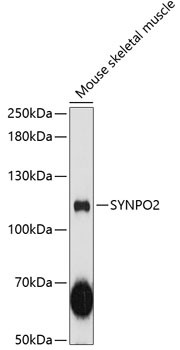
FIGURE: 1 / 1
SYNPO2 Antibody (PA5-88833) in WB
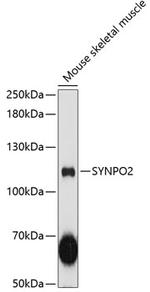
Western blot analysis of SYNPO2 in mouse skeletal muscle. Samples were incubated with SYNPO2 Polyclonal antibody (Product # PA5-88833) using a dilution of 1:3,000, followed by HRP Goat Anti-Rabbit IgG (H+L) at a dilution of 1:10,000. Lysates/proteins: 25 µg per lane. Blocking buffer: 3% nonfat dry milk in TBST. Detection: ECL Enhanced Kit. Exposure time: 90s.
Please note: We are reviewing Western blot images included in the antibody testing data in our catalog, including those provided by third parties. Unless expressly labeled or annotated as “raw-unedited”, Western blot images included in the antibody testing data in our catalog may have been edited, optimized or otherwise adjusted for presentation.

Product Details
PA5-88833
Product Specifications
Species Reactivity
Mouse
Host/Isotype
Rabbit
/ IgG
Class
Polyclonal
Type
Antibody
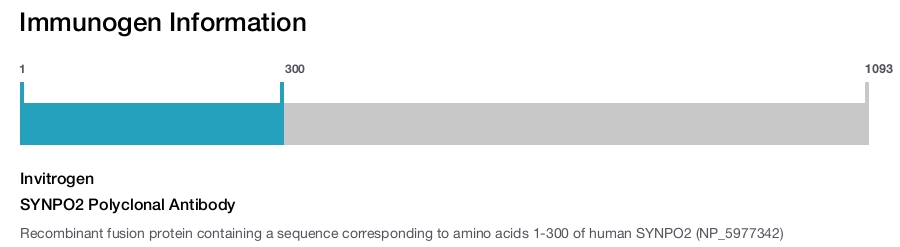
Immunogen
Recombinant fusion protein containing a sequence corresponding to amino acids 1-300 of human SYNPO2 (NP_5977342)
Conjugate
Unconjugated
Unconjugated
Unconjugated
Form
Liquid
Concentration
0.09 mg/mL
Amount
9 µg
Purification
Affinity Chromatography
Storage buffer
PBS, pH 7.3, with 50% glycerol
Contains
0.01% thimerosal
Storage conditions
-20°C, Avoid Freeze/Thaw Cycles
Shipping conditions
Ambient (domestic); Wet ice (international)
RRID
Product Specific Information
Immunogen sequence: MGTGDFICIS MTGGAPWGFR LQGGKEQKQP LQVAKIRNQS KASGSGLCEG DEVVSINGNP CADLTYPEVI KLMESITDSL QMLIKRPSSG ISEALISENE NKNLEHLTHG GYVESTTLQI RPATKTQCTE FFLAPVKTEV PLAENQRSGP DCAGSLKEET GPSYQRAPQM PDSQRGRVAE ELILREKVEA VQPGPVVELQ LSLSQERHKG ASGPLVALPG AEKSKSPDPD PNLSHDRIVH INSIPTNEKA DPFLRSSKII QISSGRELRV IQESEAGDAG LPRVEVILDC SDRQKTEGCR; Positive Samples: Mouse skeletal muscle; Cellular Location: Cytoplasm, Nucleus
Target Information
SYNPO2 was initially identified as myopodin, a member of the synaptopodin family that contains one PPXY motif and multiple PXXP motifs. It colocalizes with alpha-actinin and is found at the Z-disc and during stress conditions will translocate to the nucleus, suggesting that it is part of signaling pathways in addition to its function as a structural protein. SYNPO2 has been shown to bind to calmodulin, alpha-actinin, and smooth muscle myosin and will stimulate actin polymerization in a calmodulin dependent manner, consistent with its proposed role in organizing the cytoskeleton. While deletion of SYNPO2 has been reported to be highly correlated with the invasiveness of prostate cancers, other reports suggest that down-regulation of SYNPO2 reduces the invasiveness and motility of prostate cancer cells.
⚠WARNING: This product can expose you to chemicals including mercury, which is known to the State of California to cause birth defects or other reproductive harm. For more information go to www.P65Warnings.ca.gov.
For Research Use Only. Not for use in diagnostic procedures. Not for resale without express authorization.
References (0)
Have you cited this product in a publication?
Let us know so we can reference it here.
Bioinformatics
Protein Aliases: genethonin 2; myopodin; mypodin; unnamed protein product
Gene Aliases: 1110069I04Rik; 2310068J10Rik; 9530006G20Rik; Myo
UniProt ID: (Mouse) Q91YE8
Entrez Gene ID: (Mouse) 118449
Disclaimer

Clicking the images or links will redirect you to a website hosted by BenchSci that provides third-party scientific content. Neither the content nor the BenchSci technology and processes for selection have been evaluated by us; we are providing them as-is and without warranty of any kind, including for use or application of the Thermo Fisher Scientific products presented.

Performance Guarantee
If an Invitrogen™ antibody doesn't perform as described on our website or datasheet,we'll replace the product at no cost to you, or provide you with a credit for a future purchase.*
Learn more
We're here to help
Get expert recommendations for common problems or connect directly with an on staff expert for technical assistance related to applications, equipment and general product use.
Contact tech support