Search
Invitrogen
WT1-AS Polyclonal Antibody
{{$productOrderCtrl.translations['antibody.pdp.commerceCard.promotion.promotions']}}
{{$productOrderCtrl.translations['antibody.pdp.commerceCard.promotion.viewpromo']}}
{{$productOrderCtrl.translations['antibody.pdp.commerceCard.promotion.promocode']}}: {{promo.promoCode}} {{promo.promoTitle}} {{promo.promoDescription}}. {{$productOrderCtrl.translations['antibody.pdp.commerceCard.promotion.learnmore']}}
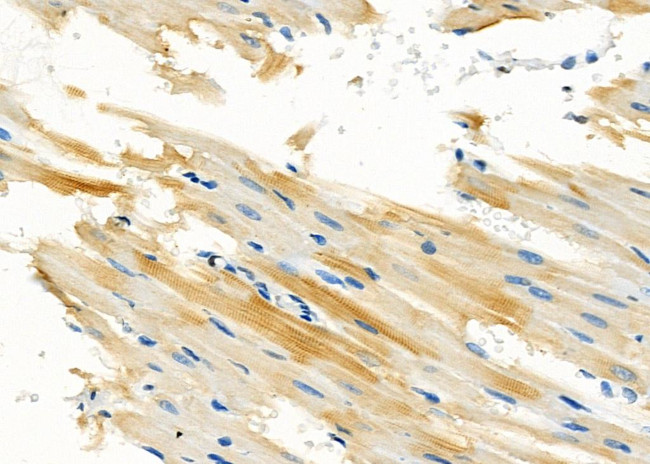
FIGURE: 1 / 2
WT1-AS Antibody (PA5-103316) in IHC (P)
Immunohistochemistry analysis of WT1-AS in rat heart tissue. The sample was formaldehyde fixed and a heat mediated antigen retrieval step in citrate buffer was performed. Samples were incubated with WT1-AS polyclonal antibody (Product # PA5-103316) using a dilution of 1:100 (4°C overnight) followed by HRP conjugated anti-Rabbit secondary antibody.

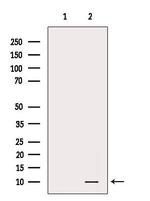
Please note: We are reviewing Western blot images included in the antibody testing data in our catalog, including those provided by third parties. Unless expressly labeled or annotated as “raw-unedited”, Western blot images included in the antibody testing data in our catalog may have been edited, optimized or otherwise adjusted for presentation.


Product Details
PA5-103316
Applications
Tested Dilution
Publications
Product Specifications
Species Reactivity
Human,
Mouse,
Rat
Host/Isotype
Rabbit
/ IgG
Class
Polyclonal
Type
Antibody
Immunogen
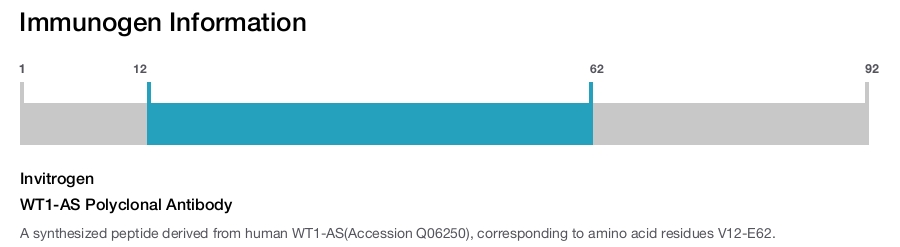
A synthesized peptide derived from human WT1-AS(Accession Q06250), corresponding to amino acid residues V12-E62.
Conjugate
Unconjugated
Unconjugated
Unconjugated
Form
Liquid
Concentration
1 mg/mL
Amount
100 µg
Purification
Affinity chromatography
Storage buffer
PBS, pH 7.4, with 50% glycerol
Contains
0.02% sodium azide
Storage conditions
-20°C
Shipping conditions
Ambient (domestic); Wet ice (international)
RRID
Product Specific Information
Antibody detects endogenous levels of total WIT1.
Target Information
Wilms' tumor is a neoplasm of the kidneys that usually occurs in children and is characterized by the presence of abortive tubules and glomeruli surrounded by a spindled cell stroma. The 11p13 Wilms' tumor locus consists of two coordinately regulated transcripts, WT1 and WIT-1, which are mutated in Wilms' tumors. Wilms' tumor upstream neighbor 1 (WIT-1) is encoded by an intron-less gene upstream of the Wilms' tumor 1 (WT1) gene, which is is important for nephrogenesis and gonadal growth. The WT1 gene is bi-directionally transcribed from the same promoter region as WIT-1, which may function as an antisense regulator of WT1. WIT-1 and WT1 have the same temporal and cell-restricted expression pattern, although the expression of WIT-1 is less abundant. Methylation of the WIT-1 gene is implicated in hematologic malignancy of chemoresistant acute myeloid leukemia. Single nucleotide polymorphisms (SNPs) in the WIT-1 gene are significantly associated with focal segmental glomerulosclerosis.
For Research Use Only. Not for use in diagnostic procedures. Not for resale without express authorization.
References (0)
Have you cited this product in a publication?
Let us know so we can reference it here.
Bioinformatics
Protein Aliases: unnamed protein product
Gene Aliases: 6030498F17; WIT-1; WIT1; Wt1-as; WT1-AS1; WT1AS
Entrez Gene ID: (Human) 51352, (Mouse) 329480
Disclaimer

Clicking the images or links will redirect you to a website hosted by BenchSci that provides third-party scientific content. Neither the content nor the BenchSci technology and processes for selection have been evaluated by us; we are providing them as-is and without warranty of any kind, including for use or application of the Thermo Fisher Scientific products presented.

Performance Guarantee
If an Invitrogen™ antibody doesn't perform as described on our website or datasheet,we'll replace the product at no cost to you, or provide you with a credit for a future purchase.*
Learn more
We're here to help
Get expert recommendations for common problems or connect directly with an on staff expert for technical assistance related to applications, equipment and general product use.
Contact tech support