Search
Invitrogen
p300 Polyclonal Antibody
{{$productOrderCtrl.translations['antibody.pdp.commerceCard.promotion.promotions']}}
{{$productOrderCtrl.translations['antibody.pdp.commerceCard.promotion.promocode']}}: {{promo.promoCode}} {{promo.promoTitle}} {{promo.promoDescription}}. {{$productOrderCtrl.translations['antibody.pdp.commerceCard.promotion.learnmore']}}
{{$ctrl.translations['antibody.pdp.skuNotes.additionalInformation']}}:
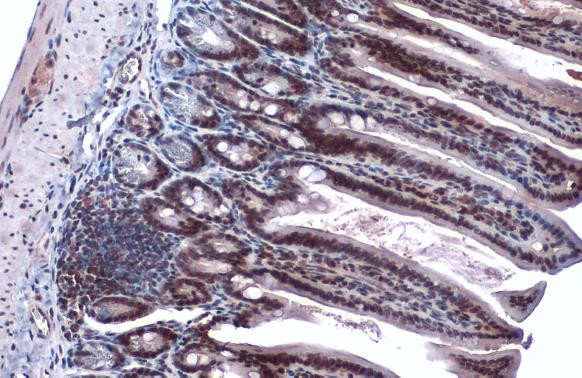

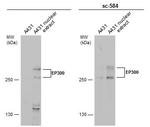
Please note: We are reviewing Western blot images included in the antibody testing data in our catalog, including those provided by third parties. Unless expressly labeled or annotated as “raw-unedited”, Western blot images included in the antibody testing data in our catalog may have been edited, optimized or otherwise adjusted for presentation.
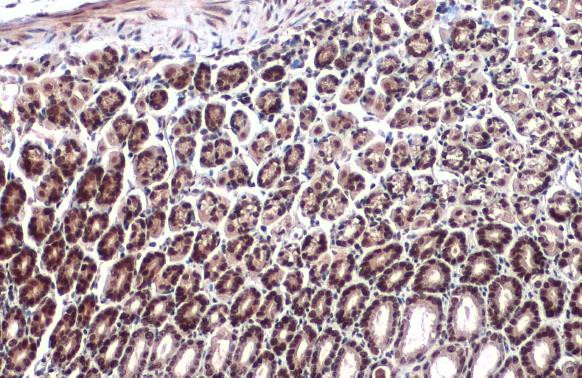
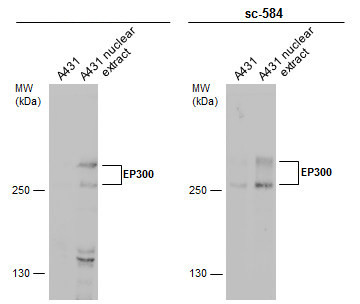
Product Details
PA5-143448
Applications
Tested Dilution
Publications
Product Specifications
Species Reactivity
Human,
Mouse
Host/Isotype
Rabbit
/ IgG
Class
Polyclonal
Type
Antibody
Immunogen
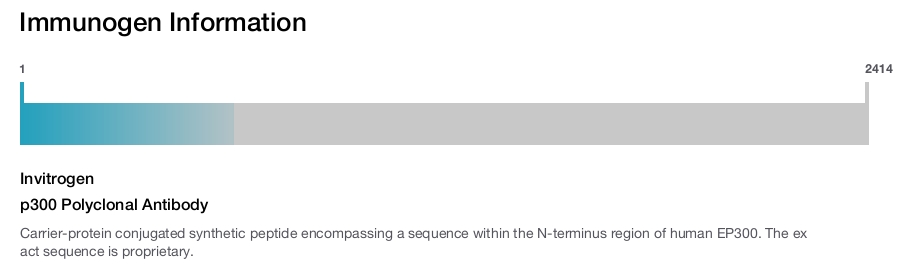
Carrier-protein conjugated synthetic peptide encompassing a sequence within the N-terminus region of human EP300. The exact sequence is proprietary.
Conjugate
Unconjugated
Unconjugated
Unconjugated
Form
Liquid
Concentration
1.29 mg/mL
Amount
129 µg
Purification
Antigen affinity chromatography
Storage buffer
PBS, pH 7, with 20% glycerol
Contains
0.025% Proclin 300
Storage conditions
Store at 4°C short term. For long term storage, store at -20°C, avoiding freeze/thaw cycles.
Shipping conditions
Ambient (domestic); Wet ice (international)
RRID
Product Specific Information
Store as concentrated solution.
Centrifuge briefly prior to opening vial.
Positive control: A431 nuclear extract.
Target Information
EP300 encodes the adenovirus E1A-associated cellular p300 transcriptional co-activator protein. p300 is related by sequence to CPB (CREB-binding protein [CREB: cyclic-AMP responsive element binding protein]), and like CPB can stimulate transcription through activation of CREB. This EP300 activity is specifically inhibited by the adenovirus oncoprotein E1A. EP300 has also been identified as a co-activator of HIF1A (hypoxia-inducible factor 1 alpha), and thus plays a role in the stimulation of hypoxia-induced genes such as VEGF.
For Research Use Only. Not for use in diagnostic procedures. Not for resale without express authorization.
References (0)
Have you cited this product in a publication?
Let us know so we can reference it here.
Bioinformatics
Protein Aliases: E1A binding protein p300; E1A-associated protein p300; E1A-binding protein, 300kD; histone butyryltransferase p300; histone crotonyltransferase p300; p300 HAT; protein 2-hydroxyisobutyryltransferase p300; protein isonicotinyltransferase p300; protein lactyltransferas p300; protein propionyltransferase p300; unnamed protein product
Gene Aliases: A430090G16; A730011L11; KAT3B; MKHK2; p300; p300 HAT; RSTS2
UniProt ID: (Human) Q09472, (Mouse) B2RWS6
Entrez Gene ID: (Human) 2033, (Mouse) 328572
transcription cofactor binding
transcription coactivator binding
p53 binding
DNA binding
chromatin binding
damaged DNA binding
transcription cofactor activity
transcription coactivator activity
histone acetyltransferase activity
lysine N-acetyltransferase activity, acting on acetyl phosphate as donor
protein binding
beta-catenin binding
zinc ion binding
H3 histone acetyltransferase activity
H4 histone acetyltransferase activity
acetyltransferase activity
transferase activity, transferring acyl groups
ligand-dependent nuclear receptor binding
chromatin DNA binding
histone acetyltransferase activity (H3-K18 specific)
histone H2B acetyltransferase activity
histone acetyltransferase activity (H3-K27 specific)
tau protein binding
androgen receptor binding
NF-kappaB binding
RNA polymerase II sequence-specific DNA binding transcription factor binding
peptide-lysine-N-acetyltransferase activity
protein propionyltransferase activity
pre-mRNA intronic binding
STAT family protein binding
peptide 2-hydroxyisobutyryltransferase activity
peptide lactyltransferase (CoA-dependent) activity
histone lactyltransferase (CoA-dependent) activity
acetylation-dependent protein binding
peptide crotonyltransferase activity
peptide butyryltransferase activity
histone crotonyltransferase activity
histone butyryltransferase activity
histone isonicotinyltransferase activity
DNA-binding transcription factor binding
histone H3K122 acetyltransferase activity
histone H1K75 acetyltransferase activity
RNA polymerase II core promoter proximal region sequence-specific DNA binding
core promoter proximal region sequence-specific DNA binding
antigen binding
protein kinase binding
glucocorticoid receptor binding
peroxisome proliferator activated receptor binding
bHLH transcription factor binding
macromolecular complex binding
SMAD binding
mitogen-activated protein kinase binding
histone reader activity
protein antigen binding
promoter-specific chromatin binding
autophagosome assembly
negative regulation of transcription from RNA polymerase II promoter
response to hypoxia
somitogenesis
positive regulation of protein phosphorylation
thigmotaxis
behavioral defense response
gluconeogenesis
glycolytic process
regulation of glycolytic process
chromatin remodeling
regulation of transcription, DNA-templated
regulation of transcription from RNA polymerase II promoter
protein acetylation
internal protein amino acid acetylation
apoptotic process
I-kappaB kinase/NF-kappaB signaling
JAK-STAT cascade
heart development
skeletal muscle tissue development
learning or memory
circadian rhythm
lipid biosynthetic process
response to xenobiotic stimulus
response to glucose
organ morphogenesis
negative regulation of autophagy
positive regulation of glycoprotein biosynthetic process
positive regulation of gene expression
regulation of mitochondrion organization
positive regulation of neuron projection development
positive regulation of muscle atrophy
N-terminal peptidyl-lysine acetylation
internal peptidyl-lysine acetylation
peptidyl-lysine acetylation
B cell differentiation
platelet formation
positive regulation of cell growth
lung development
positive regulation of transforming growth factor beta receptor signaling pathway
negative regulation of protein complex assembly
protein destabilization
cellular response to nutrient levels
negative regulation of protein oligomerization
positive regulation of collagen biosynthetic process
cellular response to UV
multicellular organism growth
megakaryocyte development
endodermal cell differentiation
swimming
TORC1 signaling
TORC2 signaling
positive regulation of protein import into nucleus
intrinsic apoptotic signaling pathway in response to DNA damage by p53 class mediator
protein kinase B signaling
response to estrogen
positive regulation by host of viral transcription
fat cell differentiation
negative regulation of gluconeogenesis
positive regulation of translation
positive regulation of axon extension
positive regulation of cell size
positive regulation of gene expression, epigenetic
positive regulation of proteolysis
positive regulation of transcription, DNA-templated
positive regulation of transcription from RNA polymerase II promoter
positive regulation of JAK-STAT cascade
positive regulation of protein secretion
protein stabilization
cartilage development
response to calcium ion
positive regulation of protein kinase B signaling
canonical Wnt signaling pathway
regulation of angiotensin metabolic process
positive regulation of sarcomere organization
face morphogenesis
regulation of androgen receptor signaling pathway
positive regulation of cell growth involved in cardiac muscle cell development
peptidyl-lysine propionylation
protein-DNA complex assembly
protein localization to chromatin
cellular response to leucine
cellular response to interleukin-1
response to dexamethasone
tricarboxylic acid metabolic process
regulation of tubulin deacetylation
peptidyl-lysine crotonylation
peptidyl-lysine butyrylation
DNA repair-dependent chromatin remodeling
positive regulation of cellular response to hypoxia
positive regulation of hydrogen peroxide-mediated programmed cell death
positive regulation of protein acetylation
negative regulation of chromosome condensation
positive regulation of TORC1 signaling
positive regulation of TORC2 signaling
positive regulation of T-helper 17 cell lineage commitment
negative regulation of miRNA metabolic process
regulation of nucleotide-excision repair
negative regulation of apoptotic signaling pathway
stimulatory C-type lectin receptor signaling pathway
nervous system development
regulation of autophagy
regulation of cellular response to heat
positive regulation of protein localization to nucleus
regulation of signal transduction by p53 class mediator
negative regulation of brown fat cell differentiation
Disclaimer

Clicking the images or links will redirect you to a website hosted by BenchSci that provides third-party scientific content. Neither the content nor the BenchSci technology and processes for selection have been evaluated by us; we are providing them as-is and without warranty of any kind, including for use or application of the Thermo Fisher Scientific products presented.

Performance Guarantee
If an Invitrogen™ antibody doesn't perform as described on our website or datasheet,we'll replace the product at no cost to you, or provide you with a credit for a future purchase.*
Learn more
We're here to help
Get expert recommendations for common problems or connect directly with an on staff expert for technical assistance related to applications, equipment and general product use.
Contact tech support