Introduction
At the recent Thermo Fisher Scientific sponsored workshop at the MSACL 2025 conference in Montreal, Canada, Dr. Patrick Vanderboom from Mayo Clinic shared groundbreaking research into the use of extracellular vesicles (EVs) as potential biomarkers for neurodegenerative diseases such as ALS (Amyotrophic Lateral Sclerosis). His team’s work highlights not only the biological promise of EV-based biomarkers, but also the power of complementary mass spectrometry strategies, leveraging deep discovery on the Thermo Scientific Orbitrap Astral mass spectrometer and highly sensitive, multiplexed targeted validation on the Thermo Scientific Stellar mass spectrometer. Together, these approaches are redefining what is achievable in both discovery and validation proteomics.
The challenge of sensitivity in biomarker discovery
Detecting disease-relevant proteins from complex, low-abundance samples like cerebrospinal fluid (CSF) or plasma remains a formidable analytical challenge. Even with advanced LC-MS workflows, background noise and insufficient detection sensitivity can obscure critical peptide signals, limiting biomarker validation and reproducibility.
Dr. Vanderboom’s team confronted this head-on while developing workflows to identify EV-based ALS-specific markers. Early targeted assays using traditional MS² approaches revealed promising candidates but struggled with low signal intensity and limited reproducibility, clear signs of hitting the sensitivity ceiling.
The MS³ advantage
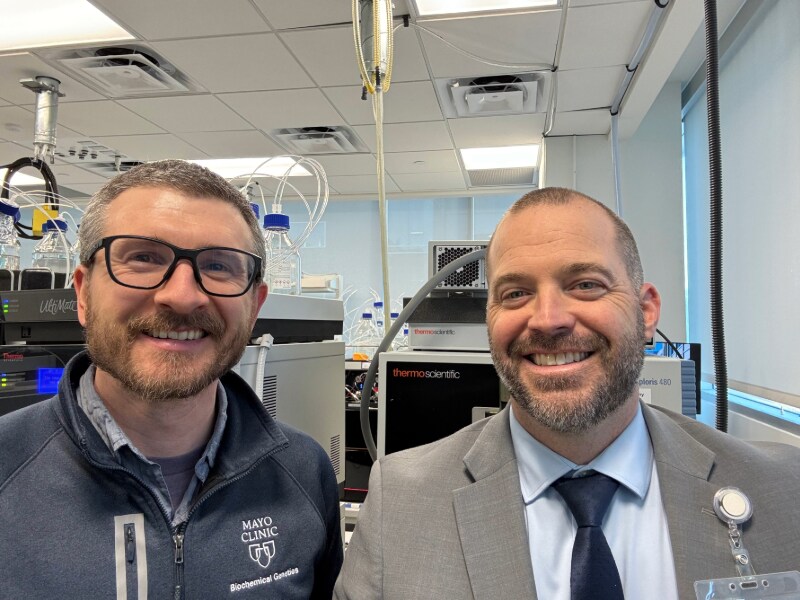
To overcome these challenges, the Mayo team (pictured above) explored targeted validation on the Stellar MS. Stellar displayed an increase in sensitivity while achieving a fast cycle time, allowing for more points across the peak and increased reproducibility. Several peptides suffered from interfering signal. For these targets, the team explored MS³ (multi-stage fragmentation). By introducing an additional fragmentation and isolation stage, MS³ effectively reduces background interference, producing cleaner spectra and allowing for lower limits of detection.
In Vanderboom’s words:
“You can see there’s quite a bit of noise in the background, but if you look at that same peptide when we acquired it with MS³, it just cleans up the background. It’s almost like high resolution.”
The result? Peptides that were previously undetectable became measurable, enabling discrimination between ALS cases and controls with improved confidence and reproducibility.
From discovery to clinical potential
EVs are a promising new source of biomarkers, but several challenges have limited progress. By leveraging the Obitrap Astral for deep, unbiased discovery using fast DIA with narrow isolation windows, the team identified nearly 6,000 proteins from small EVs in CSF, an unprecedented level of coverage. This expansion in detectable proteome depth represents a critical step toward finding reliable biomarkers that can distinguish ALS from similar neurological conditions.
Although state of the art discovery workflows allow for unprecedented depth, confirming targets identified on this platform can be difficult. This is where Stellar comes in. The ability to run highly multiplexed assays with extreme sensitivity, fast LC gradients, and MS³-enabled selectivity allows investigators to fully capitalize on even the most challenging candidate biomarkers.
Conclusion
The incorporation of MS³ workflows on Stellar marks a pivotal evolution in targeted proteomics. As Dr. Vanderboom’s work demonstrates, increasing selectivity while maintaining extreme sensitivity doesn’t just enhance data — it opens new analytical frontiers for diseases where early detection is vital. By combining robust EV isolation with advanced MS³ enabled methods, researchers are now poised to illuminate the molecular signatures of neurodegeneration with unprecedented clarity.
Watch the full workshop recording: Extracellular Vesicle Biomarkers for Neurodegenerative Disease
Resources
- Related blogs in this series → Accelerating Biomarker Discovery and Validation: From Discovery to Clinical Utility – AnalyteGuru
- Other on-demand webinars featuring Stellar → Next-generation workflows for small molecule quantitation using the Thermo Scientific Stellar mass spectrometer
- Promotions → Mass Spectrometer Affordability Programs | Thermo Fisher Scientific – US
- Follow along MSACL 2025 for more information on Thermo Fisher Scientific participation in MSACL 2026
- Interested in speaking opportunities at future events? Contact Ema Ruzic
Visit us on LinkedIn: #Stellar #MayoClinic #Biomarkers #MassSpectrometry
Thermo Fisher Scientific at the 75th APHL Annual Conference
Advancing public health through innovation Thermo Fisher Sci...
Read More
When Resolution Changes the Story: Single Quadrupole vs. HRAM GC-MS
In analytical chemistry, there are moments when your instrum...
Read More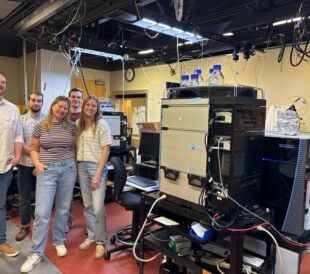
What Happens When Glycoproteomics Meets Real-Time LC-MS Decision Making?
Advancing Glycoproteomics with Flexible LC-MS at the Univers...
Read More
Join Thermo Fisher Scientific at ASCLD 2026
The forensic science landscape is evolving rapidly—and sta...
Read More