Tasty beer starts with knowing what’s in your hops. Explore how online SPE makes bitter acid analysis in hops faster and more reliable.

How can you detect bitter acid profiles quickly, reliably, and more sustainably?
For craft brewers and beer lovers alike, a refreshing experience is all about flavor.
So how can you achieve the desired bitterness in your beer? The answer is not just about the recipe. Finding the right flavor profile starts with the bitter acids present in the starting hops material.
Hops (the heart of your favorite beer) are the source of the brew’s distinctive flavor tied to bitterness and aroma.
At the molecular level, bitterness is driven by α- and β-bitter acids, like humulones and lupulones, whose concentrations determine the final sensory profile of the beer (Figure 1).
Accurately characterizing these compounds in each batch allows brewers to unlock the full potential of every variety of hops.
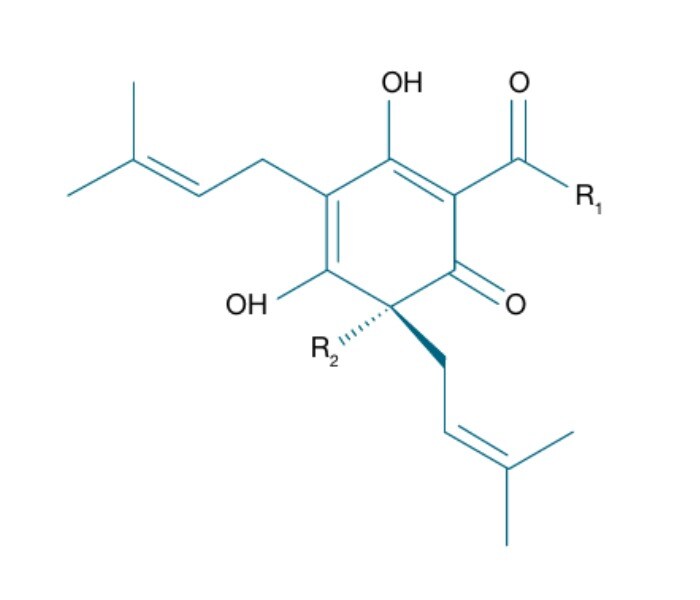
Figure 1. General chemical structure of hop bitter acids.
While conventional analytical methods rely on long, manual sample preparation steps and hazardous solvents, laboratories now strive for greener and more efficient workflows.
And moving from manual to online sample preparation is one of the easiest ways your lab can reduce waste and — most importantly — improve reliability with automation.
Key takeaways
- Online SPE reduces hands-on work, shortens turnaround time, and supports more sustainable methods by cutting solvent use and eliminating single-use cartridges.
- Automated UHPLC workflows are easier for new users to execute, offering more reproducible quantifications of α- and β-bitter acids in hops.
- Accurate bitter acid profiles help brewers distinguish hop varieties and control flavor with confidence.
Comparing offline vs. online solid phase extraction for bitter acid HPLC analysis
If you’ve spent long hours in the lab preparing samples for hops analysis, you’re not alone.
Manual sample preparation often takes the most time in hops analysis, an area where online solid phase extraction (SPE) can make a real difference. Here’s why.
Manual SPE has a lot of manual steps. Extraction. Cartridge loading. Washing. Elution. And sometimes solvent exchange or reduction. All before your actual analysis begins. This labor-intensive workflow can take up to an hour and depends strongly on operator skillsets, making reproducibility a challenge for new hires.
Online SPE analysis provides key benefits like:
- Hands-off workflow free of cartridges, manifolds, or vacuum steps.
- Column washing and re-equilibration occur in parallel with separation.
- SPE step is complete in just two minutes.
- Minimizes operator-dependent variability.
- Uses less than 8 mL of solvent.
Let’s explore what this technique looks like in practice.
Online SPE for analyzing α- and β-bitter acids in hops standard solutions.
Changing your sample preparation from manual to automated isn’t complicated. With the right tools you can fully integrate online SPE with your UHPLC system (Figure 2).
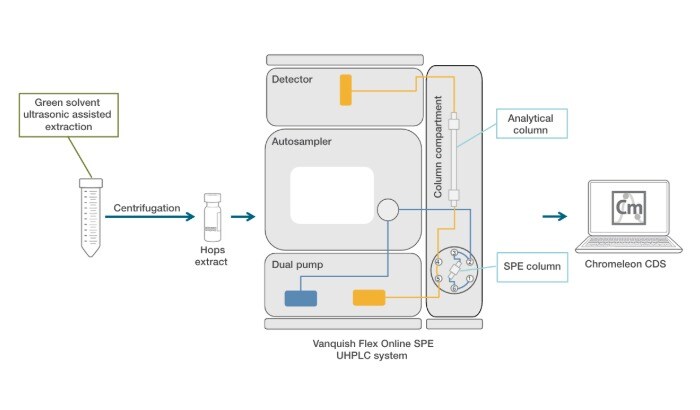
Figure 2. Schematic workflow for the determination of bitter acids in hops. The process involves clean up and instrumental analysis using the Thermo Scientific Vanquish Online SPE UHPLC System.
The process for analyzing a hops standard solution is straightforward:
- First, extract hop samples with ethanol (a greener alternative to toluene or diethyl ether in conventional methods).
- Inject the extract directly into your instrument for analysis. Bitter acids retain on the SPE column while matrix interferences that can comprise quantitation are removed.
- Next, backflush the SPE column to transfer the analytes to the analytical column for separation. While this separation is taking place, the SPE column is washed and re-equilibrated in parallel, keeping the total run time to 15 minutes, with the separation of all six major bitter acids in a single analysis (Figure 3).
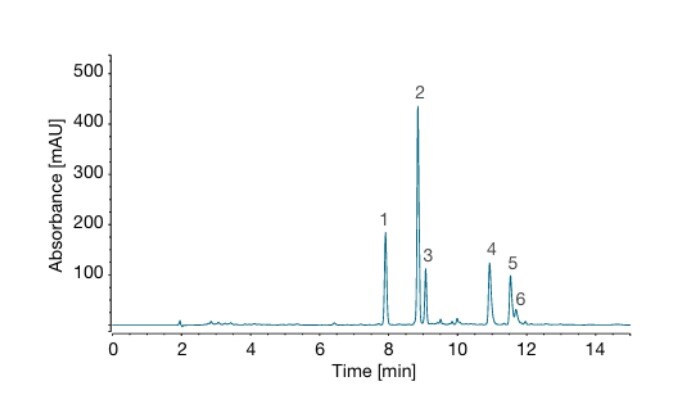
Figure 3. UV chromatogram of hop bitter acids in standard solution (1-cohumulone, 2-humulone, 3-adhumulone, 4-colupulone, 5-lupulone, 6-adlupulone).
Online SPE for analyzing α- and β-bitter acids in real hops samples
Analytical labs need methods that are accurate and reliable for brewers to develop distinct and reproducible flavor profiles across batches.
To assess the applicability of online SPE UHPLC methods for hops analysis, we analyzed bitter acid profiles from four species — Sultana, Barbe Rouge, Azacca, and Sabro.
The concentration of α-acids dominated all samples, while each hops species exhibited distinct profiles in terms of α-acid and β-acid content, making them suitable for different brewing strategies (Figure 4).
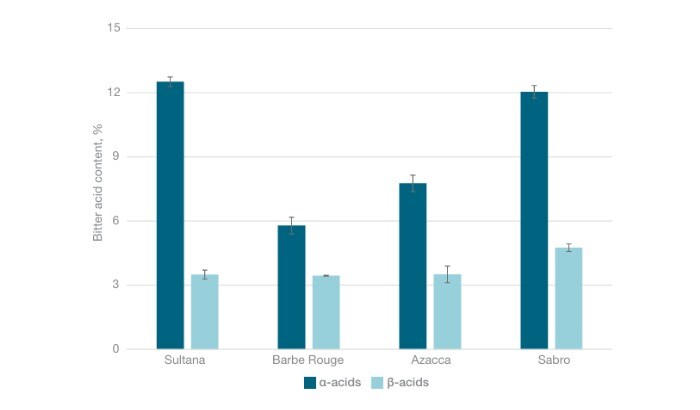
Figure 4. Bitter acid profiles in four different hop species, error bars display SD (n=6). To check method consistency, we measured each hops extract six times. Variation between measurements was low, with relative standard deviation below 3.5 % across all hops species.
- For testing labs, this process translates into a workflow that is easy to run, fast, and delivers reliable results without added complexity.
- For craft brewers, reliability means clear, trustworthy insights into hops bitter acid profiles, for better hop selection and more precise control of bitterness and flavor in your beer.
From carefully procured samples to tasty sips
Efficient UHPLC workflows support faster results, less solvent use, and reliable bitterness data for brewers. And online SPE turns those advantages into practical, day-to-day benefits for brewers and labs alike.
- Less hands-on skills required for lab analysts
- Faster results from labs to brewers
- A more sustainable way to work
- Clear insights into hops flavor
To learn more about the method and see the full application data, check out our application note today.
FAQs
Bitter acids, namely α-acids and β-acids, especially the six major bitter acids (humulones and lupulones) that define hop bitterness and are required for quality control and brewing decisions.
Classical C18 Silica columns are ideal for bitter acids separation. UHPLC compatible columns with particle size ≤ 2 µm boost analysis with higher flow rate, thus shorter analysis time and solvent consumption.
A typical workflow for hop analysis consists of three main steps: extraction of the target compounds, clean-up of co-extracted matrix components, and instrumental analysis by HPLC or UHPLC. To keep this workflow efficient and reproducible, you should minimize manual handling and add in automation when possible. Integrating online SPE into your LC instrument allows sample clean-up to run automatically, reducing hands-on time, solvent use, and variability while delivering faster, more reliable results.
Visit us on LinkedIn: #UHPLC #Automation
Modernizing Routine HPLC Methods: Aligning Productivity, Compliance, and Sustainability
Interested in HPLC method modernization and compliance? I an...
Read More
Behind the Bench: Tips to Simultaneously Analyze THC, Its Metabolites, and Other Drugs of Abuse Using LC-MS
Continuing the conversation on toxicology innovation In our ...
Read More
How to Get More Accurate HPLC Quantitation of Semi-Volatiles
Struggling to accurately measure semi-volatile analytes? Str...
Read More
Why You Need a Verification-Class Mass Spectrometer: Going Beyond 4d to Improve Analytical Performance for Targeted Quantitative Analysis
Part 4: Going beyond 4D to improve analytical performance fo...
Read More