Derivatizing amino acids doesn’t have to take hours to do. A more hands-off solution can save your lab hours of prep work. And help you trust your data even more.

Ever wonder what makes a simple molecule like valine so complicated to measure?
Amino acids—the building blocks of proteins—are everywhere. In your food. Body. And even the fertilizers that help grow our food. But measuring these compounds precisely? That’s a classic analytical headache, even for an experienced chromatographer.
Ask any lab scientist who’s done amino acid analysis, and they’ll tell you the chromatographic separation isn’t the hard part. The challenge is sample preparation, or everything before the chromatography. Handling toxic reagents. The repeated pipetting. And then timing the derivatization reactions just right.
All these manual steps can contribute to lower method precision and data reproducibility.
So, what’s the solution? Using a more hands-off approach. You get the same trusted chemical reaction, but your method is now faster, cleaner, and more reliable.
Let’s walk through a real-life example of how your lab can derivatize amino acids directly inside the HPLC autosampler needle.
Key takeaways
- Manual derivatization of amino acids is laborious, error-prone, and handling toxic chemicals can pose health hazards to lab staff.
- Automated in-needle OPA/FMOC derivatization of amino acids is a time- and labor-saving approach for HPLC-FLD analysis.
- Reliable method performance, column stability over several hundred injections, and using inexpensive reagents facilitates high sample throughput at low costs per sample for routine laboratories.
- Sample matrices of medium and high complexity (beverages, food, fertilizers) using in-needle derivatization is robust and reproducible.

Illustration showing manual derivatization versus in-needle derivatization.
Why does the derivatisation of amino acids still matter when aerosol detectors are an option? The unmatched sensitivity of fluorescence detection compared to evaporative technology.
Most amino acids don’t have double bonds that naturally absorb UV light, meaning your HPLC detector can’t “see” the compounds directly.
To solve these visibility issues, chemists use derivatization. The conjugation reaction is brilliant chemistry, facilitating the formation of fluorescent derivatives suitable for sensitive and precise analysis.
This technique involves reacting amino acids in the solution for analysis with reagents that make the amino acids fluorescent. The most common pair are OPA (ortho-phthaldialdehyde) for primary amino acids and FMOC-Cl (9-fluorenylmethyloxycarbonyl chloride) for secondary ones.
Now here’s what can go wrong. You measure reagents, mix samples by hand, wait for the reaction, then inject onto your HPLC instrument. Small inconsistencies, such as a few seconds too long or a reagent variation, can mean BIG differences in peak response, method accuracy, and data reproducibility. Removing these inconsistencies is where automated in-needle derivatization comes in.
Let your HPLC autosampler needle handle the not-so-friendly laborious tasks
Switching from manual to automated in-needle derivatization can help make this labor-intensive process easier for everyone in your lab, while improving data consistency and overall lab safety.
Here’s how:
- Instead of manually preparing reaction mixtures, you can use a compatible instrument, like Thermo Scientific Vanquish LC Systems, to perform in-needle derivatization.
- And, with the helpful guidance of supporting software, you can automatically mix samples and reagents in the needle, time the reaction more precisely, and inject the derivatized sample onto the column.

In-needle derivatization of primary and secondary AAs with OPA/MPA and FMOC-Cl reagents for subsequent LC analysis of the fluorescent derivatives. *Borate buffer pH 10, **acetic acid for quenching.
A real-life example showcasing better efficiency, robustness, and throughput capabilities.
What makes this automated workflow stand out isn’t a new reaction—but rather a faster way of working with your HPLC instrument.
The reactions between OPA/MPA and FMOC-Cl still happen as before, but now the reaction is controlled digitally through Thermo Scientific Chromeleon Chromatography Data System (CDS).
As demonstrated in our whitepaper, each reagent draw, mix, and injection step is defined in a Custom Injection Program (CIP), eliminating timing errors and variability. Chromeleon CDS visualizes every step in its Instrument Method Editor, tracks parameters in real time, and logs events in the Audit Trail for compliance.
And since the workflow design has flexibility in mind, you can use Chromeleon CDS or a third-party software, with identical parameters, which gives your labs the freedom to work within your preferred environment without retraining staff or rewriting SOPs.
Trusting your data and a faster derivatization technique. That’s the science behind putting your sample preparation inside the needle.
The most beneficial part of this workflow is the hours of time your lab and broader QC team will save.
- Consistent fluorescence response and accurate quantitation for all amino acids
- Excellent injection-to-injection reproducibility, even across reagent batches
- Improved safety through reduced manual solvent handling
- Less hands-on time, freeing analysts for higher-value work
- Seamless CDS integration for full audit traceability
So next time you’re pipetting derivatization reagents by hand, secretly wishing there was a better way, why not consider an automated method approach?
You get the same chemistry, performed automatically inside the autosampler, hands-free, ready to inject in minutes with reproducible data that you can trust.
Learn more about this new automated amino acid analytical workflow in our customer application note today.

Chromatographic results of calibration standard (50 µM) measured with the Vanquish Core HPLC system, comparing method performance on 1st and 14th day of measurements.
Helpful tips to improve method robustness with Vanquish LC Systems+ Chromeleon CDS
1. Use a 100 µL sample loop for thorough and reproducible mixing of the sample and reagents during the derivatization step.
2. Install a passive pre-heater to facilitate proper dilution of the reagents before the column.
3. Use guard cartridges for your columns and replace the cartridges when column performance diminishes. Apply smart tools like intelligent run control in Chromeleon CDS for automated checks.
4. Replace derivatization reagents in your autosampler daily.
5. Periodically flush your column with 100% acetonitrile for 30 minutes to remove persistent reaction products and matrices.
Visit us on LinkedIn: #AutomatedSamplePreparation #HPLC
Elevate Your HPLC Performance with a Modern CDS
You may have the best HPLC system on the market, but to maxi...
Read More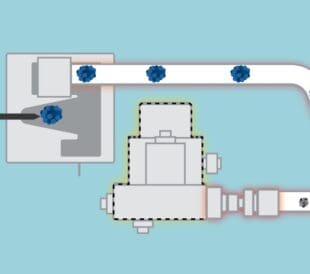
Episode 4: Introducing a More Confident Era in HPLC-CAD Analysis
The first Charged Aerosol Detector (launched in 2005) set ne...
Read More
How to Get More Accurate HPLC Quantitation of Semi-Volatiles
Struggling to accurately measure semi-volatile analytes? Str...
Read More
A Greener HPLC Guide: How ACT Labels Help Promote Lab Sustainability
Labs use up to 10 times more energy than offices. Here’s h...
Read More