Hearing loss and middle-ear anatomy
Hearing loss is a serious problem that affects all category ages worldwide1. It is estimated that by 2050, more than 700 million people will suffer from hearing impairment due to age-related deterioration. Studies of the middle ear, which contains three tiny bones called the malleus, incus, and stapes, are particularly complex due to the small size of this structure. It is also a significant challenge to conduct studies on sound transmission within this part of the ear. Understanding the intricate biomechanics of these ossicles and their role in hearing will be crucial for the development of effective treatments and interventions for hearing loss in the future.
To better understand middle-ear structures, researchers used synchrotron-based X-ray imaging to visualize the human ear as it was acoustically stimulated.2 Combined with Amira Software, this approach was able to produce 3D structures of the human eardrum and ossicular chains in motion, providing a 4D visualization of the ear over time. This approach revealed how these structures move and behave dynamically during sound stimulation.
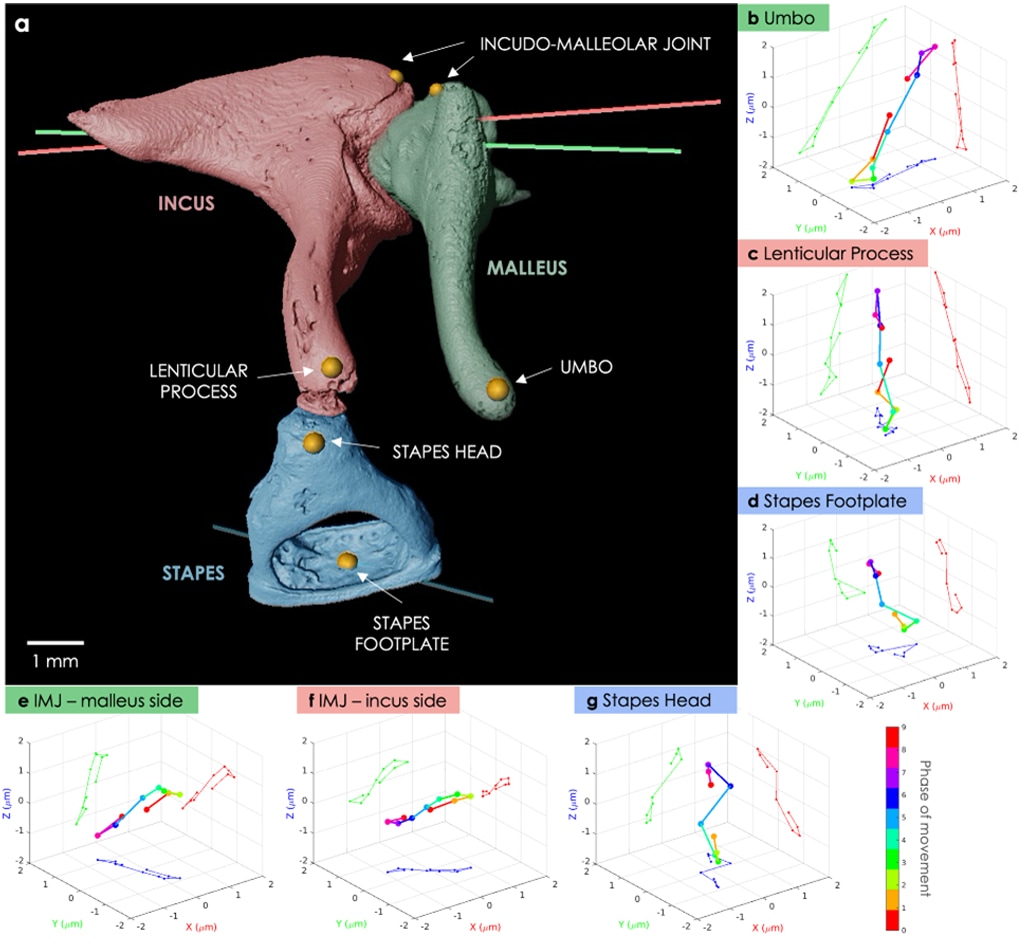
The analysis showed that most displacements followed a sinusoidal pattern along a single axis. However, the stapes exhibited a unique figure-eight periodic movement, indicating minor lateral shifts in addition to the expected unidirectional oscillation.
X-ray imaging of middle-ear structures
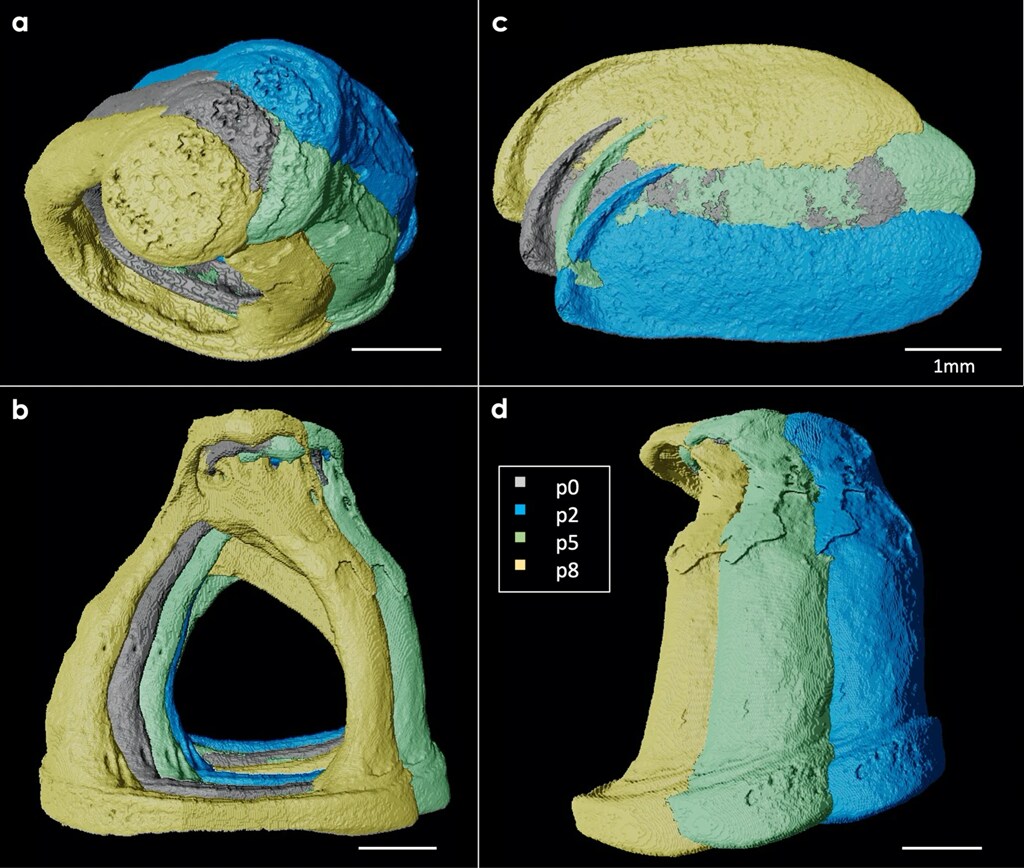
Amira Software was used to register five sub-scans that captured the ossicular chain and tympanic membrane. The combined image was subsequently processed for segmentation, isolating the stapes, incus, malleus, and tympanic membrane. This segmentation was crucial for accurately identifying and analyzing the movements of each ossicle separately. As shown below, the 3D structure of the stapes motions was analyzed at 4 different phases of the movement (labeled p0, p2, p5, and p8); p0 and p5 almost overlap, whereas p2 and p8 represent the two extreme positions of the motion.
This pipeline offers a thorough and accurate approach for examining the complex motions of the ossicular chain, improving our knowledge of middle ear structures and thereby facilitating future research endeavors.
References
- World report on hearing. World Health Organization (2021). ISBN:978-92-4-002048-1
- Schmeltz, M, et al. The human middle ear in motion: 3D visualization and quantification using dynamic synchrotron-based X-ray imaging. Commun Biol 7:157 (2024). doi: 10.1038/s42003-023-05738-6
Learn more at thermofisher.com/amira
Interested in discussing your image analysis challenges? Our experts are here to help whenever you’re ready.
Leave a Reply