Clinical challenges of esophageal cancer diagnosis
Esophageal cancer is a challenging and dangerous disease, accounting for 5.5% of cancer-related deaths while only making up 3.1% of new cases, according to 2020 GLOBOCAN estimates. Its relative lethality is a result of multiple factors including its difficult diagnosis and rapid progression, resulting in only a 15–25% 5-year survival rate. Determining the extent of tumor growth (or T-stage) is a critical part of accurate diagnosis and treatment, but this information can be challenging to obtain for esophageal cancer, particularly at early stages.
Computed tomography angiography
Clinically, doctors utilize a number of complex methods for tumor-stage determination, including computed tomography angiography (CTA). This procedure combines a typical CT scan with the injection of a dyeing agent that provides blood vessel and tissue contrast. While the procedure can be highly accurate for late-stage esophageal tumors, it struggles to accurately identify early tumors while also being invasive and cost-prohibitive. This leaves room for improved methods that can more accurately categorize these tumors earlier, enabling improved treatment.
The increased prevalence of powerful 3D reconstruction software has provided a new avenue for tumor analysis. These tools can perform a range of data post-processing and segmentation to not only identify tissue structures more accurately, but also to analyze the resulting reconstructions for trends and identifying characteristics.
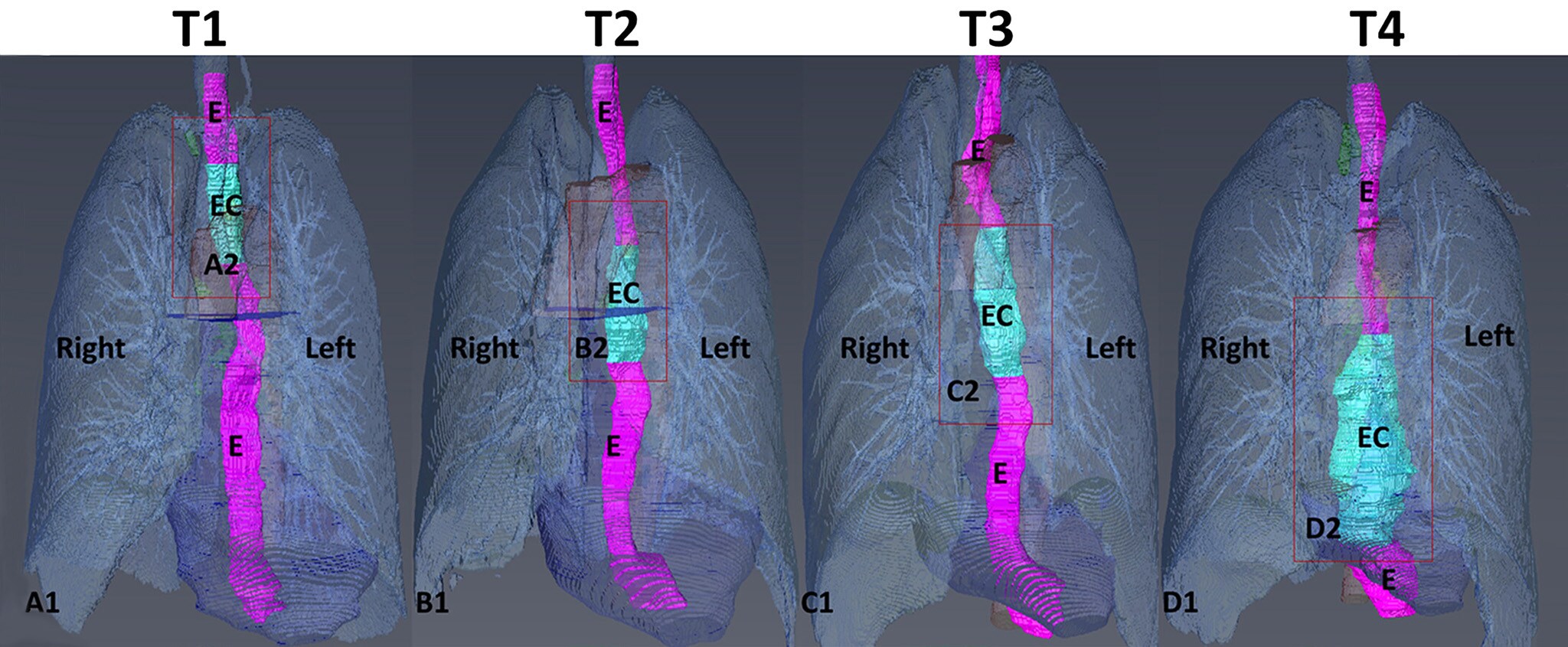
Esophageal tumor progression at different T-stages, reconstructed with Amira Software. Figure reproduced in part from Wang et al. under CC BY 4.0.
Tumor volume correlates with esophageal cancer progression
Researchers at the Army Medical University (Chongqing, China) and Shanxi Medical University have recently utilized Thermo Scientific™ Amira™ Software to analyze a wide range of pre-operative CTA data in order to find structural trends that could assist in the diagnosis of esophageal tumor growth. Data was collected from 155 patients with esophageal cancer at various T-stages, from T1 to T4. Utilizing the data segmentation and reconstruction capabilities of Amira Software, they were able to find strong correlation between tumor volume and T-stage. Additionally, the lengths of the major and minor axis of the tumor were also found to correlate with T-stage. Their results provide three critical properties that can be used to assist in the clinical determination of T-stage.
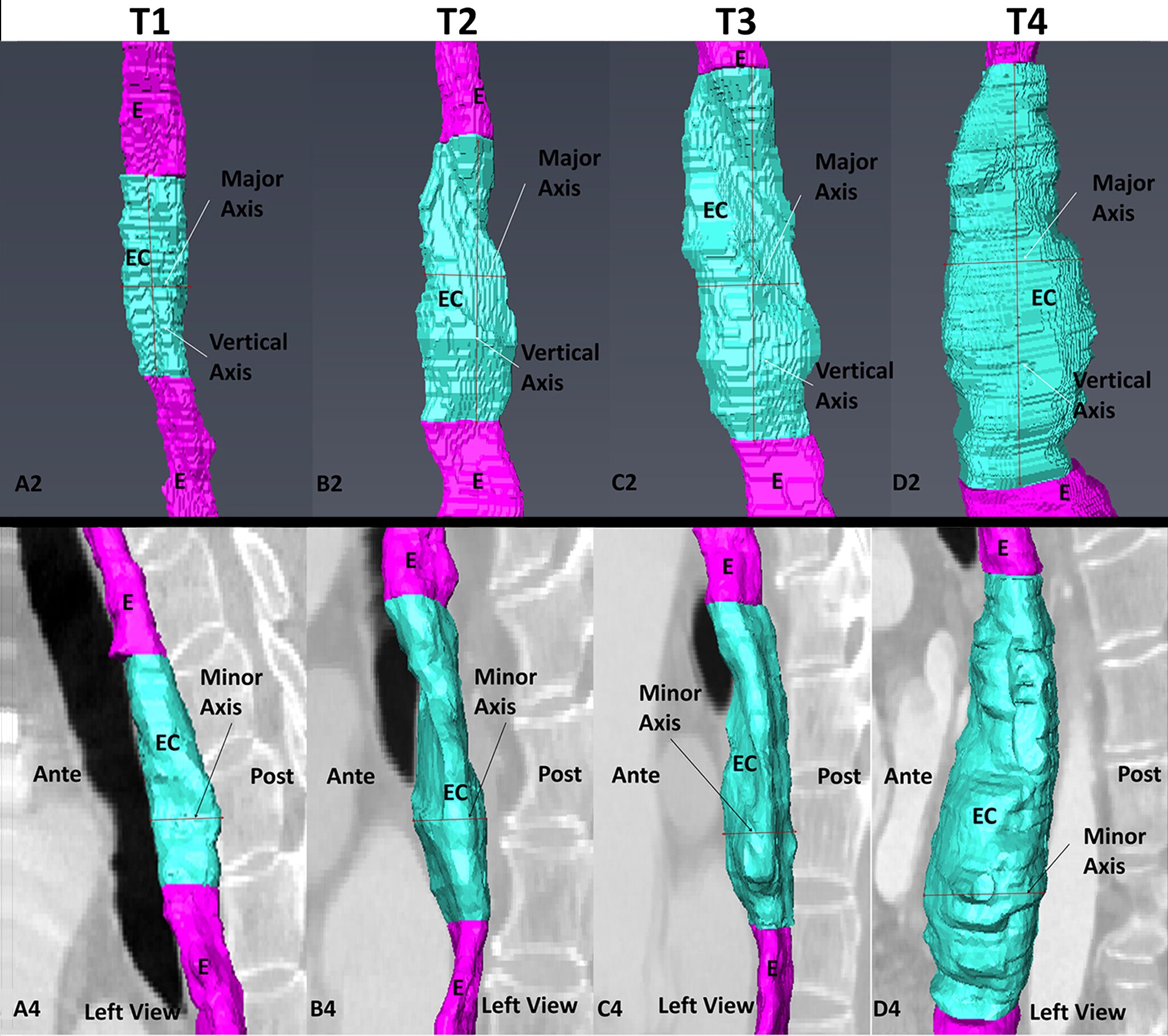
Major and minor axes of esophageal tumors at different T-stages, reconstructed with Amira Software. Figure reproduced in part from Wang et al. under CC BY 4.0.
This study highlights the impact that advanced segmentation and 3D reconstruction can have on high-resolution imaging data. As we collect more and more information with advanced tools and techniques, it only becomes ever more important that we find ways to analyze and interpret that wealth of data. Versatile tools like Amira Software, with integrated automation and AI capabilities, allow you to extract critical details from your observations, leading to valuable insights that can shape clinical procedures and ultimately improve the lives of patients.
Learn more about Amira Software and the benefits of 3D reconstruction for pre-clinical research >>

Advances in high-resolution cryo-EM at 100 kV
100 kV cryo-TEM enables high-resolution single particle anal... Alex Ilitchev, PhD
Read More
3D Tissue Histology with Light-Sheet Microscopy Enables Nondestructive Analysis of Microglia
3D tissue analysis offers critical benefits for neuroscience...
Read More
Fragment based drug discovery meets challenging drug targets with high-throughput cryo-EM
Benefits of FBDD in the search for novel therapeutics Frag...
Read More
Targeted protein degradation as a novel therapeutic approach for undruggable diseases
Induced proximity for targeted protein degradation In 1993, ...
Read More
Leave a Reply