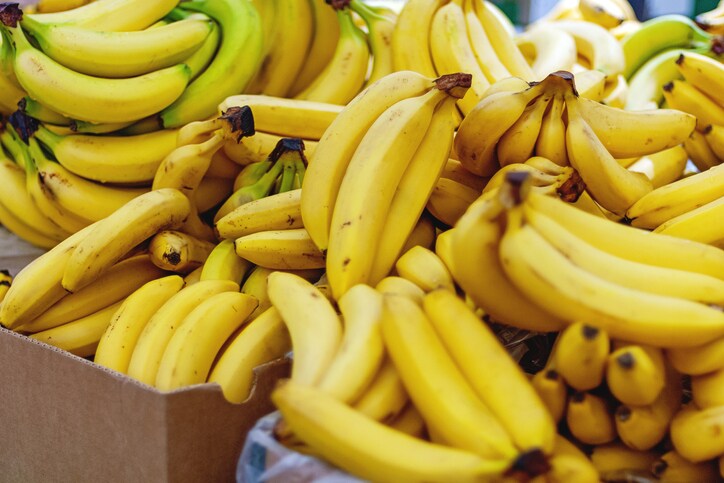
 The largest seizure of cocaine in Turkish history happened this year at a port in the southern part of the country. Over a ton of the drug was seized by agents of Turkish Customs who were working for the ministry and the local police department in Mersin.
Acting on a tip, the cocaine was discovered in a container of bananas aboard a ship arriving from Ecuador. Authorities displayed the cocaine, in 1,000 packages, to the press. The amount is the largest since authorities confiscated 800 kilograms of cocaine aboard a vessel at a port in northwestern Kocaeli province in 2018. Last year, 540 kilograms of cocaine were also seized at the same port, both arriving from South American countries.
To help find cocaine and the many more drugs entering and passing through Turkey to other destinations, law enforcement officials utilize handheld integrated Raman and FTIR spectroscopy instruments, capable of identifying more than 14,500 individual substances, solids and liquids from narcotics to explosives and chemical warfare agents to industrial chemicals and precursors. Utilizing these handheld material identification devices, agents are quickly able to successfully identify – within minutes – unknown substances including mixtures of up to four components.
The Raman technology enables a user to conduct non-contact and non-destructive analysis of samples in transparent and translucent containers without the need to open them and manipulate each sample, thus increasing user safety. Conversely, although FTIR requires direct contact analysis, it is more efficient and safer when identifying dark-colored substances such as black tar heroin. It also has fewer chemical limitations and performs better on substances that suffer from very high levels of fluorescence, which sometimes obscures Raman spectra. Both technologies thus complement each other as well as confirm results obtained by each other.
These analyzers are certainly helping Turkish law enforcement peel back the curtain of hidden illicit drugs. Turkey is a transit route in drug smuggling between Asia and Europe. The nation fights a constant battle against the proliferating illicit drug trade in the country. South America is the primary source of cocaine and similar drugs smuggled into Turkey, for both domestic use and as a transit point for smuggling to Asian countries. In 2020, counter-narcotics police conducted 140,000 operations and seized 20 tons of marijuana, 11 tons of heroin and 800 kilograms of cocaine. Customs officers at the borders and ports of the country seized 9.7 tons of drugs last year.
Slowing the flow of the drug trade requires an intimate knowledge of why certain drugs are favored in specific areas, and better tools for detection and analysis at these points. Now you can see why Turkish Customs currently possesses a bunch of these chemical analysis units (actually a fleet of 30 at their most recent count) positioned at different border gates. For more details about Turkey’s campaign against drugs entering their borders, read the case study Turkey at the Crossroads; Targeting illicit drug traffic.
- Case Study: Turkey at the Crossroads; Targeting illicit drug traffic
- Online information: Threat Identification for Customs and Border

How Arkansas Combats the Opioid Crisis with Advanced Raman Technology
The ongoing opioid crisis poses a significant challenge for ... Christopher Orf
Read More
Nitazenes: An Emerging Threat to Law Enforcement
The opioid crisis in the United States continues to evolve, ... Greg Giuntini
Read More
Presumptive Field-Testing During Narcotics Investigations
Presumptive field-testing refers to the initial testing of a... Sue Woods
Read More
Was that Fireworks or an Explosion?
Last year, there was an estimated crowd of 250,000 people wh...
Read More


Thank You for Sharing this informative article! It is very useful to everyone Stay healthy and keep safe!