 Nuclear Magnetic Resonance (NMR) spectroscopy is a crucial technique for extracting useful chemical information. The applications of NMR are vast from elucidating the structure of a newly synthesized compound to reaction monitoring to verification studies in manufacturing QA/QC laboratories. Since the introduction of the first commercial available spectrometer in 1953, NMR spectroscopy has developed very rapidly and continues to evolve. The most recent evolution of NMR has been the resurgence of low field (<100 MHz) NMR spectrometers due to advances in magnetic materials, improvements in radio frequency electronics and innovative hardware design. The technological advances that have brought about the resurgence of low field NMR also provide data with surprisingly good chemical shift resolution.
What is an example of where benchtop NMR spectroscopy can help tackle issues in your laboratory? Answer – the quick quantification of ethylene oxide (EO) content in polyols. First, what are polyols? The word “polyol” refers to chemical compounds containing multiple hydroxyl groups. Polyols are based on alkene oxides, generally ethylene oxide (EO) and propylene oxide (PO); polyols are used as the starting materials for the production of polyurethanes (PU). The EO content of polyols dictates the characteristics of the final polyurethane products. A few examples of consumer products that contain polyols are rain boots, liquid nails, and bowling balls.
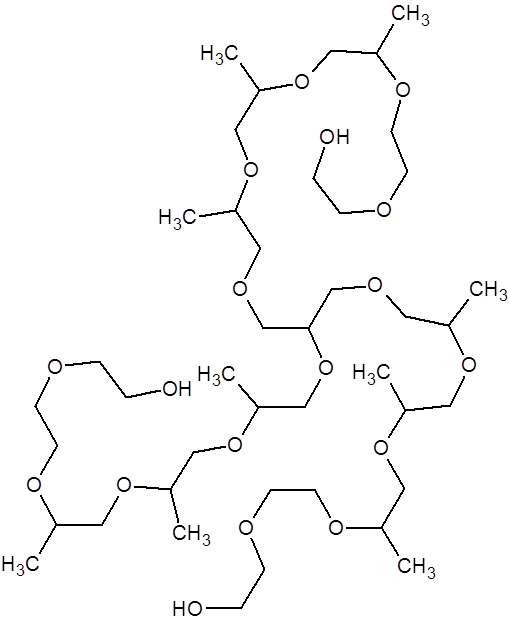 Due to the importance of understanding the composition of polyols, numerous analytical techniques have been used to elucidate the structures of polyols including gas chromatography (GC), near infrared (NIR) and NMR. NMR spectroscopy is an inherently quantitative technique, and due to the abundance of protons in the repeating structures of polyols, combined with the dispersion of signals, proton NMR spectroscopy is ideally suited for rapid characterization of EO content.
In addition, one of the recognized advantages of benchtop NMR spectrometers, including when one needs to determine EO content in polyols, is the simplicity of operation. The simplicity of operation facilitates the implementation of benchtop NMR spectrometers in laboratories outside the core high field NMR facility. Adopting benchtop NMR instrumentation decreases demand on high field instrumentation without compromising results thus improving efficiency.
Determining the weight percent EO in a polyol is a standard application for a NMR spectrometer. This particular standard NMR application does not necessitate the sensitivity nor chemical shift dispersion achieved using high field NMR instrumentation. The weight percent of EO in a polyol can be determined at low field using the ASTM standard test method (D4875). The proton NMR spectra of polyols exhibit two regions of peaks corresponding to the methyl protons of PO (δ 0.6-1.6 ppm) and methylene and methine protons of EO and PO (δ 2.8-4.0 ppm).
The EO content is calculated using the relative integration values of the PO methyl peaks and the EO and PO the methylene and methine peaks. This is a very simple calculation that provides crucial information about the nature of polyol sample.
We’ll be at the Small Molecule NMR Conference (SMASH) Sept. 20-23, 2015 in Baveno, Italy, if you would like to discuss in person the capabilities of Benchtop NMR… or you can ask your question in the comment field below.

Forensic Fractography for Critical Part Failures
How SEM, EBSD, and EDS uncover the microscopic origins of ae... Alice Scarpellini
Read More
Detecting Microscopic Contaminants on Aerospace Production Components
How advanced SEM, EDS, and ToF-SIMS techniques ensure cleanl...
Read More
FTIR in Specialty Gas Production: From Purity Verification to Process Insights
Introduction Specialty gases are essential to advanced manuf... Olivia Madamba
Read More
Lightweight Composite Materials for Aerospace Applications: Strength, Compliance, and Precision Analysis
How multi-scale materials characterization supports safer, l...
Read More
This equipment seems to be very useful in the routine analytical practices at the plant site lab., and EOPO COMPOSITIONS CAN BE ESTIMATED instantly rather as a turn-key operation. However the cost of the equipment and immediate availability are in question. Buy out options are requested and more info may be sent with literature to my email id given
Thank you for your interest in the Thermo Scientific picoSpin 80 NMR spectrometer. More information about the picoSpin 80 is available here: http://www.thermoscientific.com/content/dam/tfs/ATG/CAD/CAD%20Documents/Catalogs%20&%20Brochures/Molecular%20Spectroscopy/NMR/picoSpin%20Brochure_EN.pdf and http://www.thermoscientific.com/content/dam/tfs/ATG/CAD/CAD%20Documents/Catalogs%20&%20Brochures/Molecular%20Spectroscopy/NMR/picoSpin%2080%20Datasheet_EN.pdf. If you are interested in learning more about the pricing of the instrument, please visit http://www.thermoscientific.com to request more information.