In process analytical technology (PAT), few innovations have driven efficiency and control like Raman spectroscopy has. As industrial processes grow more complex and demand real-time insights, the architecture behind Raman analyzers for process monitoring has evolved. Today, the choice between modular multiplex Raman analysis and traditional multiplex designs defines how effectively you can monitor, adapt, and scale your process.
This article explores what these two architectures encompass and why the modular multiplex approach is quickly emerging as the smarter, more resilient path forward.
Understanding the basics: Traditional multiplex vs. modular multiplex Raman
The traditional multiplex approach
Raman systems with traditional multiplex or multi-channel setup use a single spectrometer to monitor multiple measurement points through a series of optical channels. Each channel connects to a probe via a fiber network, allowing one central unit to cycle through several process points via an optical switch
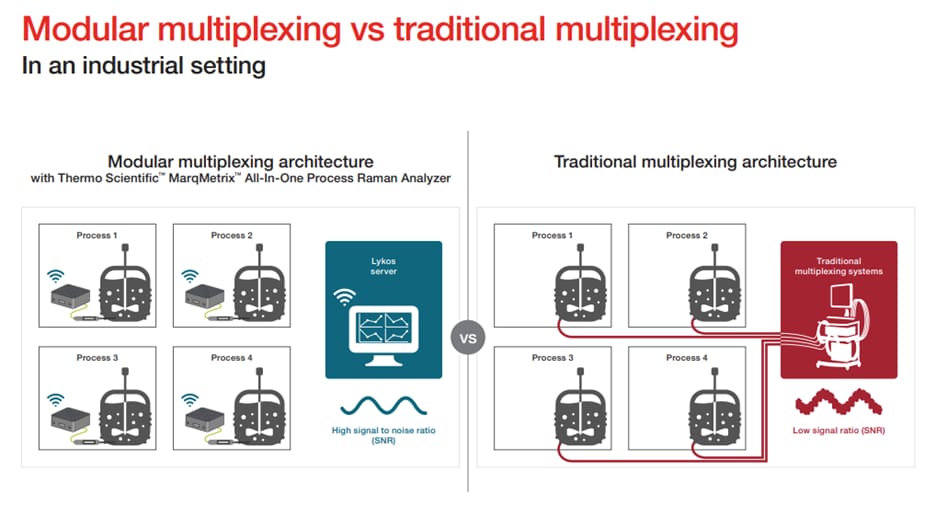
While this setup may seem efficient at first glance, it comes with significant trade-offs:
- Sequential data collection: Only one channel is measured at a time. This means the measurement is near-time rather than real-time.
- Shared dependency: All channels rely on one spectrometer. If the spectrometer fails, critical process monitoring and control stop at all measurement points.
- Downtime risk: This setup’s complex design, with multiple fiber cables running through a facility, may result in frequent breakdowns, increasing total downtime.
- Complex maintenance: Frequent calibration and servicing can be frequent and time-consuming, causing loss in critical process insight on even impacting production efficiency.
Beyond that, Raman systems with traditional multiplexing also require significant upfront investment and a higher operating budget. All of these caveats apply while delivering near-time data instead of real-time insight.
The modular multiplex approach
Raman systems with a modular multiplex architecture, by contrast, use independent analyzers (each with its own spectrometer and laser) that work together to create a multiplex network. The systems measure all the measurement points simultaneously; however, they are connected via software to a single process control system, providing synchronous data at a central location.
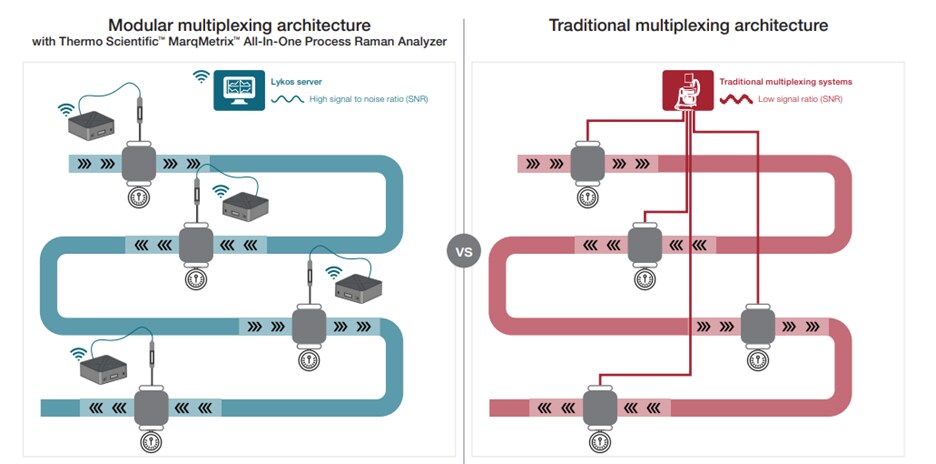
This modular multiplexing architecture offers significant advantages for modern process environments:
- True real-time data: Simultaneous measurement happens across all points.
- No single point of failure: If one analyzer is offline, others keep running.
- Scalability: The analyzer network can be easily expanded as your process grows.
- Reduced complexity: Shorter fiber runs, improved signal-to-noise ratio, and simpler installation are all possible.
- Easy maintenance: Modular maintenance allows quick swap-in servicing.
Why the modular multiplex approach is the way forward
1. Real-time process insights
Process control depends on timing. Traditional multiplex systems measure points one after another, introducing lag between readings. In fast-moving or dynamic processes, that delay can obscure critical events.
Modular multiplex architecture solves this by enabling parallel data collection. Every measurement point is analyzed in real time, providing a synchronized view of your process.
2. Maximum uptime and reliability
A traditional multiplex Raman system’s greatest weakness is its single point of failure. If the spectrometer or laser needs servicing, every connected channel goes offline. With a modular multiplex approach, each Raman analyzer operates independently. Maintenance on one unit doesn’t interrupt the rest, allowing continuous monitoring and significantly reducing unplanned downtime.
Moreover, due to multiplex systems’ complex design with numerous interconnected components, they are prone to frequent breakdowns and require costly, recurring maintenance. In contrast, Raman analyzers in a modular multiplex architecture feature a streamlined design with fewer components, making such a system more reliable, less prone to failure, and significantly easier and cheaper to maintain.
3. Flexibility for every process environment
In many process environments, space and infrastructure limit how easily you can run long fiber networks to connect multiple probes to a single analyzer. Raman analyzers in modular multiplex architecture are compact, allowing installation close to the process, thus providing better data quality (signal-to-noise ratio) and simplifying deployment.
And as the process expands, analyzers can be added to the network seamlessly without the need for re-engineering, long fiber runs, or costly recalibration.
4. Lower cost of ownership
While a modular multiplex setup may involve multiple analyzers, their lower manufacturing complexity results in a cheaper acquisition cost, even when deploying an equivalent number of systems to match the channels of a traditional multiplex Raman system. The simplified design delivers a further lower total cost of ownership over time for several reasons:
- Each system requires less maintenance.
- Downtime is localized and infrequent.
- Quick swap-in servicing keeps processes running.
- Modular growth makes scaling cost-efficient.
5. Seamless method transferability
Historically, a concern with multiple analyzers was maintaining consistency across instruments. Modern modular multiplex Raman analyzers now deliver seamless method transferability without the need for any hardware or method calibration, meaning analytical methods can be shared across systems without hardware recalibration. This ensures precision, repeatability, and reproducibility across the modular multiplex network. Further information on how a process Raman analyzer can support chemometric model transferability across instruments and processes is available here.
Conclusion
Traditional multiplex Raman systems served their purpose in the early stages of process monitoring, but their centralized, sequential design cannot meet modern industry’s need for speed, flexibility, and reliability.
Modular multiplex Raman systems represent the next generation of process monitoring, with a flexible architecture that centralizes data analytics.
Learn more about real-time analysis with Raman here.
FAQs
- What types of systems are good candidates for modular multiplex Raman analysis?
- Modular multiplex Raman analysis is ideal for situations that need sensitive, real-time chemical imaging, molecular characterization, or biological characterization. This includes in-line and real-time monitoring of critical process parameters in a field like pharmaceuticals that needs to monitor and control titer, cell densities, and nutrient concentrations. Companies who require verification of raw materials or perform environmental analyses to detect chemical contaminants, both of which may require rapid analysis over a number of sites in the lab or in the field, are good candidates for modular multiplex Raman analysis.
- Modular multiplex Raman analysis is ideal for situations that need sensitive, real-time chemical imaging, molecular characterization, or biological characterization. This includes in-line and real-time monitoring of critical process parameters in a field like pharmaceuticals that needs to monitor and control titer, cell densities, and nutrient concentrations. Companies who require verification of raw materials or perform environmental analyses to detect chemical contaminants, both of which may require rapid analysis over a number of sites in the lab or in the field, are good candidates for modular multiplex Raman analysis.
- What are some specific fields where modular multiplex Raman analysis can be helpful?
- A modular multiplex Raman analysis system, like the MarqMetrix All-In-One Process Raman Analyzer can be a part of, provides exceptional versatility, with uses as diverse as bioproduction, oil & gas production (including fuel refinement or carbon capture), industrial fermentation (such as that used in cultivated meat production), or polymers development.
- A modular multiplex Raman analysis system, like the MarqMetrix All-In-One Process Raman Analyzer can be a part of, provides exceptional versatility, with uses as diverse as bioproduction, oil & gas production (including fuel refinement or carbon capture), industrial fermentation (such as that used in cultivated meat production), or polymers development.
- How can a modular multiplex system be less expensive than a traditional multiplex Raman system?
- Modular components with wireless connectivity permit deployment of multiple units without necessitating expensive wiring setups. Modular growth makes scaling cost-efficient, avoiding the need to install an entire new system to handle a new analysis location. Also, the individual modules allow maintenance to be done on one module without affecting the others, permitting greater uptime for the overall system and thus minimizing operational losses caused by system downtime.

FTIR in Specialty Gas Production: From Purity Verification to Process Insights
Introduction Specialty gases are essential to advanced manuf... Olivia Madamba
Read More
Why Ultra-High-Purity Gas Analysis Outperforms Conventional Methods in Semiconductor Manufacturing
As semiconductor production reaches unprecedented levels of ... Daniel Merriman
Read More
How Parts-Per-Trillion Gas Analysis Protects Semiconductor Wafer Production
Ultra-high-purity gases are essential to semiconductor manuf... Daniel Merriman
Read More
Can Plastic Beads Cause Mardi Gras Misfortune? Investigating Toxic Metals and Materials
Plastic beads—an iconic part of Mardi Gras celebrations—... Marlene Gasdia-Cochrane, Editor
Read More
Leave a Reply