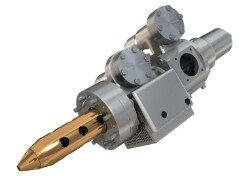
MAGCIS™ Dual Beam Ion Source for XPS Instruments
Multi-layered materials, especially those used for components in the biomedical and energy industries, are commonly composed of polymer-based materials. The surfaces of these materials must be analyzed to understand the interactions of the layers with each other and the environment. Commonly used techniques – such as an XPS system fitted with an ion gun that produces monatomic argon ions to remove material from the surface – has some drawbacks. Polymeric systems can be chemically modified by interaction with an ion beam, thus changing the chemistry and the spectra obtained during depth profiling. So, to allow depth profiling of the polymer-based systems, gas cluster ion sources have been developed.
Read the article to learn how a new monatomic and gas cluster ion source for XPS instruments uses both Ar+ and Arn+ (n>1000) gas cluster sputtering to clean surfaces and create depth profiles for a growing class of polymer-based advanced materials.

Enhancing aircraft engine performance
SEM analysis of René N5, a nickel-based superalloy for hig... Alice Scarpellini
Read More
Revolutionizing Aerospace and Defense with Electron Microscopy and Surface Analysis of Passivated Stainless Steel Landing Gear
The aerospace and defense industry is constantly evolving, d...
Read More
Advancing XPS Depth Profiling with the Hypulse Surface Analysis System
Expanding the capabilities of XPS surface analysis As materi... Tim Nunney
Read More
K 2025: Showcasing the Future of Sustainable, Smart, and Responsible Plastics Production
This week, more than 3,000 exhibitors and 177,000 visitors f... Keith Cornell Nimesh Khadka, PhD
Read More
Leave a Reply