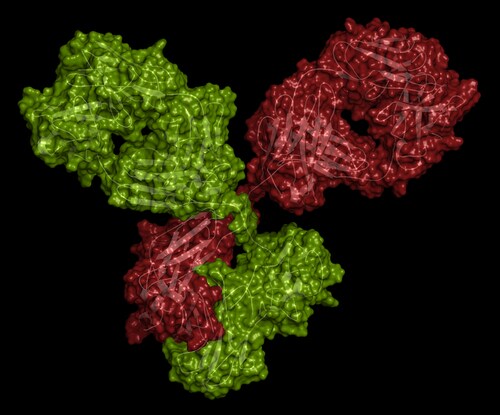
 Monoclonal antibody (mAb) therapies are growing exponentially, but they often get held up at the approval stage due to a lack of sequence information.
Using mass spectrometry (MS) in combination with protein crystallography, Bogdanoff et al. show how it is possible to determine the amino acid sequence, the glycosylation pattern and the structure of the antigen-binding fragment (Fab) of an mAb.1 This information can then be used to engineer a recombinant antibody single-chain variable fragment (scFv) that has the same specificity as the parent mAb.
Bogdanoff et al. looked at an mAb that is capable of neutralizing human astrovirus (HAstV), which is a leading cause of diarrhea in children and immunocompromised individuals. No vaccines or antiretrovirals currently exist for HAstV infections, but evidence suggests that antibodies produced by the adaptive immune response could be capable of being used as therapeutics to fight off the infection.
The team looked at mAb PL-2, which has previously been shown able to neutralize the HAstV serotype 2 (HAstV-2). The amino acid sequence of this antibody was initially unknown.
Unfortunately, the hybridoma cells that originally produced mAb PL-2 were no longer available. Using limited quantities of the antibody purified by Protein A affinity chromatography from mouse ascites, Bogdanoff et al. were able to crystallize and perform de novo sequencing by MS of the antigen-binding fragment of the mAb.
From the structural and sequence information, the team was able to “resurrect” the antibody by engineering a recombinant scFV that they found binds specifically to the HAstV-2 capsid protein.
The scientists obtained the majority of the amino acid sequence (approximately 90%) directly from the crystallographic structure, due to it being of such high resolution (1.9 Å). To obtain complete sequencing, the team then turned to de novo protein sequencing by MS.
The scientists used four different protease digestions and performed high-resolution tandem MS on 0.1 μg of the intact and 0.1 μg of the reduced Fab PL-2. It was loaded onto a ProSwift RP-4H monolithic column mounted on an EASY nLC-1000 nano ultra-high-performance liquid chromatograph coupled to a Thermo Scientific Orbitrap Fusion mass spectrometer.The proteomics search software Byonics was used for amino acid sequence determination. During this process some mass differences were noted, later found to be due to an unexpected N-linked glycosylation site on the heavy chain.
Using the combined MS and crystallography information, the team was able to deduce the remaining 10% of the amino acid sequence and determine the full Fab PL-2 sequence with no uncertainties.
Having the unambiguous Fab PL-2 heavy and light chain sequences allowed Bogdanoff et al. to engineer a recombinant antibody construct comprising a scFV of the PL-2 antibody, which was found to bind to the HAstV-2 capsid protein. The scVF construct is a fusion protein of the variable regions of the heavy and light chains, connected by a flexible 20 amino acid linker region.
The team hopes that its research will encourage other infectious disease researchers to embrace de novo protein sequencing in combination with crystallography. Advancements in de novo protein sequencing and recombinant antibody engineering means many more clinically useful mAbs can now be developed.
Reference
1. Bogdanoff, W.A., et al. (2016) “De novo sequencing and resurrection of a human astrovirus-neutralizing antibody,” ACS Infectious Diseases, 2(5) (pp. 313–321). doi: 10.1021/acsinfecdis.6b00026.
Post Author: Kathryn Loydall. Kathryn is a science and medical writer with a background in protein chemistry, biochemistry and applied biology. She enjoys making science accessible to a lay audience through writing, illustrations and media. Originally from the UK, she moved to Vancouver Island in 2008 to complete her PhD focussed on sepsis research and x-ray crystallography of monoclonal antibodies. In 2012, Kathryn left the lab behind to start freelancing as a science and medical writer and editor, and hasn’t looked back since.

Analysis of Ketosteroids by Girard P Derivatization
Dehydroepiandrosterone (DHEA); 4-androstene-3,17-dione (AD);...
Read More
Profiling Human Islet Cells with Laser Capture Microdissection
Composed mainly of β-cells, human islet cells secrete h...
Read More
Intact Proteins in Native Conditions with Quadrupole-Orbitrap Mass Spectrometry
Successful research focusing on antibody and drug interactio...
Read More
Autophagy Helps Control Endothelial Permeability
A research team in Glasgow has identified autophagy as a str...
Read More
Leave a Reply