Search
Bioss
PRLR Polyclonal Antibody
{{$productOrderCtrl.translations['antibody.pdp.commerceCard.promotion.promotions']}}
{{$productOrderCtrl.translations['antibody.pdp.commerceCard.promotion.viewpromo']}}
{{$productOrderCtrl.translations['antibody.pdp.commerceCard.promotion.promocode']}}: {{promo.promoCode}} {{promo.promoTitle}} {{promo.promoDescription}}. {{$productOrderCtrl.translations['antibody.pdp.commerceCard.promotion.learnmore']}}
Additional Information:
{{banner.description}}
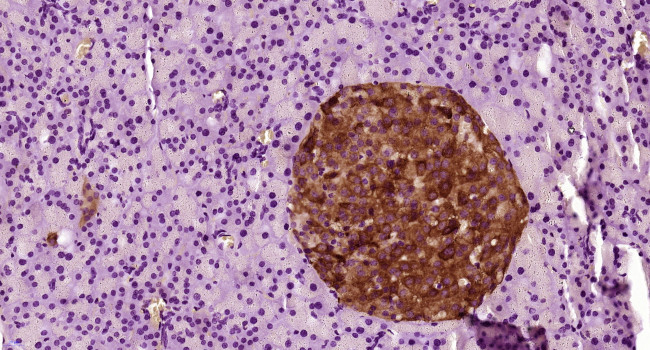
图: 1 / 3
PRLR Antibody (BS-6445R) in IHC (P)
Paraformaldehyde-fixed, paraffin embedded mouse pancreas; Antigen retrieval by boiling in sodium citrate buffer (pH6) for 15min; Block endogenous peroxidase by 3% hydrogen peroxide for 30 minutes; Blocking buffer (normal goat serum) at 37°C for 20min; Antibody incubation with PRLR Polyclonal Antibody (bs-6445R) at 1:400 overnight at 4°C, followed by a conjugated secondary and DAB staining.
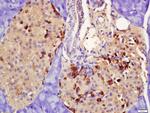
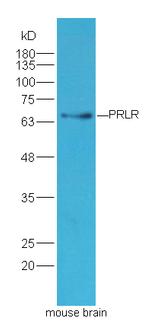
Please note: We are reviewing Western blot images included in the antibody testing data in our catalog, including those provided by third parties. Unless expressly labeled or annotated as “raw-unedited”, Western blot images included in the antibody testing data in our catalog may have been edited, optimized or otherwise adjusted for presentation.


产品信息
BS-6445R
应用
建议稀释比
已发表文章
产品规格
种属反应
Human,
Mouse,
Rat
宿主/亚型
Rabbit
/ IgG
分类
Polyclonal
类型
Antibody
抗原
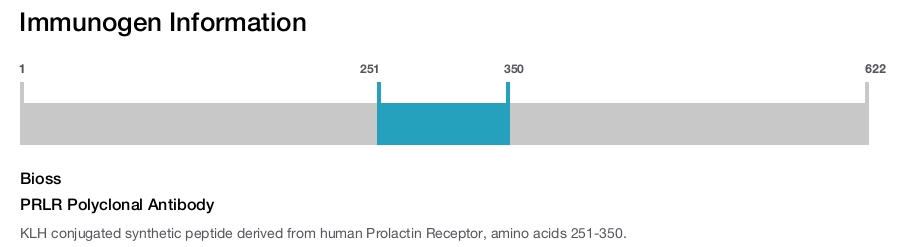
KLH conjugated synthetic peptide derived from human Prolactin Receptor, amino acids 251-350.
偶联物
Unconjugated
Unconjugated
Unconjugated
形式
Liquid
浓度
1 mg/mL
规格
100 µg
纯化类型
Protein A
保存液
0.01M TBS, pH 7.4, with 50% glycerol, 1% BSA
内含物
0.02% ProClin 300
保存条件
-20°C
运输条件
Ambient (domestic); Wet ice (international)
靶标信息
Prolactin (PRL) is a pituitary hormone involved in the stimulation of milk production, salt and water regulation, growth, development and reproduction. PRL exerts its influence on different cell types through a signal transduction pathway which begins with the binding of the hormone to a transmembrane PRL receptor. Immunoreactive PRL receptor (PRLR), a member of the cytokine receptor family, varies in size (short and long forms) with tissue source and species, from ~40 kDa to 100 kDa. PRLR consists of at least three separate domains: an extracellular region with 5 cysteines which contains the prolactin binding site, a single transmembrane domain and a cytoplasmic region, the length of which appears to influence ligand binding and regulate cellular function.
仅用于科研。不用于诊断过程。未经明确授权不得转售。
篇参考文献 (0)
您是否在文献中引用过该产品?请点击下方按钮邮件告知我们。
生物信息学
蛋白别名: cytokine receptor; cytokine receptor; PRLRSFA; cytokine receptor; PRLRSFB; delta-S1 PRLr; hPRL receptor; lactogen receptor; lactogen receptor precursor; Prl R; PRL-R; prolactin receptor; prolactin receptor precursor; prolactin receptor related sequence 1; pseudo-prolactin receptor precursor; secreted prolactin binding protein; unnamed protein product
基因别名: HPRL; hPRLrI; MFAB; Pr-1; Pr-3; Prlr-rs1; RATPRLR; RI-PRLR
UniProt ID: (Human) P16471, (Rat) P05710, (Mouse) Q08501
Entrez Gene ID: (Human) 5618, (Rat) 24684, (Mouse) 19116
activation of transmembrane receptor protein tyrosine kinase activity
JAK-STAT cascade
lactation
positive regulation of cell proliferation
response to bacterium
cytokine-mediated signaling pathway
regulation of cell adhesion
regulation of epithelial cell differentiation
positive regulation of B cell proliferation
positive regulation of protein autophosphorylation
prolactin signaling pathway
activation of Janus kinase activity
negative regulation of apoptotic process
mammary gland epithelial cell differentiation
prostate gland growth
mammary gland alveolus development
mammary gland epithelium development
cellular response to granulocyte macrophage colony-stimulating factor stimulus
positive regulation of cold-induced thermogenesis
steroid biosynthetic process
embryo implantation
Disclaimer

Clicking the images or links will redirect you to a website hosted by BenchSci that provides third-party scientific content. Neither the content nor the BenchSci technology and processes for selection have been evaluated by us; we are providing them as-is and without warranty of any kind, including for use or application of the Thermo Fisher Scientific products presented.

