Search
Invitrogen
RISC Polyclonal Antibody
{{$productOrderCtrl.translations['antibody.pdp.commerceCard.promotion.promotions']}}
{{$productOrderCtrl.translations['antibody.pdp.commerceCard.promotion.viewpromo']}}
{{$productOrderCtrl.translations['antibody.pdp.commerceCard.promotion.promocode']}}: {{promo.promoCode}} {{promo.promoTitle}} {{promo.promoDescription}}. {{$productOrderCtrl.translations['antibody.pdp.commerceCard.promotion.learnmore']}}
Additional Information:
{{banner.description}}
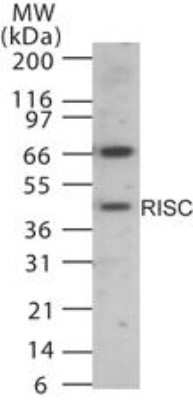
Please note: We are reviewing Western blot images included in the antibody testing data in our catalog, including those provided by third parties. Unless expressly labeled or annotated as “raw-unedited”, Western blot images included in the antibody testing data in our catalog may have been edited, optimized or otherwise adjusted for presentation.

产品信息
PA1-41233
产品规格
种属反应
Human,
Mouse,
Rat
宿主/亚型
Rabbit
/ IgG
分类
Polyclonal
类型
Antibody
抗原
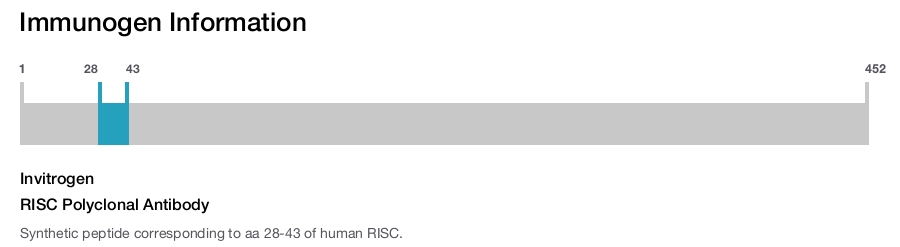
Synthetic peptide corresponding to aa 28-43 of human RISC.
偶联物
Unconjugated
Unconjugated
Unconjugated
形式
Liquid
浓度
0.5 mg/mL
规格
100 µg
纯化类型
Protein G
保存液
PBS
内含物
0.02% sodium azide
保存条件
Store at 4°C short term. For long term storage, store at -20°C, avoiding freeze/thaw cycles.
运输条件
Ambient (domestic); Wet ice (international)
RRID
产品详细信息
Suggested positive control: human heart tissue, human heart protein.
靶标信息
The RNA-induced silencing complex (RISC) is a key player in the regulation of gene expression through RNA interference (RNAi) mechanisms. It operates by utilizing small RNA molecules-such as microRNAs (miRNAs), small interfering RNAs (siRNAs), and PIWI-interacting RNAs (piRNAs)-which are processed from double-stranded RNA precursors by enzymes like Drosha and Dicer in animals, and DICER-LIKE in plants. RISC is a versatile molecular complex consisting of Argonaute proteins as its core component, which guides the complex to the target RNA by complementary base pairing. Once assembled, RISC can recruit other proteins that mediate gene silencing by degrading or inhibiting the translation of the target RNA. This post-transcriptional regulation system is integral to numerous biological processes, allowing cells to control gene expression finely and respond to endogenous and exogenous signals. The functionality of RISC in gene silencing highlights its significance in the broader context of genetic regulation and has implications in therapies that target gene expression through RNAi.
仅用于科研。不用于诊断过程。未经明确授权不得转售。
篇参考文献 (0)
您是否在文献中引用过该产品?请点击下方按钮邮件告知我们。
生物信息学
蛋白别名: retinoid-inducible serine caroboxypeptidase; retinoid-inducible serine caroboxypetidase; RISC; serine carboxypeptidase 1 precursor protein; serine caroboxypeptidase 1; unnamed protein product
基因别名: 2410018F01Rik; 4833411K15Rik; HSCP1; RISC
UniProt ID: (Human) Q9HB40, (Mouse) Q920A5, (Rat) Q920A6
Entrez Gene ID: (Human) 59342, (Mouse) 74617, (Rat) 114861
Disclaimer

Clicking the images or links will redirect you to a website hosted by BenchSci that provides third-party scientific content. Neither the content nor the BenchSci technology and processes for selection have been evaluated by us; we are providing them as-is and without warranty of any kind, including for use or application of the Thermo Fisher Scientific products presented.

