Search
Invitrogen
WNT1 Polyclonal Antibody
{{$productOrderCtrl.translations['antibody.pdp.commerceCard.promotion.promotions']}}
{{$productOrderCtrl.translations['antibody.pdp.commerceCard.promotion.promocode']}}: {{promo.promoCode}} {{promo.promoTitle}} {{promo.promoDescription}}. {{$productOrderCtrl.translations['antibody.pdp.commerceCard.promotion.learnmore']}}
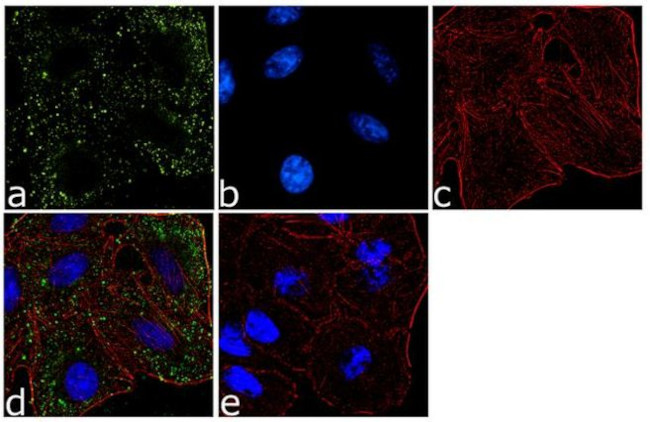
图: 1 / 2
WNT1 Antibody (720054) in ICC/IF
Immunofluorescence was performed on fixed and permeabilized MCF-7 cells for detection of WNT1 using Anti- WNT1 Rabbit Polyclonal Antibody (Product # 720054, 2 µg/mL) and labeled with Goat anti-Rabbit IgG (Heavy Chain) Superclonal™ Secondary Antibody, Alexa Fluor® 488 conjugate (Product # A27034, 1:2000). Panel a) shows representative cells that were stained for detection and localization of WNT1 protein (green), Panel b) is stained for nuclei (blue) using SlowFade® Gold Antifade Mountant with DAPI (Product # S36938). Panel c) represents cy... View More
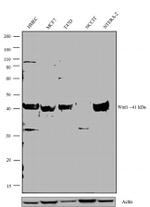
Please note: We are reviewing Western blot images included in the antibody testing data in our catalog, including those provided by third parties. Unless expressly labeled or annotated as “raw-unedited”, Western blot images included in the antibody testing data in our catalog may have been edited, optimized or otherwise adjusted for presentation.


产品信息
720054
产品规格
种属反应
Human
宿主/亚型
Rabbit
/ IgG
分类
Polyclonal
类型
Antibody
抗原
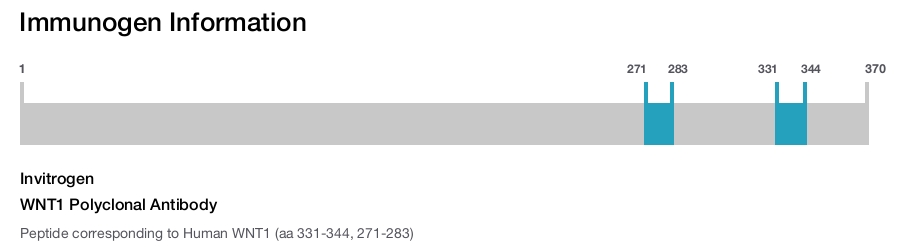
Peptide corresponding to Human WNT1 (aa 331-344, 271-283)
偶联物
Unconjugated
Unconjugated
Unconjugated
形式
Liquid
浓度
0.5 mg/mL
规格
100 µg
纯化类型
Affinity chromatography
保存液
PBS, pH 7.2-7.4, with 30% glycerol, 0.1% BSA
内含物
0.09% sodium azide
保存条件
Store at 4°C short term. For long term storage, store at -20°C, avoiding freeze/thaw cycles.
运输条件
Ambient (domestic); Wet ice (international)
RRID
产品详细信息
These Polyclonal antibodies are of rabbit origin developed by immunizing animals with proteins or peptides. The polyclonal antibody is purified by affinity purification from the rabbit sera generated after immunizing the rabbits with a specific type of protein or peptide. The purified antibody is tested for its functionality in various relevant research applications. The antibody is developed for Research Use Only and is non-hazardous or non-infectious in nature.
This antibody is predicted to react with Monkey, Mouse and Pig.
靶标信息
Wnt proteins constitute a family of secreted glyocoproteins that activate signal transduction pathways to mediate tissue homeostasis, cell fate, cell proliferation, and self-renewal. The canonical signaling pathway is initiated upon Wnt binding to a Frizzled family receptor and an LRP5/LRP6 coreceptor, which leads to activation of the beta-catenin cascade. Non-canonical Wnt signals are activated by binding to a Frizzled family receptor and ROR2 coreceptor. Extensive research has shown that deregulation of these pathways or its components can lead to cancer. Human Wnt-1 is encoded as a 370 amino acid precursor that, upon secretion, is cleaved into a 343 amino acid (42 kDa) mature form. At the amino acid level, mature human Wnt-1 is approximately 99% identical to mature mouse Wnt-1. Depending on the tissue, Wnt-1 can activate the canonical and non-canonical signaling pathways. Studies have demonstrated its involvement in a variety of functions, including embryonic development and carcinogenesis. Wnt-1 signaling can also induce the phosphorylation and subsequent degradation of c-Myb.
仅用于科研。不用于诊断过程。未经明确授权不得转售。
篇参考文献 (0)
您是否在文献中引用过该产品?请点击下方按钮邮件告知我们。
生物信息学
蛋白别名: proto-oncogene Int-1 homolog; wingless-type MMTV integration site family member 1; wingless-type MMTV integration site family, member 1 (oncogene INT1)
基因别名: BMND16; INT1; OI15
UniProt ID: (Human) P04628
Entrez Gene ID: (Human) 7471
embryonic axis specification
cell-cell signaling
positive regulation of cell proliferation
response to wounding
positive regulation of lamellipodium assembly
negative regulation of cell-substrate adhesion
Wnt signaling pathway
cerebellum development
central nervous system morphogenesis
cerebellum formation
neurogenesis
negative regulation of cell-cell adhesion
neuron differentiation
negative regulation of BMP signaling pathway
midbrain development
cell proliferation in midbrain
astrocyte-dopaminergic neuron signaling
signal transduction in response to DNA damage
negative regulation of apoptotic process
positive regulation of insulin-like growth factor receptor signaling pathway
cell fate commitment
negative regulation of cell differentiation
negative regulation of fat cell differentiation
positive regulation of Notch signaling pathway
positive regulation of transcription, DNA-templated
positive regulation of fibroblast proliferation
Spemann organizer formation
canonical Wnt signaling pathway
bone development
positive regulation of dermatome development
dopaminergic neuron differentiation
negative regulation of oxidative stress-induced neuron intrinsic apoptotic signaling pathway
midbrain dopaminergic neuron differentiation
embryonic brain development
negative regulation of cellular senescence
Disclaimer

Clicking the images or links will redirect you to a website hosted by BenchSci that provides third-party scientific content. Neither the content nor the BenchSci technology and processes for selection have been evaluated by us; we are providing them as-is and without warranty of any kind, including for use or application of the Thermo Fisher Scientific products presented.

