Search
Invitrogen
Human VEGF-165 Recombinant Protein
{{$productOrderCtrl.translations['antibody.pdp.commerceCard.promotion.promotions']}}
{{$productOrderCtrl.translations['antibody.pdp.commerceCard.promotion.promocode']}}: {{promo.promoCode}} {{promo.promoTitle}} {{promo.promoDescription}}. {{$productOrderCtrl.translations['antibody.pdp.commerceCard.promotion.learnmore']}}
{{$ctrl.translations['antibody.pdp.skuNotes.additionalInformation']}}:

Product Details
RP-8662
Product Specifications
Expression System
E. coli
Class
Recombinant
Type
Protein
Conjugate
Unconjugated
Unconjugated
Unconjugated
Form
Lyophilized
Concentration
0.1 mg/mL once reconstituted
Amount
10 µg
Storage conditions
-20°C, Avoid Freeze/Thaw Cycles
Shipping conditions
Wet ice
Product Specific Information
Recombinant human VEGF 165 is a non-glycosylated homodimer, containing two 165 amino acids, with a total molecular weight of 38.2 kDa. Purity is typically greater than 95% and endotoxin level less than 0.1 EU/ug.
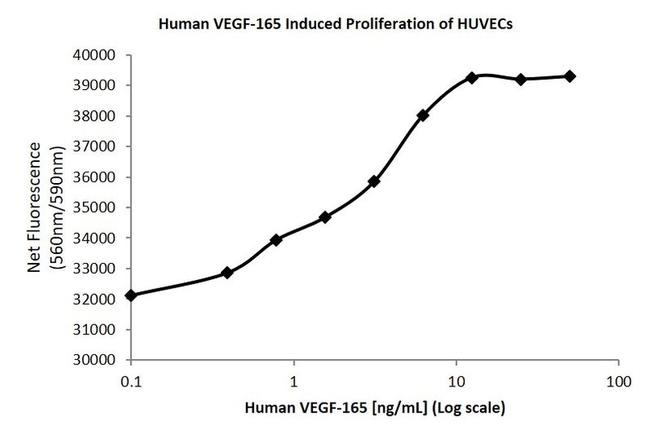
The expected biological activity (ED50) is determined by the dose-dependent proliferation of HUVECs and is typically 1-6 ng/mL. The specific activity of this protein is 1x10^6 units/mg.
Reconstitute using sterile water at 0.1 mg/mL and centrifuge prior to opening vial. Gently pipet solution down the sides of the vial. DO NOT VORTEX sample. Store reconstituted material at -20°C and add 0.1% BSA for additional stability.
Amino acid sequence: APMAEGGGQN HHEVVKFMDV YQRSYCHPIE TLVDIFQEYP DEIEYIFKPS CVPLMRCGGC CNDEGLECVP TEESNITMQI MRIKPHQGQH IGEMSFLQHN KCECRPKKDR ARQENPCGPC SERRKHLFVQ DPQTCKCSCK NTDSRCKARQ LELNERTCRC DKPRR.
Target Information
The vascular endothelial growth factor (VEGF) family currently includes VEGF-A, VEGF-B, VEGF-C, VEGF-D, VEGF-E, and PIGF. VEGF and its receptor system have been shown to be the fundamental regulators in the cell signaling of angiogenesis. Most tumors have the absolute requirement of angiogenesis and VEGF has been described as the most potent angiogenic cytokine linked to this process. To date 5 different isoforms of VEGF have been described. These isoforms are generated as the result of alternative splicing from a single VEGF gene. These various isoforms have been shown to bind to two tyrosine-kinase receptors flt-1 (VEGFR-1) and flk-1/KDR (VEGFR-2), which have been found to be expressed almost exclusively on endothelial cells.
For Research Use Only. Not for use in diagnostic procedures. Not for resale without express authorization.
References (0)
Have you cited this product in a publication?
Let us know so we can reference it here.
Disclaimer

Clicking the images or links will redirect you to a website hosted by BenchSci that provides third-party scientific content. Neither the content nor the BenchSci technology and processes for selection have been evaluated by us; we are providing them as-is and without warranty of any kind, including for use or application of the Thermo Fisher Scientific products presented.

We're here to help
Get expert recommendations for common problems or connect directly with an on staff expert for technical assistance related to applications, equipment and general product use.
Contact tech support