Search
Invitrogen
AP3B2 Polyclonal Antibody
{{$productOrderCtrl.translations['antibody.pdp.commerceCard.promotion.promotions']}}
{{$productOrderCtrl.translations['antibody.pdp.commerceCard.promotion.viewpromo']}}
{{$productOrderCtrl.translations['antibody.pdp.commerceCard.promotion.promocode']}}: {{promo.promoCode}} {{promo.promoTitle}} {{promo.promoDescription}}. {{$productOrderCtrl.translations['antibody.pdp.commerceCard.promotion.learnmore']}}
Additional Information:
{{banner.description}}
产品信息
PA1-1067
产品规格
宿主/亚型
Rabbit
/ IgG
分类
Polyclonal
类型
Antibody
抗原
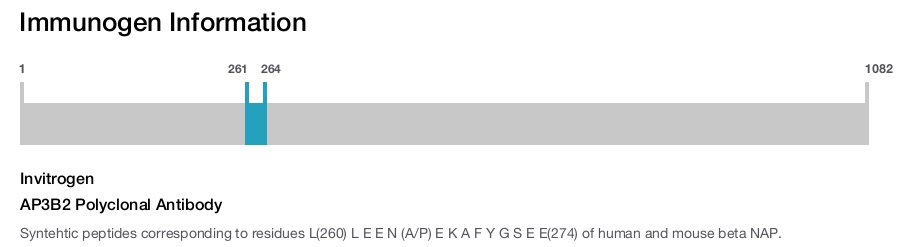
Syntehtic peptides corresponding to residues L(260) L E E N (A/P) E K A F Y G S E E(274) of human and mouse beta NAP.
偶联物
形式
Liquid
浓度
1 mg/mL
保存条件
-20°C, Avoid Freeze/Thaw Cycles
运输条件
Wet ice
RRID
产品详细信息
PA1-1067 detects beta NAP from human, rat, and mouse samples.
PA1-1067 has been successfully used in Western blot applications. By Western blot this antibody detects a ~119-130 kDa protein representing beta NAP from brain samples.
The PA1-1067 immunogens is a mixture of syntehtic peptides corresponding to residues L(260) L E E N (A/P) E K A F Y G S E E(274) of human and mouse beta NAP. The immunizing peptides (Cat. # PEP-294) are available for purchase for use in neutralization controls.
靶标信息
The AP3 complex is a heterotetramer composed of two large adaptins (AP3D1, AP3B1 or AP3B2), a medium adaptin (AP3M1 or AP3M2) and a small adaptin (APS1 or AP3S2). The complex is associated with the Golgi region as well as more peripheral structures. It facilitates the budding of vesicles from the Golgi membrane and may be directly involved in trafficking to lysosomes. Unlike the homologous AP3B1, AP3B2-containing AP3 complexes are preferentially targeted to neuronal processes, and mice deficient in AP3B2 displayed compromised synaptic zinc stores.
仅用于科研。不用于诊断过程。未经明确授权不得转售。
篇参考文献 (0)
您是否在文献中引用过该产品?请点击下方按钮邮件告知我们。
Disclaimer

Clicking the images or links will redirect you to a website hosted by BenchSci that provides third-party scientific content. Neither the content nor the BenchSci technology and processes for selection have been evaluated by us; we are providing them as-is and without warranty of any kind, including for use or application of the Thermo Fisher Scientific products presented.

