Search
Invitrogen
ASIP Polyclonal Antibody
{{$productOrderCtrl.translations['antibody.pdp.commerceCard.promotion.promotions']}}
{{$productOrderCtrl.translations['antibody.pdp.commerceCard.promotion.promocode']}}: {{promo.promoCode}} {{promo.promoTitle}} {{promo.promoDescription}}. {{$productOrderCtrl.translations['antibody.pdp.commerceCard.promotion.learnmore']}}
{{$ctrl.translations['antibody.pdp.skuNotes.additionalInformation']}}:
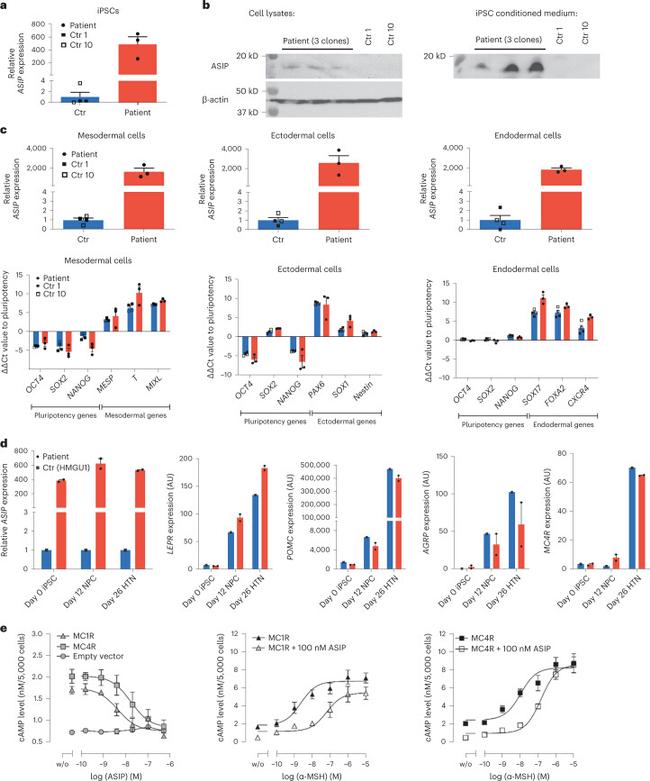
图: 1 / 3
ASIP Antibody (PA5-77052) in WB
Nature metabolism 2022 -
Ectopic ASIP expression in patient-derived iPSCs persists during differentiation. a , ASIP expression in SVF cell-derived iPSCs from n = 3 clones (as biological independent samples) of the patient and n = 2 clones from each control (Ctr) 1 and 10. b , Immunoblot of ASIP in cell lysates and supernatants from untreated iPSCs from the patient and the two control children. Similar results were obtained by a sec... View More
Please note: We are reviewing Western blot images included in the antibody testing data in our catalog, including those provided by third parties. Unless expressly labeled or annotated as “raw-unedited”, Western blot images included in the antibody testing data in our catalog may have been edited, optimized or otherwise adjusted for presentation.


产品信息
PA5-77052
产品规格
种属反应
Human
已发表种属
Human
宿主/亚型
Rabbit
/ IgG
分类
Polyclonal
类型
Antibody
抗原
Recombinant full length Human ASIP.
偶联物
Unconjugated
Unconjugated
Unconjugated
形式
Liquid
浓度
1 mg/mL
规格
100 µg
纯化类型
Antigen affinity chromatography
保存液
PBS, pH 7.2, with 50% glycerol
内含物
0.02% sodium azide
保存条件
Store at 4°C short term. For long term storage, store at -20°C, avoiding freeze/thaw cycles.
运输条件
Ambient (domestic); Wet ice (international)
RRID
产品详细信息
The antibody was affinity-purified from rabbit antiserum by affinity-chromatography using epitope-specific immunogen and the purity is > 95% (by SDS-PAGE).
靶标信息
In mice, the agouti gene encodes a paracrine signaling molecule that causes hair follicle melanocytes to synthesize pheomelanin, a yellow pigment, instead of the black or brown pigment, eumelanin. Pleiotropic effects of constitutive expression of the mouse gene include adult-onset obesity, increased tumor susceptibility, and premature infertility. This gene is highly similar to the mouse gene and encodes a secreted protein that may (1) affect the quality of hair pigmentation, (2) act as a pharmacological antagonist of alpha-melanocyte-stimulating hormone, (3) play a role in neuroendocrine aspects of melanocortin action, and (4) have a functional role in regulating lipid metabolism in adipocytes.
仅用于科研。不用于诊断过程。未经明确授权不得转售。
生物信息学
蛋白别名: agouti signaling protein, nonagouti homolog; agouti switch protein; nonagouti homolog
基因别名: AGSW; AGTI; AGTIL; ASP; SHEP9
UniProt ID: (Human) P42127
Entrez Gene ID: (Human) 434
generation of precursor metabolites and energy
signal transduction
cell-cell signaling
hormone-mediated signaling pathway
melanin biosynthetic process
negative regulation of melanin biosynthetic process
positive regulation of melanin biosynthetic process
negative regulation of adenylate cyclase-activating G protein-coupled receptor signaling pathway
Disclaimer

Clicking the images or links will redirect you to a website hosted by BenchSci that provides third-party scientific content. Neither the content nor the BenchSci technology and processes for selection have been evaluated by us; we are providing them as-is and without warranty of any kind, including for use or application of the Thermo Fisher Scientific products presented.

