Search
Abnova
IRF2BP2 Polyclonal Antibody, MaxPab™
{{$productOrderCtrl.translations['antibody.pdp.commerceCard.promotion.promotions']}}
{{$productOrderCtrl.translations['antibody.pdp.commerceCard.promotion.promocode']}}: {{promo.promoCode}} {{promo.promoTitle}} {{promo.promoDescription}}. {{$productOrderCtrl.translations['antibody.pdp.commerceCard.promotion.learnmore']}}
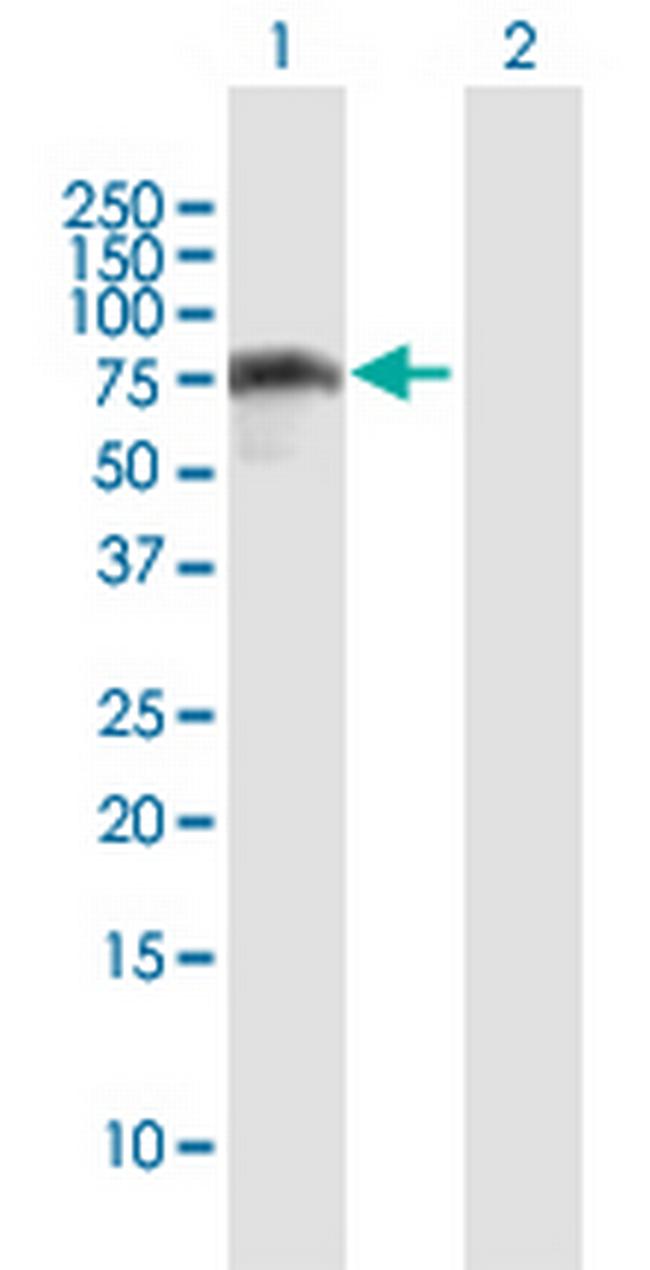
Please note: We are reviewing Western blot images included in the antibody testing data in our catalog, including those provided by third parties. Unless expressly labeled or annotated as “raw-unedited”, Western blot images included in the antibody testing data in our catalog may have been edited, optimized or otherwise adjusted for presentation.

产品信息
H00359948-B01P
产品规格
种属反应
Human
宿主/亚型
Mouse
/ IgG
分类
Polyclonal
类型
Antibody
抗原
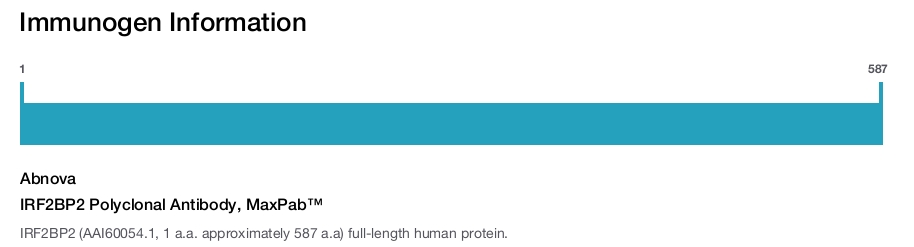
IRF2BP2 (AAI60054.1, 1 a.a. approximately 587 a.a) full-length human protein.
偶联物
Unconjugated
Unconjugated
Unconjugated
形式
Liquid
浓度
0.5-1 mg/mL
规格
50 µg
纯化类型
Protein A
保存液
PBS, pH 7.4
内含物
no preservative
保存条件
-20°C, Avoid Freeze/Thaw Cycles
运输条件
Ambient (domestic); Wet ice (international)
产品详细信息
Product may be used with Western Blot (Transfected lysate).
The Isotype of this product is composed of an IgG Mixture.
Immunogen sequence: MAAAVAVAAA SRRQSCYLCD LPRMPWAMIW DFTEPVCRGC VNYEGADRVE FVIETARQLK RAHGCFPEGR SPPGAAASAA AKPPPLSAKD ILLQQQQQLG HGGPEAAPRA PQALERYPLA AAAERPPRLG SDFGSSRPAA SLAQPPTPQP PPVNGILVPN GFSKLEEPPE LNRQSPNPRR GHAVPPTLVP LMNGSATPLP TALGLGGRAA ASLAAVSGTA AASLGSAQPT DLGAHKRPAS VSSSAAVEHE QREAAAKEKQ PPPPAHRGPA DSLSTAAGAA ELSAEGAGKS RGSGEQDWVN RPKTVRDTLL ALHQHGHSGP FESKFKKEPA LTAGRLLGFE ANGANGSKAV ARTARKRKPS PEPEGEVGPP KINGEAQPWL STSTEGLKIP MTPTSSFVSP PPPTASPHSN RTTPPEAAQN GQSPMAALIL VADNAGGSHA SKDANQVHST TRRNSNSPPS PSSMNQRRLG PREVGGQGAG NTGGLEPVHP ASLPDSSLAT SAPLCCTLCH ERLEDTHFVQ CPSVPSHKFC FPCSRQSIKQ QGASGEVYCP SGEKCPLVGS NVPWAFMQGE IATILAGDVK VKKERDS
靶标信息
The nuclear factor of activated T-cells (NFAT) transcription complex is required for the expression of a group of proteins that collectively regulate the immune response. Four NFAT proteins, encoded on separate genes and expressed as several splice variants, have been described: NFAT1 (also known as NFATp or NFATc2), NFAT2 (NFATc or NFATc1), NFAT3, and NFAT4 (NFATx or NFATc3). These proteins show a low level of sequence similarity with the Dorsal/Rel/NFkB family of transcription factors. Another NFAT-related protein termed NFAT5 differs from isoforms 1-4 in that it lacks many of the Fos/Jun contact sites observed in its predecessors and its subcellular localization is not calcineurin-dependent.
仅用于科研。不用于诊断过程。未经明确授权不得转售。
篇参考文献 (0)
您是否在文献中引用过该产品?请点击下方按钮邮件告知我们。
生物信息学
蛋白别名: IRF-2-binding protein 2; transcriptional co-repressor; unnamed protein product
基因别名: CVID14; LRIR2
UniProt ID: (Human) Q7Z5L9
Entrez Gene ID: (Human) 359948
Disclaimer

Clicking the images or links will redirect you to a website hosted by BenchSci that provides third-party scientific content. Neither the content nor the BenchSci technology and processes for selection have been evaluated by us; we are providing them as-is and without warranty of any kind, including for use or application of the Thermo Fisher Scientific products presented.

