Search
Invitrogen
XPC Polyclonal Antibody
{{$productOrderCtrl.translations['antibody.pdp.commerceCard.promotion.promotions']}}
{{$productOrderCtrl.translations['antibody.pdp.commerceCard.promotion.promocode']}}: {{promo.promoCode}} {{promo.promoTitle}} {{promo.promoDescription}}. {{$productOrderCtrl.translations['antibody.pdp.commerceCard.promotion.learnmore']}}
{{$ctrl.translations['antibody.pdp.skuNotes.additionalInformation']}}:
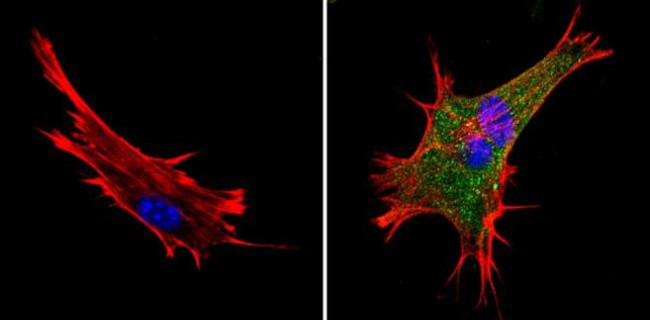
图: 1 / 3
XPC Antibody (PA3-956) in ICC/IF
Immunofluorescent analysis of XPC (green) showing staining in the nucleus and cytoplasm of NIH-3T3 cells (right) compared to a negative control without primary antibody (left). Formalin-fixed cells were permeabilized with 0.1% Triton X-100 in TBS for 5-10 minutes and blocked with 3% BSA-PBS for 30 minutes at room temperature. Cells were probed with a XPC polyclonal antibody (Product # PA3-956) in 3% BSA-PBS at a dilution of 1:100 and incubated overnight at 4 °C in a humidified chamber. Cells were washed with PBST and incubated with a DyLig... View More
Please note: We are reviewing Western blot images included in the antibody testing data in our catalog, including those provided by third parties. Unless expressly labeled or annotated as “raw-unedited”, Western blot images included in the antibody testing data in our catalog may have been edited, optimized or otherwise adjusted for presentation.


产品信息
PA3-956
产品规格
种属反应
Human,
Mouse
已发表种属
Human
宿主/亚型
Rabbit
/ IgG
分类
Polyclonal
类型
Antibody
抗原
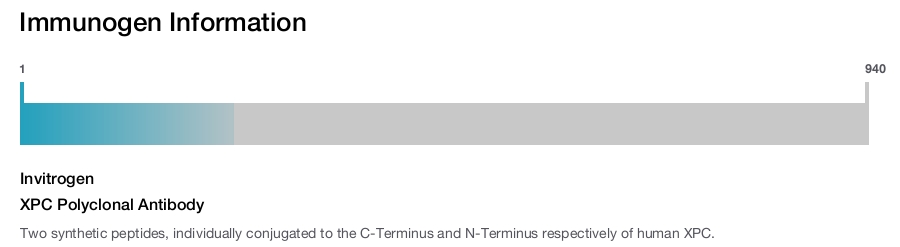
Two synthetic peptides, individually conjugated to the C-Terminus and N-Terminus respectively of human XPC.
偶联物
Unconjugated
Unconjugated
Unconjugated
形式
Liquid
浓度
Conc. Not Determined
保存液
whole serum
内含物
0.05% sodium azide
保存条件
-20°C, Avoid Freeze/Thaw Cycles
运输条件
Ambient (domestic); Wet ice (international)
RRID
产品详细信息
PA3-956 detects XPC in human and mouse cells.
PA3-956 has been successfully used in Western blotting and ICC/IF procedures. By Western blot it detects a ~125 kDa protein representing XPC.
The PA3-956 immunogen is two synthetic peptides, individually conjugated to the C-Terminus and N-Terminus respectively of human XPC.
靶标信息
This gene encodes a component of the nucleotide excision repair (NER) pathway. There are multiple components involved in the NER pathway, including Xeroderma pigmentosum (XP) A-G and V, Cockayne syndrome (CS) A and B, and trichothiodystrophy (TTD) group A, etc. This component, XPC, plays an important role in the early steps of global genome NER, especially in damage recognition, open complex formation, and repair protein complex formation. Mutations in this gene or some other NER components result in Xeroderma pigmentosum, a rare autosomal recessive disorder characterized by increased sensitivity to sunlight with the development of carcinomas at an early age. Alternatively spliced transcript variants have been found for this gene.
仅用于科研。不用于诊断过程。未经明确授权不得转售。
生物信息学
蛋白别名: mutant xeroderma pigmentosum group C; NER; nucleotide excision repair protein; p125; unnamed protein product; xeroderma pigmentosum group C; xeroderma pigmentosum group C-complementing protein homolog; xeroderma pigmentosum, complementation group C
基因别名: p125; RAD4; XP3; XPCC
UniProt ID: (Human) Q01831, (Mouse) P51612
Entrez Gene ID: (Human) 7508, (Mouse) 22591
DNA repair
nucleotide-excision repair
mismatch repair
regulation of mitotic cell cycle
response to xenobiotic stimulus
response to auditory stimulus
positive regulation of transcription, DNA-templated
UV-damage excision repair
regulation of cell cycle phase transition
regulation of mitotic cell cycle phase transition
pyrimidine dimer repair by nucleotide-excision repair
cellular response to DNA damage stimulus
response to UV-B
intra-S DNA damage checkpoint
negative regulation of gluconeogenesis
Disclaimer

Clicking the images or links will redirect you to a website hosted by BenchSci that provides third-party scientific content. Neither the content nor the BenchSci technology and processes for selection have been evaluated by us; we are providing them as-is and without warranty of any kind, including for use or application of the Thermo Fisher Scientific products presented.

