Search
Gibco
Human gAcrp30/Adipolean Variant Recombinant Protein, PeproTech®
{{$productOrderCtrl.translations['antibody.pdp.commerceCard.promotion.promotions']}}
{{$productOrderCtrl.translations['antibody.pdp.commerceCard.promotion.promocode']}}: {{promo.promoCode}} {{promo.promoTitle}} {{promo.promoDescription}}. {{$productOrderCtrl.translations['antibody.pdp.commerceCard.promotion.learnmore']}}
{{$ctrl.translations['antibody.pdp.skuNotes.additionalInformation']}}:

产品信息
450-20-25UG
应用
建议稀释比
已发表文章
产品规格
种属
Human
已发表种属
Mouse,
Rat
Expression System
E. coli
氨基酸序列
PGAEGPRGFP GIQGRKGEPG EGAYVYRSAF SVGLETYVTI PNMPIRFTKI FYNQQNHYDG STGKFHCNIP GLYYFAYHIT VYMKDVKVSL FKKDKAMLFT YDQYQENNVD QASGSVLLHL EVGDQVWLQV YGEGERNGLY ADNDNDSTFT GFLLYHDTN
分子量
18.1 kDa
分类
Recombinant
类型
Protein
纯度
≥ 98% by SDS-PAGE gel and HPLC analyses.
内毒素浓度
<1 EU/µg
活性
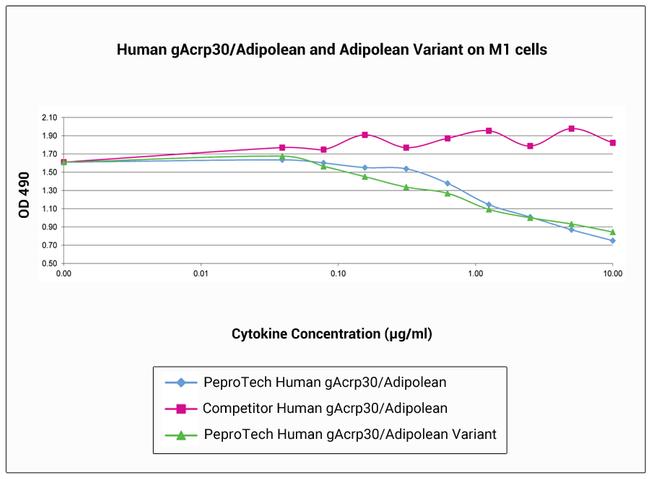
Determined by a cytotoxicity assay using M1 cells. The expected ED50 for this effect is 0.5-1.0 ug/ml.
偶联物
Unconjugated
Unconjugated
Unconjugated
形式
Lyophilized
Amount
25 µg
纯化类型
purified
内含物
no preservative
保存条件
-20°C
运输条件
Ambient
产品详细信息
450-20-1MG will be provided as 2 x 500 µg (450-20-500UG).
This naturally occurring variant of human gAcrp30/Adipolean is an 18.1 kDa protein, containing 14 extra amino acids extra at the N-terminus of human gAcrp30/Adipolean.
This product is shipped at ambient temperature. For storage, handling and reconstitution information, please see the lot-specific Certificate of Analysis
靶标信息
The gAcrp30 variant is a naturally occurring globular protein obtained by proteolytic processing of adiponectin. Adiponectin is produced and secreted exclusively by adipocytes, and is a relatively abundant plasma protein, accounting for up to 0.05% of total serum protein. Like Adiponectin, Acrp30 is capable of decreasing hyperglycemia and reversing insulin resistance. Additionally, gAcrp30 has been shown to be an important factor in promoting fat loss by signaling muscle to absorb and burn Free-Fatty Acids (FFAs). The signaling receptors for adiponectin and gAcrp30 have recently been identified and named AdipoR1 and AdipoR2. AdipoR2 is predominantly expressed in the liver. This naturally occurring variant of human gAcrp30/Adipolean is an 18.1 kDa protein, containing 14 extra amino acids extra at the N-terminus of human gAcrp30/Adipolean.
仅用于科研。不用于诊断过程。未经明确授权不得转售。
生物信息学
蛋白别名: 30 kDa adipocyte complement-related protein; adipocyte complement-related 30 kDa protein; adipose most abundant gene transcript 1 protein; adipose specific collagen-like factor; gAcrp30; gelatin-binding protein 28; unnamed protein product
基因别名: ACDC; ACRP30; ADIPQTL1; ADPN; APM-1; APM1; GBP28
UniProt ID: (Human) Q15848
Entrez Gene ID: (Human) 9370
Disclaimer

Clicking the images or links will redirect you to a website hosted by BenchSci that provides third-party scientific content. Neither the content nor the BenchSci technology and processes for selection have been evaluated by us; we are providing them as-is and without warranty of any kind, including for use or application of the Thermo Fisher Scientific products presented.
