Search
Invitrogen
Human HMGB-1 ELISA Kit
{{$productOrderCtrl.translations['antibody.pdp.commerceCard.promotion.promotions']}}
{{$productOrderCtrl.translations['antibody.pdp.commerceCard.promotion.promocode']}}: {{promo.promoCode}} {{promo.promoTitle}} {{promo.promoDescription}}. {{$productOrderCtrl.translations['antibody.pdp.commerceCard.promotion.learnmore']}}
{{$ctrl.translations['antibody.pdp.skuNotes.additionalInformation']}}:

Product Specifications
Analytical sensitivity
18.75 pg/mL
Assay range
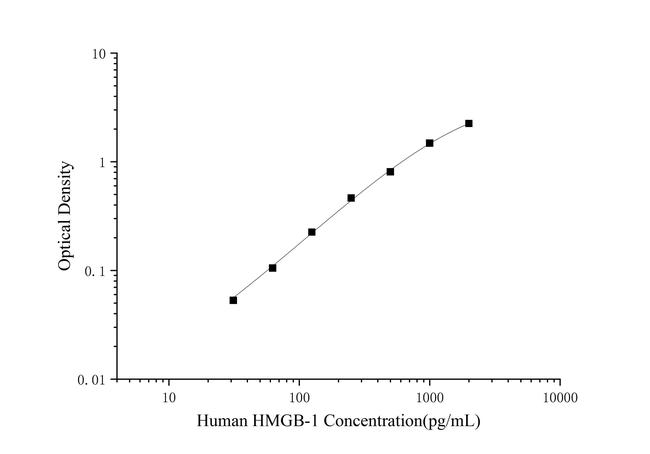
31.25-2,000 pg/mL
Sample type/volume
Plasma
100 µL
Serum
100 µL
Supernatant
100 µL
Hands-on time
1 hr 20 min
Time-to-result
3 hr 30 min
Homogenous (no wash)
No
Interassay CV
<10%
Intraassay CV
<10%
Instrument
Absorbance Microplate Reader
Product size
96 Tests
Contents
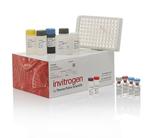
Pre-coated 96 well plate, Standard, Biotinylated Detection Antibody, HRP Conjugate, Standard & Sample Diluent, Biotinylated Detection Antibody Diluent, HRP Conjugate Diluent, Wash Buffer, TMB Substrate, Stop Solution, Plate Sealer
Shipping conditions
Wet ice
Storage
Refer to product documentation for component specific storage temperature.
Protein name
HMGB1
Protein family
High mobility group box
Species (tested)
Human
Detector antibody conjugate
Biotin
Label or dye
HRP
About This Kit
The Human High Mobility Group Protein B1 (HMGB-1) ELISA quantitates HMGB-1 in serum, plasma, and other biological fluids
The Human High Mobility Group Protein B1 (HMGB-1) solid-phase sandwich ELISA (enzyme-linked immunosorbent assay) is designed to measure the amount of the target bound between a matched antibody pair. A target-specific antibody has been pre-coated in the wells of the supplied microplate. Samples are then added into these wells and bind to the immobilized (capture) antibody. The sandwich is formed by the binding of the second (detector) antibody to the target on a different epitope from the capture antibody. An antibody conjugated with enzyme binds the formed sandwich. After incubation and washing steps to rid the microplate of unbound substances, a substrate solution is added that reacts with the enzyme-antibody-target complex to produce measurable signal. The intensity of this signal is directly proportional to the concentration of target present in the original specimen.
Rigorous validation:
Each manufactured lot of this ELISA kit is quality tested for criteria such as sensitivity, specificity, precision, and lot-to-lot consistency. See manual for more information on validation.
Target information
High-mobility group box 1 protein, previously known as HMG-1 or amphoterin, is a member of the high mobility group box family of non-histone chromosomal proteins. Human HMGB1 is expressed as a 30 kDa, 215 amino acid (aa) single chain polypeptide containing three domains: two N-terminal globular, 70 aa positively charged DNA-binding domains (HMG boxes A and B), and a negatively charged 30 aa C-terminal region that contains only Asp and Glu. HMGB1 is expressed at high levels in almost all cells. It was originally discovered as a nuclear protein that could bend DNA. Such bending stabilizes nucleosome formation and regulates the expression of select genes upon recruitment by DNA binding proteins. It is now known that HMGB1 can also act extracellularly, both as an inflammatory mediator that promotes monocyte migration and cytokine secretion, and as a mediator of T cell-dendritic cell interaction. Moreover, HMGB1 is reported that the level of HMGB1 is elevated during sterile tissue injury, infection, lethal endotoxemia or sepsis, collagen-induced arthritis, and ischemia-reperfusion induced tissue injury.
For Research Use Only. Not for use in diagnostic procedures. Not for resale without express authorization.
Bioinformatics
Gene aliases : HMG-1, HMG1, HMG3, SBP-1
Gene ID : (Human) 3146
Gene symbol : HMGB1
Protein Aliases : Amphoterin, Amphoterin antibody, DKFZp686A04236, HMG3 antibody, hmgb 1, hmgb-1, RP11-550P23.1, high-mobility group (nonhistone chromosomal) protein 1, HMGB1, Sulfoglucuronyl carbohydrate binding protein, unnamed protein product
UniProt ID (Human) P09429

Performance Guarantee
If an Invitrogen™ immunoassay doesn't perform as described on our website or datasheet,we'll replace the product at no cost to you, or provide you with a credit for a future purchase.*
Learn more
We're here to help
Get expert recommendations for common problems or connect directly with an on staff expert for technical assistance related to applications, equipment and general product use.
Contact tech support