Search


引用和文献 (2)
Invitrogen™
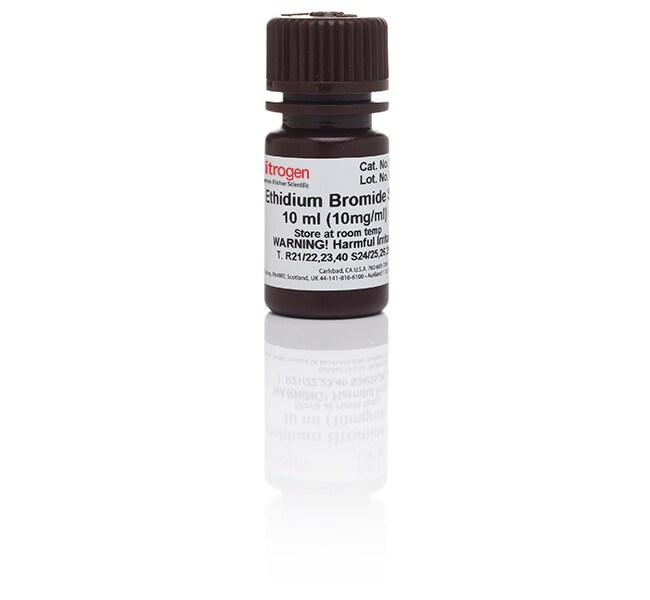
UltraPure™ 溴化乙锭,10 mg/mL
UltraPure™ 溴化乙锭是一种灵敏的荧光染料,用于检测琼脂糖凝胶和氯化铯 (CsCl) 梯度溶液中的核酸。本品以水溶液形式提供,由 10mg/ml UltraPure™ 溴化乙锭和高纯度水组成。• 灵敏:可检测琼脂糖凝胶中低至了解更多信息
| 货号 | 数量 |
|---|---|
| 15585011 | 10 mL |
货号 15585011
价格(CNY)
696.00
飞享价
Ends: 31-Dec-2026
1,427.00共减 731.00 (51%)
Each
数量:
10 mL
价格(CNY)
696.00
飞享价
Ends: 31-Dec-2026
1,427.00共减 731.00 (51%)
Each
UltraPure™ 溴化乙锭是一种灵敏的荧光染料,用于检测琼脂糖凝胶和氯化铯 (CsCl) 梯度溶液中的核酸。本品以水溶液形式提供,由 10mg/ml UltraPure™ 溴化乙锭和高纯度水组成。
• 灵敏:可检测琼脂糖凝胶中低至 1 ng 核酸
• 通用:可检测 DNA 或 RNA
• 易于使用:可未经稀释或稀释至所需浓度后使用
UltraPure™ 溴化乙锭是一种以菲啶为核心的芳香族化合物(参见以下结构)。溴化乙锭的最大荧光激发波长为 300 nm 和 520 nm,最大发射波长为 600 nm(参见荧光光谱)。
仅供研究使用。不可用于人或动物的治疗或诊断。
• 灵敏:可检测琼脂糖凝胶中低至 1 ng 核酸
• 通用:可检测 DNA 或 RNA
• 易于使用:可未经稀释或稀释至所需浓度后使用
UltraPure™ 溴化乙锭是一种以菲啶为核心的芳香族化合物(参见以下结构)。溴化乙锭的最大荧光激发波长为 300 nm 和 520 nm,最大发射波长为 600 nm(参见荧光光谱)。
仅供研究使用。不可用于人或动物的治疗或诊断。
仅供科研使用。不可用于诊断程序。
规格
检测定位凝胶内检测
检测方法荧光
数量10 mL
运输条件室温
靶标分子RNA,DNA
标签或染料溴化乙锭
产品线UltraPure
产品类型溴化乙锭
Unit SizeEach
内容与储存
10ml,浓度为 10mg⁄ml的溶液。在 15°C 至 30°C 下储存
常见问题解答 (FAQ)
你们是否有在琼脂糖凝胶中进行溴化乙锭染色的实验方案?
溴化乙锭可以用来检测哪些靶标?灵敏性如何?
Do you have a protocol for ethidium bromide staining in agarose gels?
What can ethidium bromide be used to detect and what is its sensitivity?
What amount of ethidium bromide do I need to stain nucleic acids in gels?
引用和文献 (2)
引用和文献
Abstract
Immune-like phagocyte activity in the social amoeba.
Journal:Science
PubMed ID:17673666
Social amoebae feed on bacteria in the soil but aggregate when starved to form a migrating slug. We describe a previously unknown cell type in the social amoeba, which appears to provide detoxification and immune-like functions and which we term sentinel (S) cells. S cells were observed to engulf bacteria
Cloning and pharmacological characterization of the guinea pig P2X7 receptor orthologue.
Journal:Br J Pharmacol
PubMed ID:18037910
BACKGROUND AND PURPOSE: The human, rat, and mouse P2X(7) receptors have been previously characterized, and in this study we report the cloning and pharmacological properties of the guinea pig orthologue. EXPERIMENTAL APPROACH: A cDNA encoding for the guinea pig P2X(7) receptor was isolated from a guinea pig brain library. The