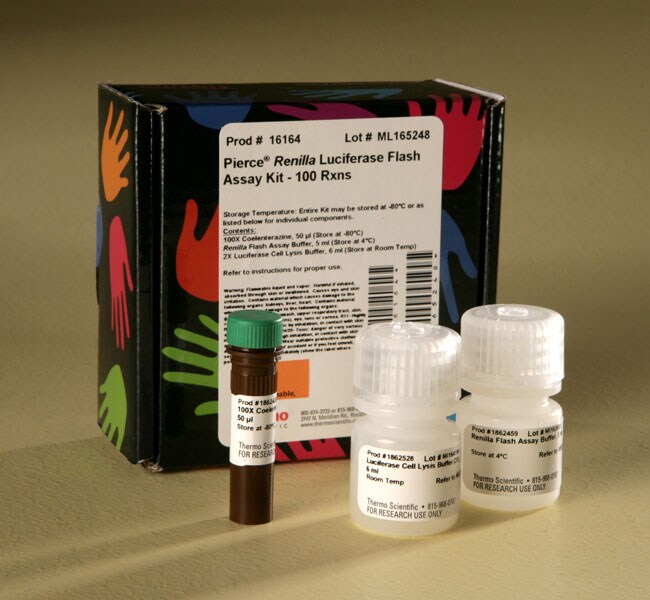
Pierce™ 海肾荧光素酶闪光检测试剂盒
Thermo Scientific™

Pierce™ 海肾荧光素酶闪光检测试剂盒

Thermo Scientific Pierce 海肾荧光素酶闪光检测试剂盒为研究人员提供了高度灵敏的细胞内测定,用于检测哺乳动物全细胞裂解物中调节元素的转录活性。海肾荧光素酶闪光检测试剂盒的特点:•灵敏—更高灵敏度允许使用较小数量的细胞• 具有成本效益—高度灵敏的测定减少了试剂消耗• 节省时间—进行测定只需要极少的样品处理• 适合自动化—适合用于高通量筛选• 便利—包含一种通用的细胞裂解缓冲液和经过优化的闪光型测定试剂• 安全—允许用户执行非放射性测定该闪光检测试剂盒包含的试剂用于测定哺乳动物细胞裂解物中海肾荧光素酶的活性了解更多信息
Have Questions?
更改视图buttonViewtableView
货号数量
16164100 次反应试剂盒
161651000 次反应试剂盒
货号 16164
价格(CNY)
857.00
飞享价
Ends: 31-Dec-2025
1,152.00
共减 295.00 (26%)
Each
添加至购物车
数量:
100 次反应试剂盒
价格(CNY)
857.00
飞享价
Ends: 31-Dec-2025
1,152.00
共减 295.00 (26%)
Each
添加至购物车
Thermo Scientific Pierce 海肾荧光素酶闪光检测试剂盒为研究人员提供了高度灵敏的细胞内测定,用于检测哺乳动物全细胞裂解物中调节元素的转录活性。

海肾荧光素酶闪光检测试剂盒的特点:

灵敏—更高灵敏度允许使用较小数量的细胞
具有成本效益—高度灵敏的测定减少了试剂消耗
节省时间—进行测定只需要极少的样品处理
适合自动化—适合用于高通量筛选
便利—包含一种通用的细胞裂解缓冲液和经过优化的闪光型测定试剂
安全—允许用户执行非放射性测定

该闪光检测试剂盒包含的试剂用于测定哺乳动物细胞裂解物中海肾荧光素酶的活性。当与 Thermo Scientific 绿色海肾 Luc 质粒一起使用时,该试剂盒提供了一个非常灵敏的生物发光报告基因测定系统,用于对启动子或通路活性进行细胞内检测。绿色海肾 Luc 所产生的信号要比在类似条件下测定的天然萤火虫或海肾荧光素酶的信号高得多。使用光度计捕获的光输出可与生成的海肾荧光素酶蛋白的量相关,并可用于确定驱动海肾表达的启动子的活性。

包括:
细胞裂解缓冲液、反应缓冲液和底物

需要:
海肾荧光素酶和光度计或其他能够监测发光的仪器(如 Thermo Scientific Luminoskan Ascent 和 Varioskan 闪光酶标仪)。

应用:
• 用于分析顺式调节元素和反式作用因子的启动子研究
• 药物筛选
• siRNA 和 miRNA 筛选
• 研究脱靶效应的多通路测定
• 蛋白定位报告基因测定
• 信号转导通路分析
• RNA 剪接研究

绿色海肾荧光素酶是来自海肾的野生型海肾荧光素酶基因衍生物产生的一种 36kDa 蛋白。与野生型荧光素酶相比,绿色海肾在血清中更稳定,并且具有一种向绿色区域转移的发射光谱。该蛋白提供快速衰变的极其明亮的闪光信号。Pierce 海肾闪光检测试剂盒试剂可以优化这种信号以用于闪光型荧光素酶报告基因测定。该试剂盒还兼容使用腔肠素作为底物的其他海肾荧光素酶和衍生物的闪光测定。

更多产品数据
难以转染的 Jurkat 细胞中的荧光素酶测定
多功能荧光素酶:微孔板光度计和闪光荧光素酶测定

相关产品
Pierce™ 海肾萤火虫荧光素酶双检测试剂盒
仅供科研使用。不可用于诊断程序。
规格
检测报告基因酶、荧光素酶报告基因检测
适用细胞哺乳动物细胞
检测方法生物发光
适用于(设备)化学发光酶标仪(微孔板)
产品规格384 孔板、96 孔板
标签类型酶标记
产品线Pierce™
数量100 次反应试剂盒
底物腔肠素
底物属性化学底物
底物类型荧光素酶底物
靶标荧光素酶、绿色海肾荧光素酶
技术增强的化学发光法
类型检测试剂盒
Unit SizeEach

常见问题解答 (FAQ)

I got a high background signal with a Gaussia/Cypridina/Renilla Luciferase Glow/Luciferase Flash assay. What went wrong?

Here are possible causes and solutions:

- Non-specific oxidation of substrate: Use less serum in the cell culture media; Note: Albumin can increase the auto-oxidation of Vargulin; Avoid repeated freezing and thawing of the sample.
- Control sample is contaminated: Use new sample; Change pipette tips after each well.

Find additional tips, troubleshooting help, and resources within our Protein Assays and Analysis Support Center.

I am getting a high saturating signal with a Gaussia/Cypridina/Renilla Luciferase Glow/Luciferase Flash assay. What could have happened?

This could be due to high luciferase expression. Here are some suggestions:

  • Reduce incubation time before collecting samples. 
  • Decrease the integration time on the instrument.
  • Dilute the sample: for secreted Gaussia/Cypridina Luciferase, dilute the sample using media from the cell culture; for cell lysate, dilute the sample using lysis buffer 


  • Note: A low sample volume can increase assay variability. Dilute the sample and use the recommended volume of 10-20 µL per assay.

    Find additional tips, troubleshooting help, and resources within our Protein Assays and Analysis Support Center.

    Why am I getting a low signal in lysate using a Gaussia/Cypridina/Renilla Luciferase Glow/Luciferase Flash assay? Can you provide some suggestions?

    Here are possible causes and solutions:

    - Non-optimized lysis buffer used: Assay luciferase activity in the media to confirm good expression of luciferase; Use only the provided lysis buffer.
    - Low luciferase expression: Lyse cells in smaller volume of 1X Cell Lysis Buffer; Use a different promoter or growth conditions to improve expression; Increase the integration time on the instrument; Scale up volume of sample and reagent per well.

    Find additional tips, troubleshooting help, and resources within our Protein Assays and Analysis Support Center.

    I got a low signal in media when I used a Gaussia/Cypridina/Renilla Luciferase Glow/Luciferase Flash assay. What happened?

    Here are possible causes and solutions:

    - Insufficient luciferase accumulation in media: Incubate cells for a longer time.
    - Low luciferase expression: Use less media per well during the experiment;.Use a different promoter or growth conditions to improve expression;.Increase the integration time on the instrument;.Scale-up the volume of sample and reagent per well.
    - Treatment interfered with cellular secretory pathway: Transfect cells with a plasmid for constitutive expression of Luciferase (i.e., with pTK or pCMV promoter); Determine if luciferase actively expresses in media without treatment. Add treatment; Determine if there is a corresponding drop in luciferase activity from the constitutively expressed plasmid.

    Find additional tips, troubleshooting help, and resources within our Protein Assays and Analysis Support Center.

    I am getting no signal with my Gaussia/Cypridina/Renilla Luciferase Glow/Luciferase Flash assay. Why is this?

    Here are possible causes and solutions:

    - Low transfection efficiency: Optimize transfection conditions using a visual transfection control (e.g., a plasmid over-expressing a fluorescent protein); Verify plasmid DNA quality - use only transfection grade DNA; Use actively dividing, low passage cells; Use a different cell type.
    - No or low promoter activity: Use conditions known for promoter activation; Incubate cells for a longer time; Change growth conditions to improve expression; Use a different promoter.
    - Substrate auto-oxidized: Protect substrate from light and air; Maintain 100X Coelenterazine at -80 degrees C; maintain 100X Vargulin at -80 degrees C; Prepare new Coelenterazine Working Solution if used longer than 8 hours; Prepare new Vargulin Working Solution if used longer than 2 hours

    Find additional tips, troubleshooting help, and resources within our Protein Assays and Analysis Support Center.