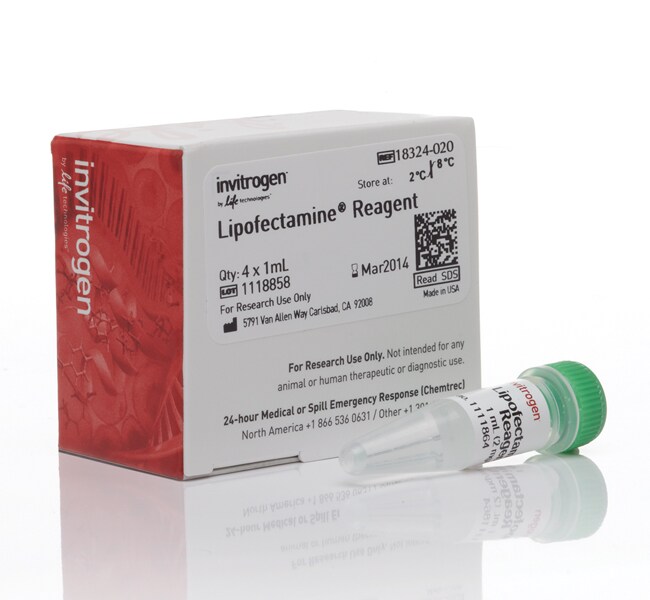
Lipofectamine™ Transfection Reagent
Invitrogen17万+抗体限时买二赠一,靶点广,灵活用!
Lipofectamine™ Transfection Reagent
Invitrogen™

Lipofectamine™ Transfection Reagent

Lipofectamine™ Transfection Reagent is one of our first-generation, cationic-lipid transfection reagents formulated for the transfection of DNA into eukaryotic cells.Read more
Have Questions?
Change viewbuttonViewtableView
Catalog NumberQuantity
183240204 mL
183240100.3 mL
183240121 mL
Catalog number 18324020
Price (CNY)
34,088.00
Each
Add to cart
Quantity:
4 mL
Price (CNY)
34,088.00
Each
Add to cart

Lipofectamine™ Transfection Reagent is one of our first-generation, cationic-lipid transfection reagents formulated for the transfection of DNA into eukaryotic cells. Lipofectamine™ Transfection Reagent is a trusted, value reagent with many years of cited use in thousands of publications and with many cell lines.

With Lipofectamine™ Transfection Reagent, you'll get:

  • A reagent proven to work in high-throughput applications
  • A reliable reagent for establishing stable cell lines
  • A reagent that works well with PLUS™ reagent for higher protein expression

A proven technology

Our Lipofectamine™-brand reagents have been recognized as the most-cited transfection reagent family, with tens of thousands of citations since launch in 1993. Lipofectamine™ Transfection Reagent is no exception as a trusted reagent for a wide range of cell lines. When used in combination with PLUS™ Reagent, Lipofectamine™ Transfection Reagent has been shown to work well with cells such as BHK-21, NIH 3T3, COS-1, fibroblasts, keratinocytes, HT-29, MRC-5, and SK-BR3.

A 'value' alternative for plasmid DNA

With such a legacy comes a commitment to providing the best reagents for all scientists and labs, regardless of their funding capabilities. Lipofectamine™ Transfection Reagent is a value alternative for transfection of plasmid DNA into eukaryotic cells with a simplified protocol. For optimal results in a wider range of plasmid DNA transfection conditions, we recommend Lipofectamine™ LTX Reagent, due to its optimal balance of potency & low-cytotoxicity. Lipofectamine™ 2000 Transfection Reagent is recommended if you are transfecting a broad range of cell lines or want to transfect RNA.

For Research Use Only. Not for use in diagnostic procedures.
Specifications
For Use With (Application)Transfection
High-throughput CompatibilityNot High-throughput Compatible (Manual)
Product LineLipofectamine
Product TypeTransfection Reagent
Quantity4 mL
Serum CompatibleNo
Shipping ConditionWet Ice
Cell TypeEstablished Cell Lines, Primary Cells, Hard-to-Transfect Cells
Format6-well Plate, 12-well Plate, 24-well Plate, 48-well Plate, 96-well Plate, Flasks
Sample TypePlasmid DNA
Transfection TechniqueLipid-based Transfection
Unit SizeEach
Contents & Storage
Contains 4 vial (1 mL each) of Lipofectamine™ Transfection Reagent. Store at 2°C to 8°C. Do not freeze.

Frequently asked questions (FAQs)

I accidentally left my lipid reagent at room temperature. Can I still use it?

Yes, all of our lipid transfection reagents are stable at room temperature for months.

Find additional tips, troubleshooting help, and resources within our Lipid-Based Transfection Support Center.

What is the difference between reverse transfection and forward transfection? What should I use?

In forward transfection, cells are seeded to appropriate confluence or cell density in wells or dishes, and the lipid-DNA complexes are added the next day. In reverse transfection, the transfection complexes are prepared inside the wells, after which cells and medium are added. Reverse transfection is faster to perform than forward transfection, and is the method of choice for high-throughput transfection. For non-high-throughput transfections, generally forward transfections have better efficiency for most cell types.

Find additional tips, troubleshooting help, and resources within our Transfection Support Center.

Is there a place where I can find references from other researchers who have used your transfection reagents?

Visit the product page for each reagent type and you will see a list of references at the bottom of the page. A table that lists specific cell line references is also accessible. We also recommend www.highwire.org as a search engine to find a large selection of up-to-date research articles using our transfection products. Simply include the name of the transfection reagent and your cell line/application of interest in your search criteria.

Find additional tips, troubleshooting help, and resources within our Transfection Support Center.

Can I use antibiotics in the medium during transfection?

Antibiotics can be used in the medium for culturing of cell lines. However, we do not recommend using antibiotics in the transfection medium unless previously tested in the cell type and payload being transfected. This is because presence of antibiotics during transfection may adversely affect transfection efficiency (i.e., positively charged antibiotics binding to the DNA being transfected) and overall health of cells being transfected.

For stable transfection, we recommend waiting wait 24-48 hrs after transfection before adding selected antibiotics.

Find additional tips, troubleshooting help, and resources within ourTransfection Basics Support Center.

Is it necessary to use serum-free medium during lipid transfection?

It is not necessary to use serum-free medium during lipid transfection. However, it is critical to form the lipid:nucleic acid complex in the absence of serum, because proteins can interfere with complex formation. Once the complexes are formed, they can be added to cells in serum-containing medium. For optimal results with Lipofectin Transfection Reagent, we recommend performing transfection in medium without serum.

Find additional tips, troubleshooting help, and resources within our Lipid-Based Transfection Support Center.

Citations & References (71)

Citations & References
Abstract
Low-density lipoprotein receptor-related protein 5 (LRP5) is essential for normal cholesterol metabolism and glucose-induced insulin secretion.
Authors:Fujino T, Asaba H, Kang MJ, Ikeda Y, Sone H, Takada S, Kim DH, Ioka RX, Ono M, Tomoyori H, Okubo M, Murase T, Kamataki A, Yamamoto J, Magoori K, Takahashi S, Miyamoto Y, Oishi H, Nose M, Okazaki M, Usui S, Imaizumi K, Yanagisawa M, Sakai J, Yamamoto TT,
Journal:Proc Natl Acad Sci U S A
PubMed ID:12509515
A Wnt coreceptor low-density lipoprotein receptor-related protein 5 (LRP5) plays an essential role in bone accrual and eye development. Here, we show that LRP5 is also required for normal cholesterol and glucose metabolism. The production of mice lacking LRP5 revealed that LRP5 deficiency led to increased plasma cholesterol levels in ... More
Regulation of cortical dendrite development by Slit-Robo interactions.
Authors:Whitford Kristin L; Marillat Valérie; Stein Elke; Goodman Corey S; Tessier-Lavigne Marc; Chédotal Alain; Ghosh Anirvan;
Journal:Neuron
PubMed ID:11779471
Slit proteins have previously been shown to regulate axon guidance, branching, and neural migration. Here we report that, in addition to acting as a chemorepellant for cortical axons, Slit1 regulates dendritic development. Slit1 is expressed in the developing cortex, and exposure to Slit1 leads to increased dendritic growth and branching. ... More
Extracellular Export of Sphingosine Kinase-1 Enzyme. SPHINGOSINE 1-PHOSPHATE GENERATION AND THE INDUCTION OF ANGIOGENIC VASCULAR MATURATION.
Authors:Ancellin Nicolas; Colmont Chantal; Su Joseph; Li Qin; Mittereder Nanette; Chae Sung-Suk; Stefansson Steingrimur; Liau Gene; Hla Timothy;
Journal:J Biol Chem
PubMed ID:11741921
The enzyme sphingosine kinase (SK) catalyzes the formation of sphingosine 1-phosphate (S1P), a bioactive lipid that acts extracellularly on G protein-coupled receptors of the S1P(1)/EDG-1 subfamily. Although S1P is formed in the cytosol of various cells, S1P release is not understood and is controversial because this lipid mediator is also ... More
Different composite regulatory elements direct expression of the human alpha subunit gene to pituitary and placenta.
Authors: Heckert L L; Schultz K; Nilson J H;
Journal:J Biol Chem
PubMed ID:7592867
'To identify elements of the human alpha subunit gene necessary for cell-specific expression, we generated an array of block mutations spanning approximately 400 base pairs (bp) of promoter proximal region and examined them using transient transfection analysis in pituitary (alpha T3) and placental (BeWo) cell lines. Comparison of promoter activity ... More
ATF3 gene. Genomic organization, promoter, and regulation.
Authors: Liang G; Wolfgang C D; Chen B P; Chen T H; Hai T;
Journal:J Biol Chem
PubMed ID:8576171
'ATF3 gene, which encodes a member of the activating transcription factor/cAMP responsive element binding protein (ATF/CREB) family of transcription factors, is induced by many physiological stresses. As a step toward understanding the induction mechanisms, we isolated the human ATF3 gene and analyzed its genome organization and 5''-flanking region. We found ... More