Search


引用和文献 (13)
Gibco™
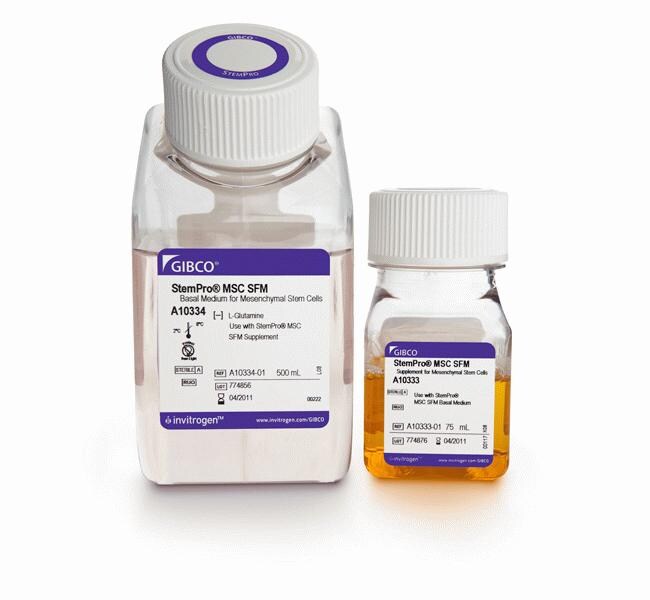
StemPro™ MSC SFM
专为人间充质干细胞培养而开发StemPro™ MSC SFM 是一种专为人间充质干细胞 (MSC) 的生长和扩增而配制的无血清培养基 (SFM)。与经典的添加血清培养基 (DMEM +了解更多信息
| 货号 | 加有添加剂 | 不加添加剂 |
|---|---|---|
| A1033201 | 低糖, 丙酮酸钠, 碳酸氢钠, 腺苷, 脱氧核糖核苷 | 无谷氨酰胺, 无酚红 |
货号 A1033201
价格(CNY)
4,260.00
Each
加有添加剂:
低糖, 丙酮酸钠, 碳酸氢钠, 腺苷, 脱氧核糖核苷
不加添加剂:
无谷氨酰胺, 无酚红
价格(CNY)
4,260.00
Each
专为人间充质干细胞培养而开发
StemPro™ MSC SFM 是一种专为人间充质干细胞 (MSC) 的生长和扩增而配制的无血清培养基 (SFM)。与经典的添加血清培养基 (DMEM + 10% FBS) 相比,StemPro™ MSC SFM 能够更好地促进人 MSC 生长并提高一致性。使用 StemPro™ MSC SFM,人 MSC 可以扩增超过 5 代,同时仍然保持三谱系中胚层分化潜能(即,分化为成骨细胞、成软骨细胞和成脂肪细胞谱系的能力)。每批 StemPro™ MSC SFM 均使用人 MSC 性能检测进行过鉴定,且生长于添加血清培养基的人 MSC 可以直接过渡到 StemPro™ MSC SFM,只需少量适应或无需适应。此外,StemPro™ MSC SFM 还可促进直接从原代人骨髓中扩增 MSC。
StemPro™ MSC SFM 是一种专为人间充质干细胞 (MSC) 的生长和扩增而配制的无血清培养基 (SFM)。与经典的添加血清培养基 (DMEM + 10% FBS) 相比,StemPro™ MSC SFM 能够更好地促进人 MSC 生长并提高一致性。使用 StemPro™ MSC SFM,人 MSC 可以扩增超过 5 代,同时仍然保持三谱系中胚层分化潜能(即,分化为成骨细胞、成软骨细胞和成脂肪细胞谱系的能力)。每批 StemPro™ MSC SFM 均使用人 MSC 性能检测进行过鉴定,且生长于添加血清培养基的人 MSC 可以直接过渡到 StemPro™ MSC SFM,只需少量适应或无需适应。此外,StemPro™ MSC SFM 还可促进直接从原代人骨髓中扩增 MSC。
仅供科研使用。不可用于诊断程序。
规格
细胞类型间充质干细胞
培养环境CO2
内毒素水平≤ 10 EU/mL
无机盐钙、磷酸钠
产品线Gibco、StemPro
产品类型干细胞无血清培养基 (SFM)
纯度或质量等级研究级
数量1 个试剂盒
有效期24 months from date of manufacture
种属人
分类无血清
培养类型贴壁细胞培养
形式液体
血清水平无血清
加有添加剂低糖, 丙酮酸钠, 碳酸氢钠, 腺苷, 脱氧核糖核苷
不加添加剂无谷氨酰胺, 无酚红
Unit SizeEach
内容与储存
本试剂盒分为两部分,分别具有不同的储存要求。这些组分不单独出售:
•500 mL StemPro™ MSC SFM 基础培养基(在黑暗环境中于 2°C 至 8°C 下储存)
• 75 mL StemPro™ MSC SFM 补充剂(在黑暗环境中于 -5°C 至 -20°C 下储存)
基础培养基在室温下运输,而补充剂在干冰上运输。
•500 mL StemPro™ MSC SFM 基础培养基(在黑暗环境中于 2°C 至 8°C 下储存)
• 75 mL StemPro™ MSC SFM 补充剂(在黑暗环境中于 -5°C 至 -20°C 下储存)
基础培养基在室温下运输,而补充剂在干冰上运输。
常见问题解答 (FAQ)
间充质干细胞(MSC)研究中一般使用何种生长因子?
我如何在体外培养间充质干细胞(MSC)?
你们如何鉴定人间充质干细胞(MSC)?
什么是间充质干细胞(MSC)?
Can StemPro MSC SFM (Cat. No. A1003201) be used to isolate primary cells?
引用和文献 (13)
引用和文献
Abstract
PDGF, TGF-beta, and FGF signaling is important for differentiation and growth of mesenchymal stem cells (MSCs): transcriptional profiling can identify markers and signaling pathways important in differentiation of MSCs into adipogenic, chondrogenic, and osteogenic lineages.
Journal:Blood
PubMed ID:18332228
We compared the transcriptomes of marrow-derived mesenchymal stem cells (MSCs) with differentiated adipocytes, osteocytes, and chondrocytes derived from these MSCs. Using global gene-expression profiling arrays to detect RNA transcripts, we have identified markers that are specific for MSCs and their differentiated progeny. Further, we have also identified pathways that MSCs
Ischemic Preconditioning Potentiates the Protective Effect of Stem Cells through Secretion of Exosomes by Targeting Mecp2 via miR-22.
Journal:
PubMed ID:24558412
Mesenchymal stem cells (MSCs) have potential application for the treatment of ischemic heart diseases. Besides differentiation properties, MSCs protect ischemic cardiomyocytes by secretion of paracrine factors. In this study, we found exosomes enriched with miR-22 were secreted by MSCs following ischemic preconditioning (Exo(IPC)) and mobilized to cardiomyocytes where they reduced
Critical steps in the isolation and expansion of adipose-derived stem cells for translational therapy.
Journal:
PubMed ID:26052798
Since the discovery of adipose-derived stem cells (ASCs), there have been high expectations of their putative clinical use. Recent advances support these expectations, and it is expected that the transition from pre-clinical and clinical studies to implementation as a standard treatment modality is imminent. However ASCs must be isolated and
Serum-free, xeno-free culture media maintain the proliferation rate and multipotentiality of adipose stem cells in vitro.
Journal:Cytotherapy
PubMed ID:19903107
BACKGROUND AIMS: Human adipose stem cells (ASC) are an abundant, readily available population of multipotent progenitor cells that reside in adipose tissue. ASC have been shown to have therapeutic applicability in pre-clinical studies, but a standardized expansion method for clinical cell therapy has yet to be established. Isolated ASC are
Growth, differentiation capacity, and function of mesenchymal stem cells expanded in serum-free medium developed via combinatorial screening.
Journal:Exp Cell Res
PubMed ID:23597555
The presence of serum in cell culture medium presents an obstacle to safe and efficient production of hMSCs for therapeutic purposes. Availability of defined medium will be crucial to elucidating the mechanism of action of hMSCs in many indications as well as a prerequisite to consistently produce cells with predictable