Search

Applied Biosystems™
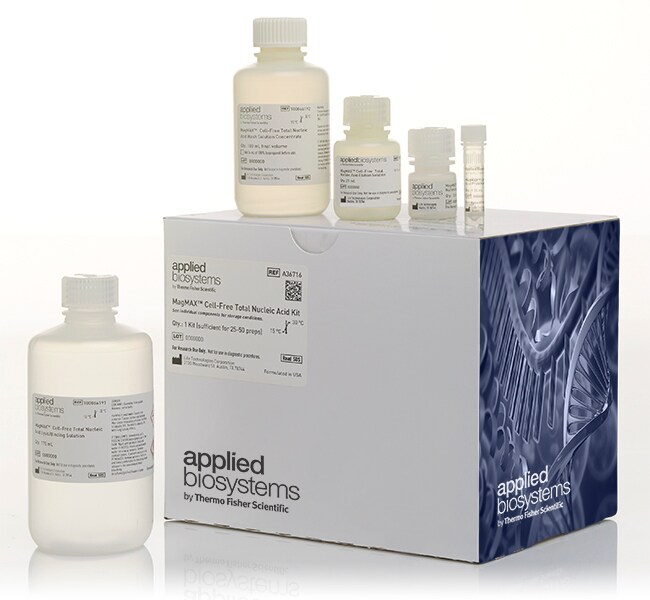
MagMAX™ 无细胞总核酸分离试剂盒
MagMAX 无细胞总核酸分离试剂盒设计用于富集无细胞生物样品(如血浆)中存在的核酸物种。该试剂盒采用 MagMAX 磁珠技术,可确保以可重现的方式回收适用于多种应用(包括实时荧光定量 PCR、数字了解更多信息
| 货号 | 数量 |
|---|---|
| A36716 | 1 kit |
货号 A36716
价格(CNY)
5,975.00
飞享价
Ends: 31-Dec-2026
7,656.00共减 1,681.00 (22%)
Each
数量:
1 kit
价格(CNY)
5,975.00
飞享价
Ends: 31-Dec-2026
7,656.00共减 1,681.00 (22%)
Each
MagMAX 无细胞总核酸分离试剂盒设计用于富集无细胞生物样品(如血浆)中存在的核酸物种。该试剂盒采用 MagMAX 磁珠技术,可确保以可重现的方式回收适用于多种应用(包括实时荧光定量 PCR、数字 PCR 和下一代测序)的高质量核酸。
磁珠法纯化形式可让您轻松处理多种样品起始量体积(1 mL 至 6 mL)。当与 KingFisher Duo Prime 或 KingFisher Flex 磁粒子处理器配合使用时,可以一次从 2 mL 起始体积中分离出 6 至 24 份血浆样品。或者,可以使用磁力架手动处理样品。
MagMAX 无细胞总核酸分离试剂盒的特点包括:
•自动化,无苯酚提取
• 快速程序,允许与 KingFisher Duo Prime 或配有 24 孔深孔磁头的 KingFisher Flex 磁粒子处理器配合使用时在 90 分钟或更短时间内处理 6 至 24 份样品
•灵活方案,容纳范围为 1 L
至 6 mL 血浆的样品体积起始量
•无需载体 RNA
•洗脱体积范围为15 μL 至 60 μL
•与 Oncomine 肺 cfTNA 研究测定兼容
超越无细胞 DNA 并获得整体图像分离和分析血浆或者无细胞样品中的循环无细胞总核酸 (cfTNA) 可以作为一种非侵入性方法来检测和监测与某些疾病状态(如癌症)相关的靶标。
获得这一有价值信息的第一步是有效的核酸分离,其可专门回收含有疾病状态相关信息的循环核酸物质。无细胞 DNA (cfDNA) 的重要性正在确立,但它可能不能分辨整体情况。无细胞 RNA (cfRNA) 序列作为关键生物标志物以及 microRNA 和基因融合形式。cfRNA 与 cfDNA 的这种结合为研究人员扩大研究和促进人类健康提供了机会。
MagMAX 无细胞总核酸试剂盒由同一位 Thermo Fisher Scientific 科学家开发,为您提供 MagMAX 无细胞 DNA 分离试剂盒。差异为洗脱液中包含所有 cfRNA 物种,使您可以从单个无细胞样品中获得更多信息。与 cfDNA 分离试剂盒一样,cfTNA 试剂盒设计用于从较宽的样品体积起始量在 1 至 6 mL 范围内手动和自动分离核酸。无苯酚、磁珠形式使该试剂盒完全适合用于自动分离。
可扩展格式允许各种样品起始量,因此可以更改使用单一试剂盒处理的样品数量。例如,提供足够的试剂用于处理各含 2 mL 血浆的 50 份样品。或者,使用相同的试剂盒可分别处理各含 4 mL 血浆的 25 份样品。起始量更高和更低时,可以处理的样品数量也会相应变化。此独特的产品属性允许您根据特定需求定制产品
MagMAX 磁珠法纯化的优势
与其他分离核酸的技术相比,磁珠具备许多优势。与玻璃纤维过滤柱相比,磁珠可更高效地结合 DNA,从而获得更高且更一致的产量。此外,由于未使用过滤柱和真空歧管,不存在样品中的细胞颗粒堵塞过滤柱的风险。这种堵塞问题对于经常用于循环无细胞核酸研究的富含蛋白的大量样品(如血浆)特别严重。
磁珠法纯化形式可让您轻松处理多种样品起始量体积(1 mL 至 6 mL)。当与 KingFisher Duo Prime 或 KingFisher Flex 磁粒子处理器配合使用时,可以一次从 2 mL 起始体积中分离出 6 至 24 份血浆样品。或者,可以使用磁力架手动处理样品。
MagMAX 无细胞总核酸分离试剂盒的特点包括:
•自动化,无苯酚提取
• 快速程序,允许与 KingFisher Duo Prime 或配有 24 孔深孔磁头的 KingFisher Flex 磁粒子处理器配合使用时在 90 分钟或更短时间内处理 6 至 24 份样品
•灵活方案,容纳范围为 1 L
至 6 mL 血浆的样品体积起始量
•无需载体 RNA
•洗脱体积范围为15 μL 至 60 μL
•与 Oncomine 肺 cfTNA 研究测定兼容
超越无细胞 DNA 并获得整体图像分离和分析血浆或者无细胞样品中的循环无细胞总核酸 (cfTNA) 可以作为一种非侵入性方法来检测和监测与某些疾病状态(如癌症)相关的靶标。
获得这一有价值信息的第一步是有效的核酸分离,其可专门回收含有疾病状态相关信息的循环核酸物质。无细胞 DNA (cfDNA) 的重要性正在确立,但它可能不能分辨整体情况。无细胞 RNA (cfRNA) 序列作为关键生物标志物以及 microRNA 和基因融合形式。cfRNA 与 cfDNA 的这种结合为研究人员扩大研究和促进人类健康提供了机会。
MagMAX 无细胞总核酸试剂盒由同一位 Thermo Fisher Scientific 科学家开发,为您提供 MagMAX 无细胞 DNA 分离试剂盒。差异为洗脱液中包含所有 cfRNA 物种,使您可以从单个无细胞样品中获得更多信息。与 cfDNA 分离试剂盒一样,cfTNA 试剂盒设计用于从较宽的样品体积起始量在 1 至 6 mL 范围内手动和自动分离核酸。无苯酚、磁珠形式使该试剂盒完全适合用于自动分离。
可扩展格式允许各种样品起始量,因此可以更改使用单一试剂盒处理的样品数量。例如,提供足够的试剂用于处理各含 2 mL 血浆的 50 份样品。或者,使用相同的试剂盒可分别处理各含 4 mL 血浆的 25 份样品。起始量更高和更低时,可以处理的样品数量也会相应变化。此独特的产品属性允许您根据特定需求定制产品
MagMAX 磁珠法纯化的优势
与其他分离核酸的技术相比,磁珠具备许多优势。与玻璃纤维过滤柱相比,磁珠可更高效地结合 DNA,从而获得更高且更一致的产量。此外,由于未使用过滤柱和真空歧管,不存在样品中的细胞颗粒堵塞过滤柱的风险。这种堵塞问题对于经常用于循环无细胞核酸研究的富含蛋白的大量样品(如血浆)特别严重。
仅供科研使用。不可用于诊断程序。
规格
适用于(应用)下一代测序,实时荧光定量 PCR
高通量能力高通量兼容性、手动方案、自动方案
产品线MagMAX
产品类型总核酸分离试剂盒
数量1 kit
样品类型血浆
运输条件室温
测试时间90 min
产品规格试剂盒
分离技术磁珠
Unit SizeEach
内容与储存
• 175 mL MagMAX 无细胞总核酸裂解/结合溶液
•100 mL(最终体积)MagMAX 无细胞总核酸洗涤液浓缩液
• 21 mL MagMAX 无细胞总核酸洗脱溶液
• 3.5 mL MagMAX 无细胞总核酸磁珠
• 1.5 mL MagMAX 无细胞总核酸蛋白酶 K
•100 mL(最终体积)MagMAX 无细胞总核酸洗涤液浓缩液
• 21 mL MagMAX 无细胞总核酸洗脱溶液
• 3.5 mL MagMAX 无细胞总核酸磁珠
• 1.5 mL MagMAX 无细胞总核酸蛋白酶 K