Search


引用和文献 (19)
Invitrogen™
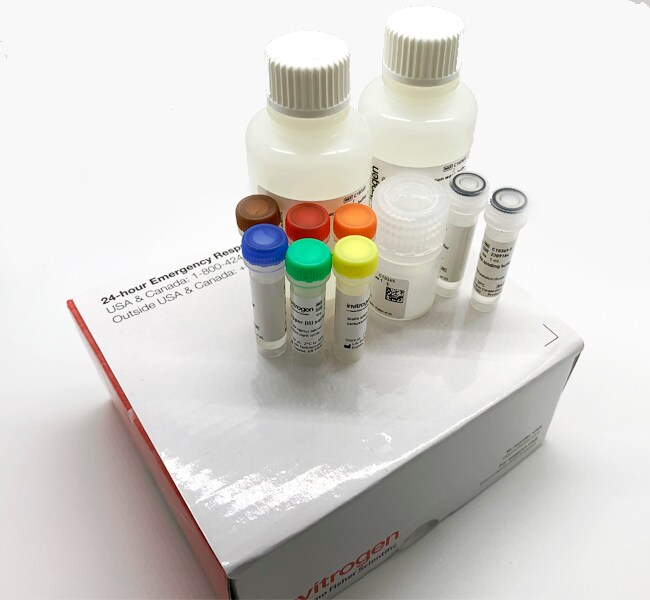
Click-iT™ Nascent RNA Capture Kit, for gene expression analysis
Click-iT™新生RNA捕获试剂盒,采用我们专利的Click-iT™化学技术可高效、高灵敏度地捕捉新生RNA。Click-iT方法可在进行基因调控的高分辨率分析的同时进行RNA调控、RNA稳定性、RNA合成、RNA衰变与降解、转录调控、delta⁄delta C、核run了解更多信息
| 货号 | 数量 |
|---|---|
| C10365 | 1 kit |
货号 C10365
价格(CNY)
9,232.00
Each
数量:
1 kit
价格(CNY)
9,232.00
Each
Click-iT™新生RNA捕获试剂盒,采用我们专利的Click-iT™化学技术可高效、高灵敏度地捕捉新生RNA。Click-iT方法可在进行基因调控的高分辨率分析的同时进行RNA调控、RNA稳定性、RNA合成、RNA衰变与降解、转录调控、delta⁄delta C、核run on⁄run off等许多分析。将含有一个炔烃反应基团的乙基尿嘧啶(EU)核糖核苷酸类似物导入细胞或者组织中。一旦掺入后,将细胞裂解、提取RNA。炔烃反应基团与生物素修饰的叠氮发生Click反应,随后用链霉亲和素磁珠来捕获新生成的RNA产物。捕获的RNA被扩增,其反转录生成的cDNA可用来做捕获后的各种分析研究。我们用它做了微阵(包括高密度和低密度的)、SOLiD™测序、SYBR™ 或TaqMan™荧光定量PCR的delta CT等的验证。仅需1000个细胞的样品即可用于新生转录产物的分析。此试剂盒包含可完成40个标记与捕获所需的试剂量,其可用来做400个独立的分析检测。就总价位来看,本试剂盒特别适于学校与工业的研究者使用。
EU试剂,在推荐的200 μM浓度 ,可以被细胞很好地耐受。在对超过32,000基因进行的微阵分析中,我们能够只检测与对照组相对比的12个中最微小的变化。此外,在将EU的起始添加浓度增加为5倍推荐浓度后(200 μM 变成 1.0 mM),细胞的一组看家基因及正常增殖能力和均未受到影响。其灵敏度和可靠性经低密度凋亡基因微阵分析(TLDA™)确定。在捕获的新生产物中,准确的检测到了所有已被验证的细胞凋亡(叉抱素诱导的)转录产物,并且其序列信息与之前报道的结果无偏差。
*不是重复而是重新发现。* 在最近几十年的人类基因组研究中,仅有2%的人类编码基因获得解析,余下的98%人类基因组仍处于未知状态。在对如此庞大数目的未知序列的用途与表达模式进行研究时,这种新方法对近十年这种转录组学的研究将会有显著的帮助作用。
*研究RNA稳定性的能力。* 与其他方法相对比,本方法的最突出特点是在对mRNA的稳定性进行研究时无需使用放射性物质。在以前,传统的核run and run off实验中,有大约一半的转录本被放射性核苷酸所破坏。这种使用放射性物质的方法既繁琐又危险,越来越少地被采用。如今,通过新方法这些极其重要的评估可以简单、安全而又准确的获得。
*想知道什么是最新的?*与Click-iT系列的代谢类似物结合来标记新的材料!没有放射性或使用半抗原的困难。查找DNA、RNA、蛋白、糖类、翻译后修饰等更多的新内容。
*Click-iT™技术——一种反应,无限可能!*
EU试剂,在推荐的200 μM浓度 ,可以被细胞很好地耐受。在对超过32,000基因进行的微阵分析中,我们能够只检测与对照组相对比的12个中最微小的变化。此外,在将EU的起始添加浓度增加为5倍推荐浓度后(200 μM 变成 1.0 mM),细胞的一组看家基因及正常增殖能力和均未受到影响。其灵敏度和可靠性经低密度凋亡基因微阵分析(TLDA™)确定。在捕获的新生产物中,准确的检测到了所有已被验证的细胞凋亡(叉抱素诱导的)转录产物,并且其序列信息与之前报道的结果无偏差。
*不是重复而是重新发现。* 在最近几十年的人类基因组研究中,仅有2%的人类编码基因获得解析,余下的98%人类基因组仍处于未知状态。在对如此庞大数目的未知序列的用途与表达模式进行研究时,这种新方法对近十年这种转录组学的研究将会有显著的帮助作用。
*研究RNA稳定性的能力。* 与其他方法相对比,本方法的最突出特点是在对mRNA的稳定性进行研究时无需使用放射性物质。在以前,传统的核run and run off实验中,有大约一半的转录本被放射性核苷酸所破坏。这种使用放射性物质的方法既繁琐又危险,越来越少地被采用。如今,通过新方法这些极其重要的评估可以简单、安全而又准确的获得。
*想知道什么是最新的?*与Click-iT系列的代谢类似物结合来标记新的材料!没有放射性或使用半抗原的困难。查找DNA、RNA、蛋白、糖类、翻译后修饰等更多的新内容。
*Click-iT™技术——一种反应,无限可能!*
仅供科研使用。不可用于诊断程序。
规格
最大浓度2X (EU Buffer & RNA Binding Buffer)
适用于(设备)7000 System, 7200 System, 7300 System, 7500 Fast System, 7500 System, 7900HT Fast System, 7900HT System, StepOne™, Fast Mode, StepOne™, Standard Mode, StepOnePlus™, Fast Mode, StepOnePlus™, Standard Mode, Veriti Thermal Cycler, Agilent 2100 Bioanalyzer, SOLiD™
分离技术Magnetic Bead
产品线Click-iT
产品类型Nascent RNA Capture Kit
数量1 kit
运输条件Wet Ice
产品规格Kit
Unit SizeEach
内容与储存
Component A
1 X 5 mg 5-ethynyl uridine (EU)
Component B
1 X1 ml Click-iT™ EU buffer *2X concentrate*
Component C
1 X 340 μg biotin azide (PEG4 carboxamide-6-azidohexanyl biotin)
Component D
1 X 200 μl copper (II) sulfate (CuSO4) *25mM aqueous solution*
Component E
1 X 400 mg Click-iT™ reaction buffer additive 1
Component F
1 X 100 μl Click-iT™ reaction buffer additive 2
Component G
2 X 1 ml Click-iT™ RNA binding buffer *2X concentrate*
Component H
1 X 500 μl Dynabeads™ MyOne™ Streptavidin T1
Component I
1 X 35 ml Click-iT™ reaction wash buffer 1
Component J
1 X 35 ml Click-iT™ reaction wash buffer 2
Store at 4 degrees C
1 X 5 mg 5-ethynyl uridine (EU)
Component B
1 X1 ml Click-iT™ EU buffer *2X concentrate*
Component C
1 X 340 μg biotin azide (PEG4 carboxamide-6-azidohexanyl biotin)
Component D
1 X 200 μl copper (II) sulfate (CuSO4) *25mM aqueous solution*
Component E
1 X 400 mg Click-iT™ reaction buffer additive 1
Component F
1 X 100 μl Click-iT™ reaction buffer additive 2
Component G
2 X 1 ml Click-iT™ RNA binding buffer *2X concentrate*
Component H
1 X 500 μl Dynabeads™ MyOne™ Streptavidin T1
Component I
1 X 35 ml Click-iT™ reaction wash buffer 1
Component J
1 X 35 ml Click-iT™ reaction wash buffer 2
Store at 4 degrees C
常见问题解答 (FAQ)
What are the main characteristics of a Click-iT reaction?
Can the Click-iT Nascent RNA Capture Kit, for gene expression analysis (Cat. No. C10365) be used in downstream next-generation sequencing (NGS) applications?
引用和文献 (19)
引用和文献
Abstract
EU-RNA-seq for in vivo labeling and high throughput sequencing of nascent transcripts.
Journal:STAR protocols
PubMed ID:34485932
The protocol allows for labeling nascent RNA without isolating nuclei. The cell-permeable uridine analog, 5-ethynyluridine (EU), is added to media to allow in vivo labeling of nascent transcripts. Cells are lysed, total RNA is collected, and biotin is conjugated to EU-labeled RNAs. Custom biotin RNAs are added and biotinylated RNAs
METTL14 is a chromatin regulator independent of its RNA N6-methyladenosine methyltransferase activity.
Journal:Protein & cell
PubMed ID:37030005
METTL3 and METTL14 are two components that form the core heterodimer of the main RNA m6A methyltransferase complex (MTC) that installs m6A. Surprisingly, depletion of METTL3 or METTL14 displayed distinct effects on stemness maintenance of mouse embryonic stem cell (mESC). While comparable global hypo-methylation in RNA m6A was observed in
Tudor domain containing 7 (Tdrd7) is essential for dynamic ribonucleoprotein (RNP) remodeling of chromatoid bodies during spermatogenesis.
Journal:Proc Natl Acad Sci U S A
PubMed ID:21670278
'In the male germline in mammals, chromatoid bodies, a specialized assembly of cytoplasmic ribonucleoprotein (RNP), are structurally evident during meiosis and haploidgenesis, but their developmental origin and regulation remain elusive. The tudor domain containing proteins constitute a conserved class of chromatoid body components. We show that tudor domain containing 7
The repression domain of the E1B 55-kilodalton protein participates in countering interferon-induced inhibition of adenovirus replication.
Journal:J Virol
PubMed ID:23388716
'To begin to investigate the mechanism by which the human adenovirus type 5 E1B 55-kDa protein protects against the antiviral effects of type 1 interferon (IFN) (J. S. Chahal, J. Qi, and S. J. Flint, PLoS Pathog. 8:e1002853, 2012 [doi:10.1371/journal.ppat.1002853]), we examined the effects of precise amino acid substitution in
NEAT1 long noncoding RNA regulates transcription via protein sequestration within subnuclear bodies.
Journal:
PubMed ID:24173718
Paraspeckles are subnuclear structures formed around nuclear paraspeckle assembly transcript 1 (NEAT1)/MENe/ß long noncoding RNA (lncRNA). Here we show that paraspeckles become dramatically enlarged after proteasome inhibition. This enlargement is mainly caused by NEAT1 transcriptional up-regulation rather than accumulation of undegraded paraspeckle proteins. Of interest, however, using immuno-electron microscopy, we