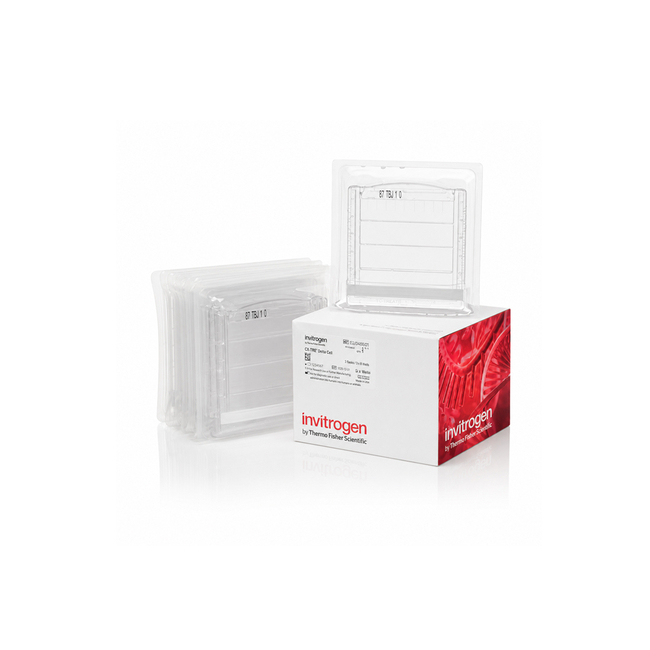
DNA Retardation Gels (6%), 1.0 mm
Product Image
Invitrogen™

DNA Retardation Gels (6%), 1.0 mm

Novex™ DNA Retardation Gels are 6% polyacrylamide prepared with 0.5X TBE gel buffer, providing clear resolution of fragments used for DNA retardation assays from 60–2500 bp.
Have Questions?
更改视图buttonViewtableView
货号
EC63652BOX12孔
EC6365BOX10孔
EC63655BOX15孔
货号 EC63652BOX
价格(CNY)
1,795.00
飞享价
Ends: 31-Dec-2025
2,138.00
共减 343.00 (16%)
Each
添加至购物车
孔:
12孔
请求批量或定制报价
价格(CNY)
1,795.00
飞享价
Ends: 31-Dec-2025
2,138.00
共减 343.00 (16%)
Each
添加至购物车
Novex™ DNA Retardation Gels are 6% polyacrylamide prepared with 0.5X TBE gel buffer, providing clear resolution of fragments used for DNA retardation assays from 60–2500 bp. This preparation is good for electrophoretic separation, yet low enough to promote DNA-protein interactions. Novex DNA Retardation Gels are designed to run on the XCell SureLock™ Mini-Cell and are available in 10-, 12-, or 15-well formats.

• DNA fragments ranging from 60-2,500 bp
• Prepared with 0.5X TBE as gel buffer
• Designed to run on the XCell SureLock Mini-Cell
• Available in 10, 12, and 15 well formats
• Manufactured with high-purity tris base, boric acid, EDTA, acrylamide, bisacrylamide, TEMED, and APS

To ensure best possible results, these gels are single use and individually wrapped. Detection is performed with ethidium bromide staining of DNA or, for greater sensitivity, with radiolabeling the DNA or protein.

Formulation
Novex DNA Retardation Gels are manufactured with high-purity tris base, boric acid, EDTA, acrylamide, bisacrylamide, TEMED, and APS

Recommended buffers
For optimum performance, Novex™ TBE Running Buffer and Novex™ Hi-Density TBE Sample Buffer are strongly recommended for use with these gels. Novex Hi-Density TBE Sample Buffer contains the tracking dyes Bromophenol Blue and Xylene Cyanol as well as the density agent Ficoll™, which yields sharper and straighter bands than conventional density agents.

For Research Use Only. Not for use in diagnostic procedures.
规格
描述DNA Retardation Gels, 12-well
凝胶厚度1 mm
产品类型DNA 阻滞凝胶
数量10 块凝胶/盒
样品缓冲液类型TBE Hi-Density Sample Buffer (5X)
样品类型Double-stranded DNA (dsDNA)
运输条件湿冰
适用于(设备)XCell SureLock Mini-Cell
凝胶百分比6%
凝胶类型DNA 阻滞
分离范围10 bp 至 3 kb
12孔
Unit SizeEach
内容与储存
• 货号是指一盒10块凝胶

在 4°C 下储存。

常见问题解答 (FAQ)

什么是凝胶迁移实验(shift assay)?什么是超迁移实验(supershift assay)?

凝胶迁移实验是一种使用非变性PAGE测定DNA结合的实验。它提供了一种简单、快速并且非常灵敏的检测序列特异性DNA结合蛋白的方法。蛋白与末端标记的DNA片段结合形成一个独立的蛋白-DNA复合物。你可以用此方法检测纯化蛋白或粗提取物中的未知因子与DNA的结合。该方法也可以实现对DNA结合蛋白的亲和性、丰度、结合速率常数、解离速率常数,以及结合特异性进行定量分析。

超迁移实验是凝胶迁移DNA结合实验的一种变形,它使用抗体检测蛋白-DNA复合体中的蛋白。向一个结合反应内加入一种特异性抗体可能会产生下面几种效应。如果被抗体识别的蛋白与复合体的形成无关,那么加入抗体应当对电泳没有任何影响。如果形成复合体的蛋白被抗体识别,那么该抗体或者将阻止复合体的形成,或者将形成一个抗体-蛋白-DNA三元复合物,从而导致蛋白-DNA复合体迁移率的进一步下降(超迁移)。在蛋白结合DNA前还是结合后加入抗体,结果可能会不同(特别是当抗原表位是在蛋白与DNA结合区域时)。

Invitrogen 6% TBE凝胶和Invitrogen 6% DNA阻滞凝胶的成分有什么区别?

Invitrogen 6% DNA阻滞凝胶包含0.5X TBE。两种凝胶均能用于凝胶阻滞实验;但是,Invitrogen 6% TBE凝胶内的1X TBE有更高的离子环境,可能会影响DNA-蛋白相互作用。Invitrogen 6% DNA阻滞凝胶内的0.5X TBE通常效果更好,因为它在电泳中有较高的片段分离效果而且其离子强度较低,可以促进DNA-蛋白相互作用。

What is a shift assay? What is a supershift assay?

A shift assay is a DNA-binding assay using nondenaturing PAGE. It provides a simple, rapid, and extremely sensitive method for detecting sequence-specific DNA-binding proteins. Proteins bind specifically to an end-labeled DNA fragment corresponding to the individual protein-DNA complexes. You can use the assay to test binding of purified proteins or of uncharacterized factors in crude extracts. This assay also permits quantitative determination of the affinity, abundance, association rate constants, dissociation rate constants, and binding specificity of DNA-binding proteins.

A supershift assay is a variation of the mobility shift DNA-binding assay that uses antibodies to identify proteins present in the protein-DNA complex.Addition of a specific antibody to a binding reaction can have one of several effects. If the protein recognized by the antibody is not involved in complex formation, addition of the antibody should have no effect. If the protein that forms the complex is recognized by the antibody, the antibody can either block complex formation or it can form an antibody-protein-DNA ternary complex and thereby specifically result in a further reduction in the mobility of the protein-DNA complex (a supershift). Results may be different depending upon whether the antibody is added before or after the protein binds DNA (particularly if there are epitopes on the DNA binding surface of the protein).

Find additional tips, troubleshooting help, and resources within our Nucleic Acid Purification and Analysis Support Center.

What is the difference in composition between the Invitrogen 6% TBE Gels and the Invitrogen 6% DNA Retardation Gels?

The Invitrogen 6% DNA Retardation Gels contain 0.5X TBE. Both gels will work for gel retardation; however, the 1X TBE in the Invitrogen 6% TBE Gels have a higher ionic environment, which may affect DNA-protein interactions. The 0.5X TBE used in the Invitrogen 6% DNA Retardation Gels usually works better, as it offers good fragment separation in electrophoresis yet has an ionic strength low enough to promote DNA-protein interactions.

Find additional tips, troubleshooting help, and resources within our Nucleic Acid Purification and Analysis Support Center.

What's the difference in composition between the 6% TBE gels and the 6% DNA retardation gels?

The 6% DNA retardation gels are 0.5X TBE. Both gels will work for gel mobility shift assays, but the 1X TBE has a higher ionic environment that may affect DNA/protein interactions. 0.5X TBE usually works better.

Find additional tips, troubleshooting help, and resources within our Nucleic Acid Purification and Analysis Support Center.