Search


Citations & References (2)
Invitrogen™
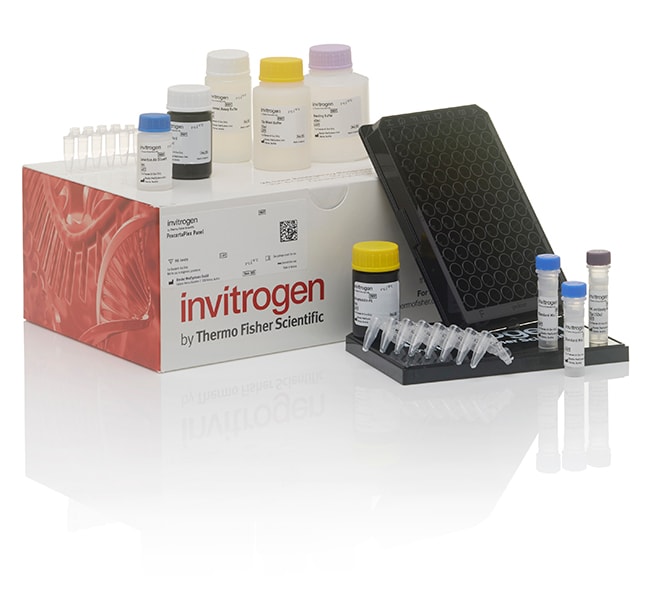
ProcartaPlex™ Human MMP Panel 2, 3plex
The ProcartaPlex Human MMP Panel 2 3plex enables researchers to explore inflammation and tissue repair by analyzing 3 protein targets: MMP-2, MMP-3, and MMP-9 using Luminex xMAP technology.
| Catalog Number | Quantity |
|---|---|
| EPX03A-10829-901 | 96 Tests |
Catalog number EPX03A-10829-901
Price (CNY)
-
Quantity:
96 Tests
The ProcartaPlex Human MMP Panel 2 3plex enables researchers to explore inflammation and tissue repair by analyzing 3 protein targets: MMP-2, MMP-3, and MMP-9 using Luminex xMAP technology. Simultaneous detection of these targets can help explore physiological processes such as reproduction or any other benign or malignant tissue remodeling process.
ProcartaPlex Preconfigured panels are extensively tested for analyte combinability, interference, and cross-reactivity to provide the highest level of validation and precision. All ProcartaPlex panels are supplied with the necessary reagents to perform the assay.
Target list [bead region]: MMP-2 [18], MMP-3 [19], MMP-9 [20]
Recommended sample pre-dilution: Serum, Plasma: 1:100
About ProcartaPlex assays for the Luminex platform
ProcartaPlex immunoassays are based on the principles of a sandwich ELISA, using two highly specific antibodies binding to different epitopes of one protein to quantitate all protein targets simultaneously using a Luminex instrument. ProcartaPlex multiplex assays require as little as 25 μL of plasma or serum, or 50 μL of cell culture supernatant, and just four hours to obtain analyzed results.
- Reproducible, reliable results—validated as a panel to the highest industry standard, including protein target combinability and cross-reactivity testing
- More results per sample—measure multiple protein targets simultaneously in a single 25–50 μL sample
- Well-established Luminex technology—highly referenced multiplexing platform for protein detection and quantitation
ProcartaPlex assays utilize Luminex xMAP (multianalyte profiling) technology for the simultaneous detection and quantitation of up to 80 protein targets in a single 25–50 μL sample—from plasma, serum, cell culture supernatants, and other bodily fluids.
The Luminex beads in the ProcartaPlex assay are internally dyed with precise proportions of red and infrared fluorophores to create spectrally unique signatures that can be identified by the Luminex xMAP detection systems (e.g., Luminex 200, FLEXMAP 3D, and MAGPIX). Similar to a sandwich ELISA, the ProcartaPlex assay uses matched antibody pairs to identify the protein of interest. In a multiplexed assay, each spectrally unique bead is labeled with antibodies specific for a single target protein, and bound proteins are identified with biotinylated antibodies and streptavidin–R-phycoerythrin (RPE). The conjugation of protein-specific antibodies to a distinct bead allows for analysis of multiple targets in a single well.
The most significant difference between a ProcartaPlex assay and ELISA is that the capture antibody in the ProcartaPlex assay is conjugated to a bead and not adsorbed to the microplate well, so the ProcartaPlex assay reagents are free-floating in the solution. For detection, the Luminex 200 instrument, for example, contains two lasers, one to distinguish the spectral signature of each bead and the second to quantify the amount of RPE fluorescence, which is proportional to the amount of protein present in the sample. ProcartaPlex multiplex assays can profile more target proteins using significantly less sample in the same time that it takes to perform a traditional sandwich ELISA.
For Research Use Only. Not for use in diagnostic procedures.
Specifications
Assay RangeSee Certificate of Analysis
Assay SensitivitySee Certificate of Analysis
Detection MethodFluorescence
For Use With (Equipment)Luminex™ Instruments
FormatMultiplex Kit
Product LineProcartaPlex
Sample TypeSerum, Plasma, Cell Culture Supernatants
Sample VolumeSerum, Plasma: 25 μL, CCS: 50 μL
Shipping ConditionWet Ice
CombinabilityNon-Combinable
Product TypeMultiplex Panel
Quantity96 Tests
Research AreaImmunology
SpeciesHuman
Unit SizeEach
Contents & Storage
• 2 vials Human Standard Mix MMP (lyophilized)
• 1 vial Capture Bead Mix (1X)
• 1 vial Biotinylated Detection Antibody Mix (50X)
• 1 Bottle Detection Antibody Diluent (1X)
• 1 Bottle Reading Buffer (1X)
• 1 Bottle Streptavidin-PE (1X)
• 1 Bottle Universal Assay Buffer (10X)
• 1 Bottle Wash Buffer (10X)
• 8-tube strip
• Adhesive film
• Flat-bottom 96-well plate, black
Store at 2°C to 8°C
Frequently asked questions (FAQs)
Do you offer a Mac-compatible version of the ProcartaPlex Analyst Software?
Do you offer FlowCytomix assays?
How long does it take to acquire ProcartaPlex assay data on the different Luminex instruments?
Is the sensitivity value for a Multiplex ProcartaPlex assay different when compared to the sensitivity for those same analytes assayed as Simplex assays?
Why does the ProcartaPlex ULOQ (Upper Limit of Quantitation) and LLOQ (Lower Limit of Quantitation) change between different lots of standards?
Citations & References (2)
Citations & References
Abstract
On the prospect of serum exosomal miRNA profiling and protein biomarkers for the diagnosis of ascending aortic dilatation in patients with bicuspid and tricuspid aortic valve.
Journal:Int J Cardiol
PubMed ID:30297190
To determine the impact of circulating miRNA and protein activity on the severity of ascending aortic dilatation in patients with bicuspid (BAV) and tricuspid aortic valve (TAV).
Effect of omalizumab on bronchoalveolar lavage matrix metalloproteinases in severe allergic asthma.
Journal:J Asthma
PubMed ID:33764254
Airway inflammation in asthma is accompanied by reconstruction of the bronchial wall extracellular matrix that most likely occurs with a contribution of matrix metalloproteinases (MMPs). Recently we have reported that omalizumab may decrease reticular basement membrane (RBM) thickness together with fibronectin deposits in asthmatic airways, although mechanisms involved are unknown.