Search


引用和文献 (23)
Invitrogen™
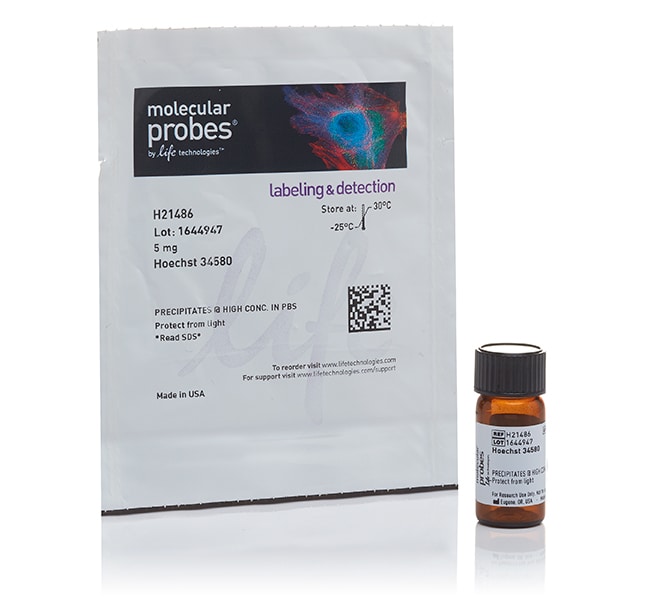
Hoechst 34580
这种双苯甲亚胺染料 Hoechst 34580 与重要的小沟结合性 dsDNA 选择性染料 Hoechst 33258 以及 Hoechst了解更多信息
| 货号 | 数量 |
|---|---|
| H21486 | 5 mg |
货号 H21486
价格(CNY)
2,911.00
飞享价
Ends: 31-Dec-2026
3,868.00共减 957.00 (25%)
Each
数量:
5 mg
价格(CNY)
2,911.00
飞享价
Ends: 31-Dec-2026
3,868.00共减 957.00 (25%)
Each
这种双苯甲亚胺染料 Hoechst 34580 与重要的小沟结合性 dsDNA 选择性染料 Hoechst 33258 以及 Hoechst 33342 有关。Hoechst 34580 与核酸结合后具有比其他 Hoechst 染料更长的波长光谱 [Howard Shapiro,个人通信]。
仅供科研使用。不可用于诊断程序。
规格
检测方法荧光
染料类型Hoechst 34580
激发波长范围392⁄440
适用于(设备)荧光显微镜
形式固体
产品规格管
数量5 mg
运输条件室温
溶解度水、DMF 或 DMSO(二甲基亚砜)
产品类型核酸染色剂
亚细胞定位细胞核,核酸, Nucleus
Unit SizeEach
内容与储存
包含1瓶 Hoechst 34580 (5 mg)。
在 -25°C 冷冻冰箱中避光储存。
在 -25°C 冷冻冰箱中避光储存。
常见问题解答 (FAQ)
DAPI和Hoechst 染料非常相似,该如何选用?
Is DAPI a good live-cell nuclear label?
I want to label the nuclei of live cells and track them over time. Can I use DAPI for this?
DAPI and Hoechst dyes are quite similar to each other. Why would I choose one over the other?
引用和文献 (23)
引用和文献
Abstract
The inflammatory mediator leukotriene D4 induces beta-catenin signaling and its association with antiapoptotic Bcl-2 in intestinal epithelial cells.
Journal:J Biol Chem
PubMed ID:16407243
'Increased levels of the inflammatory mediator leukotriene D4 (LTD4) are present at sites of inflammatory bowel disease, and such areas also exhibit an increased risk for subsequent cancer development. It is known that LTD4 affects the expression of many proteins that influence survival and proliferation of intestinal epithelial cells. We
ATP-dependent interaction of the cytosolic domains of the inwardly rectifying K+ channel Kir6.2 revealed by fluorescence resonance energy transfer.
Journal:Proc Natl Acad Sci U S A
PubMed ID:14681552
'ATP-sensitive K(+) (K(ATP)) channels play important roles in the regulation of membrane excitability in many cell types. ATP inhibits channel activity by binding to a specific site formed by the N and C termini of the pore-forming subunit, Kir6.2, but the structural changes associated with this interaction remain unclear. Here,
Nucleic acid binding agents exert local toxic effects on neurites via a non-nuclear mechanism.
Journal:J Neurochem
PubMed ID:16441515
'The mechanism by which drugs that target nucleic acids cause neurotoxicity is not well described. We characterized the neurotoxicity of Hoechst 33342 (bis-benzimide), a common cell permeable nuclear dye, in primary neuronal cultures. The mechanism of cell death was not apoptotic, as death is rapid, not accompanied by typical nuclear
Real-time multiple particle tracking of gene nanocarriers in complex biological environments.
Journal:Methods Mol Biol
PubMed ID:18470640
'Complex biological fluids, such as the vast and molecularly crowded cell cytoplasm and the highly viscoelastic mucus that protects many entry ways to the body, pose significant barriers to efficient gene delivery. Understanding the dynamics of gene carriers in such environments allows insight that leads to rational improvements in gene
Isolation, structure elucidation and cytotoxic evaluation of endiandrin B from the Australian rainforest plant Endiandra anthropophagorum.
Journal:Bioorg Med Chem
PubMed ID:19138858
Chemical investigations of the DCM extract from the roots of Endiandra anthropophagorum resulted in the isolation of a new cyclobutane lignan endiandrin B (1), together with the known natural products, endiandrin A (2), and (-)-dihydroguaiaretic acid (3). The structure of 1 was determined by extensive spectroscopic analyses, and confirmed by