Search


引用和文献 (6)
Invitrogen™
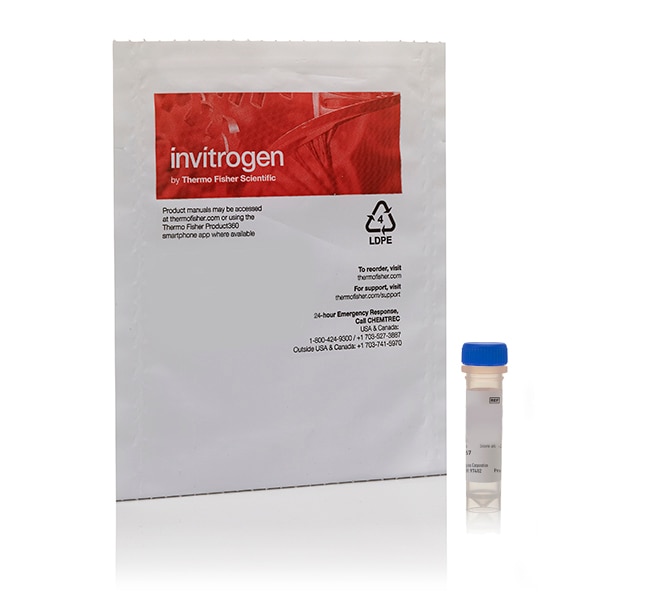
Image-IT™ DEAD Green™ 活力染色剂
Image-iT DEAD Green viability stain is a fast, sensitive and easy-to-use viability indicator that is also amenable to fixation and了解更多信息
| 货号 | 数量 |
|---|---|
| I10291 | 1 Vial |
货号 I10291
价格(CNY)
6,026.00
Each
数量:
1 Vial
价格(CNY)
6,026.00
Each
Image-iT DEAD Green viability stain is a fast, sensitive and easy-to-use viability indicator that is also amenable to fixation and permeabilization, thus allowing for multiplexing with other biomarkers of cytotoxicity. Image-iT DEAD Green is an impermeant dye to healthy cells that becomes permeant when the plasma membrane of cells is compromised.
Visualize staining your cell without wasting your reagents, antibodies, or time with our new Stain-iT Cell Staining Simulator.
Visualize staining your cell without wasting your reagents, antibodies, or time with our new Stain-iT Cell Staining Simulator.
仅供科研使用。不可用于诊断程序。
规格
最大浓度1 mM
检测方法荧光
形式液体
数量1 Vial
运输条件湿冰
子细胞定位细胞核/核仁
颜色绿色
发射波长范围可见光
适用于(应用)活力测定试剂盒
适用于(设备)荧光显微镜
产品线Image-iT、Molecular Probes
产品类型细胞活力染色剂
Unit SizeEach
内容与储存
该染色剂包含足够的材料,能够测定96孔板规格和 50 μL 孔体积的10块板。在 ≤ −20°C 下干燥、避光储存。
常见问题解答 (FAQ)
哪一种细胞活力试剂盒兼容固定?
Do you offer a cell viability stain compatible with fixation?
Which cell viability kits are compatible with fixation?
引用和文献 (6)
引用和文献
Abstract
Global metabolic profiling of infection by an oncogenic virus: KSHV induces and requires lipogenesis for survival of latent infection.
Journal:PLoS Pathog
PubMed ID:22916018
Like cancer cells, virally infected cells have dramatically altered metabolic requirements. We analyzed global metabolic changes induced by latent infection with an oncogenic virus, Kaposi's Sarcoma-associated herpesvirus (KSHV). KSHV is the etiologic agent of Kaposi's Sarcoma (KS), the most common tumor of AIDS patients. Approximately one-third of the nearly 200
Antibody-targeted nanovectors for the treatment of brain cancers.
Journal:ACS Nano
PubMed ID:22390360
Introduced here is the hydrophilic carbon clusters (HCCs) antibody drug enhancement system (HADES), a methodology for cell-specific drug delivery. Antigen-targeted, drug-delivering nanovectors are manufactured by combining specific antibodies with drug-loaded poly(ethylene glycol)-HCCs (PEG-HCCs). We show that HADES is highly modular, as both the drug and antibody component can be varied
Analysis of cell cycle and replication of mouse macrophages after in vivo and in vitro Cryptococcus neoformans infection using laser scanning cytometry.
Journal:Infect Immun
PubMed ID:22252872
We investigated the outcome of the interaction of Cryptococcus neoformans with murine macrophages using laser scanning cytometry (LSC). Previous results in our lab had shown that phagocytosis of C. neoformans promoted cell cycle progression. LSC allowed us to simultaneously measure the phagocytic index, macrophage DNA content, and 5-ethynyl-2'-deoxyuridine (EdU) incorporation
Induction of the Warburg effect by Kaposi's sarcoma herpesvirus is required for the maintenance of latently infected endothelial cells.
Journal:Proc Natl Acad Sci U S A
PubMed ID:20498071
Kaposi's sarcoma (KS) is the most commonly reported tumor in parts of Africa and is the most common tumor of AIDS patients world-wide. KS-associated herpesvirus (KSHV) is the etiologic agent of KS. Although KS tumors contain many cell types, the predominant cell is the spindle cell, a cell of endothelial
Miniaturized modular-array fluorescence microscopy.
Journal:Biomed Opt Express
PubMed ID:33408992