Search
Invitrogen
ITGB5 Recombinant Rabbit Monoclonal Antibody (PSH11-53)
{{$productOrderCtrl.translations['antibody.pdp.commerceCard.promotion.promotions']}}
{{$productOrderCtrl.translations['antibody.pdp.commerceCard.promotion.promocode']}}: {{promo.promoCode}} {{promo.promoTitle}} {{promo.promoDescription}}. {{$productOrderCtrl.translations['antibody.pdp.commerceCard.promotion.learnmore']}}
{{$ctrl.translations['antibody.pdp.skuNotes.additionalInformation']}}:
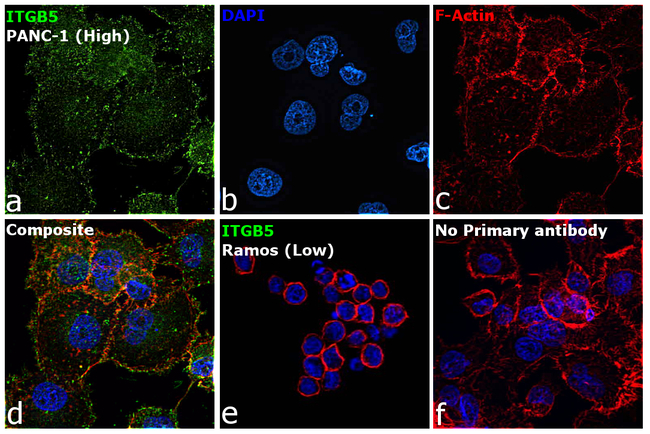
FIGURE: 1 / 7
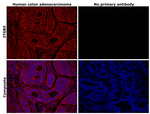
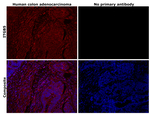
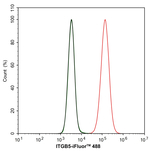
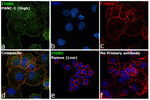
ITGB5 Antibody (MA562921) in ICC/IF
Immunofluorescence analysis of ITGB5 was performed using PANC-1 cells. The cells were fixed with 4% paraformaldehyde for 5 minutes, permeabilized with 0.1% Triton™ X-100 for 15 minutes and blocked with 2% BSA for 1 hour at room temperature. The cells were labeled with ITGB5 Recombinant Rabbit Monoclonal Antibody (PSH11-53) (Product # MA562921) at 1:100 in 0.1% BSA, incubated at 4 degree celsius overnight and then labeled with Donkey anti-Rabbit IgG (H+L) Highly Cross-Adsorbed Secondary Antibody, Alexa Fluor Plus 488 (Product # A32790, 1:2,... View More
Please note: We are reviewing Western blot images included in the antibody testing data in our catalog, including those provided by third parties. Unless expressly labeled or annotated as “raw-unedited”, Western blot images included in the antibody testing data in our catalog may have been edited, optimized or otherwise adjusted for presentation.


Product Details
MA562921
Applications
Tested Dilution
Publications
Product Specifications
Species Reactivity
Human
Host/Isotype
Rabbit
/ IgG
Expression System
HEK293 cells
Class
Recombinant Monoclonal
Type
Antibody
Clone
PSH11-53
Immunogen
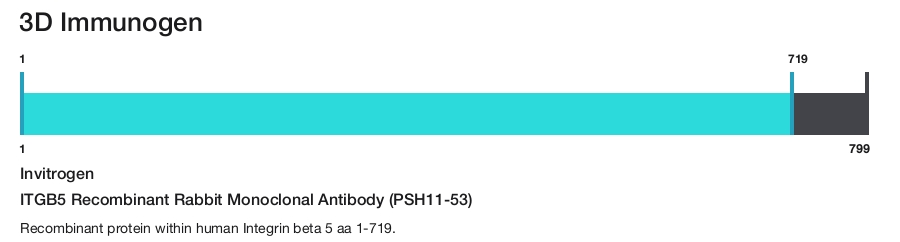
Recombinant protein within human Integrin beta 5 aa 1-719.
Conjugate
Unconjugated
Unconjugated
Unconjugated
Form
Liquid
Concentration
1 mg/mL
Amount
100 µg
Purification
Protein A
Storage buffer
PBS, pH 7.4, with 0.1% BSA, 40% glycerol
Contains
0.05% sodium azide
Storage conditions
Store at 4°C short term. For long term storage, store at -20°C, avoiding freeze/thaw cycles.
Shipping conditions
Ambient (domestic); Wet ice (international)
Product Specific Information
Positive Control: A549
Tissue Specificity: Low tissue specificity
Subcellular Location: Cell membrane.
Sequence Similarities: 91% Mouse,Rat
Predicted band size: 37 kDa.
Target Information
Integrins are important extracellular matrix (ECM) receptor proteins located on cell surfaces. They are hetrodimers composed of an alpha and a beta transmembrane glycoprotein subunit. Around 22 different integrins (different alpha/ beta subunit combinations) are found in nature. Integrins are generally present in high concentrations at the cell surface, but, unlike most other cell-surface receptors, they bind ligands with very low affinity. Due to their weak individual binding, integrins need to cluster and bind in-groups in order to effectively bind the ECM. Integrins bind many different ligands including laminin. Each integrin is made up of a large N-terminal extracellular domain that binds the ECM ligand and a small C-terminal cytoplasmic domain that mediates interaction with the actin cytoskeleton and signaling function.
For Research Use Only. Not for use in diagnostic procedures. Not for resale without express authorization.
References (0)
Have you cited this product in a publication?
Let us know so we can reference it here.
Bioinformatics
Protein Aliases: CD61; FLJ26658; GP3A; GPIIIa; integrin beta-5 subunit; integrin beta-5 subunit precursor; testis secretory sperm-binding protein Li 217p; unnamed protein product
UniProt ID: (Human) P18084
Entrez Gene ID: (Human) 3693
formation of primary germ layer
cell-matrix adhesion
transforming growth factor beta receptor signaling pathway
integrin-mediated signaling pathway
cell migration
cell adhesion mediated by integrin
wound healing, spreading of epidermal cells
endodermal cell differentiation
stress fiber assembly
epithelial cell-cell adhesion
cell-cell adhesion
Disclaimer

Clicking the images or links will redirect you to a website hosted by BenchSci that provides third-party scientific content. Neither the content nor the BenchSci technology and processes for selection have been evaluated by us; we are providing them as-is and without warranty of any kind, including for use or application of the Thermo Fisher Scientific products presented.

Performance Guarantee
If an Invitrogen™ antibody doesn't perform as described on our website or datasheet,we'll replace the product at no cost to you, or provide you with a credit for a future purchase.*
Learn more
We're here to help
Get expert recommendations for common problems or connect directly with an on staff expert for technical assistance related to applications, equipment and general product use.
Contact tech support