Search
Invitrogen
Diamides I Recombinant Mouse Monoclonal Antibody (1B3)
{{$productOrderCtrl.translations['antibody.pdp.commerceCard.promotion.promotions']}}
{{$productOrderCtrl.translations['antibody.pdp.commerceCard.promotion.promocode']}}: {{promo.promoCode}} {{promo.promoTitle}} {{promo.promoDescription}}. {{$productOrderCtrl.translations['antibody.pdp.commerceCard.promotion.learnmore']}}
{{$ctrl.translations['antibody.pdp.skuNotes.additionalInformation']}}:
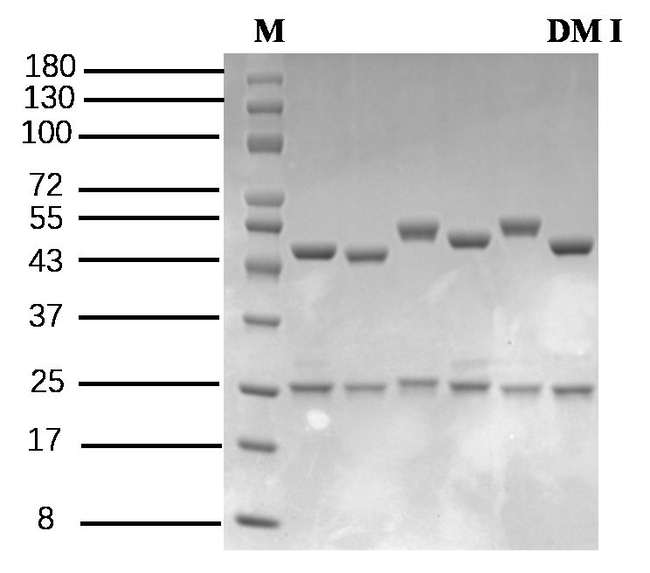
FIGURE: 1 / 1
Diamides I Antibody (MA566553) in SDS-PAGE
SDS-PAGE characterization of Diamides I under reducing conditions. Lane M: Protein marker (kDa); Lane DM I: Purified Diamides I Recombinant Monoclonal (Product # MA566553). Diamides I showing heavy chain (~50 kDa) and light chain (~25 kDa). Gels were stained with Coomassie Brilliant Blue R-526.
Please note: We are reviewing Western blot images included in the antibody testing data in our catalog, including those provided by third parties. Unless expressly labeled or annotated as “raw-unedited”, Western blot images included in the antibody testing data in our catalog may have been edited, optimized or otherwise adjusted for presentation.

Product Details
MA566553
Product Specifications
Species Reactivity
Chemical
Host/Isotype
Mouse
/ IgG
Expression System
CHO cells
Class
Recombinant Monoclonal
Type
Antibody
Clone
1B3
Immunogen
Conjugate of DM I hapten and KLH.
Conjugate
Unconjugated
Unconjugated
Unconjugated
Form
Liquid
Concentration
8.9 mg/mL
Amount
200 µg
Purification
Protein G
Storage buffer
PBS
Contains
0.09% sodium azide
Storage conditions
-20°C
Shipping conditions
Ambient (domestic); Wet ice (international)
RRID
Target Information
Diamides, specifically referring to diamide insecticides, belong to a class of agrochemicals that exert their effect by targeting the ryanodine receptors within insect muscles, leading to disruption of calcium ion flow and muscular paralysis. These compounds, such as chlorantraniliprole and flubendiamide, are highly effective against Lepidopteran pests, including caterpillars, which are major agricultural nuisances. Structurally, diamides are typically derivatives of anthranilic or phthalic acids, characterized by amide linkages that enhance their selectivity towards insect targets while presenting minimal risks to non-target organisms, particularly beneficial insects and mammals. Diamides are valued for their low toxicity to humans and favorable environmental profile, yet studies highlight the need for strategic application due to potential persistence in soil and aquatic systems. Continued research seeks to optimize their use and address resistance issues, ensuring sustainable integration into pest management strategies.
For Research Use Only. Not for use in diagnostic procedures. Not for resale without express authorization.
References (0)
Have you cited this product in a publication?
Let us know so we can reference it here.
Disclaimer

Clicking the images or links will redirect you to a website hosted by BenchSci that provides third-party scientific content. Neither the content nor the BenchSci technology and processes for selection have been evaluated by us; we are providing them as-is and without warranty of any kind, including for use or application of the Thermo Fisher Scientific products presented.

Performance Guarantee
If an Invitrogen™ antibody doesn't perform as described on our website or datasheet,we'll replace the product at no cost to you, or provide you with a credit for a future purchase.*
Learn more
We're here to help
Get expert recommendations for common problems or connect directly with an on staff expert for technical assistance related to applications, equipment and general product use.
Contact tech support